
Organ-on-a-chip models are built to reproduce real tissue physiology as faithfully as possible, and hormone signaling is one of the physiological systems these platforms are most often used to study. That precision creates a problem: standard fetal bovine serum (FBS) carries its own native hormone load, which sits in the background of every experiment and can mask or distort the exact signal a hormone-responsive chip is designed to measure.
Charcoal-stripped FBS removes background hormone activity that would otherwise mask the exact signal a hormone-responsive chip is built to measure.
Why Standard FBS Is a Poor Fit for Hormone-Sensitive Chips
Standard FBS naturally contains a range of steroid hormones, growth factors, and binding proteins, useful for general cell growth, but a serious confound for any assay measuring a specific hormone response. If your organ-on-a-chip is modeling a liver, kidney, or endocrine tissue’s response to a test compound or hormone, residual hormone activity from the serum itself competes with, or masks, the signal you’re actually trying to measure. The result is noisier, less interpretable data, and it’s often difficult to distinguish a genuine biological effect from background serum activity after the fact.
What Charcoal Stripping Actually Removes
Charcoal stripping uses activated carbon to adsorb hormones and steroids out of serum, producing a version of FBS with dramatically reduced hormone content while retaining most of the growth factors and proteins needed for healthy cell growth. It’s the standard treatment used across endocrine research and hormone receptor studies for exactly this reason: it controls the one variable, background hormone activity, that would otherwise confound the results.
The tradeoff is that charcoal stripping isn’t perfectly selective. The process also removes more growth factors than a milder treatment like dialysis, since activated carbon adsorption isn’t hormone-specific. For organ-on-a-chip applications, that’s usually an acceptable cost given how much cleaner the hormone-response data becomes.
Where This Matters Most in Chip-Based Models
- Endocrine and hormone receptor studies: any chip modeling estrogen, androgen, glucocorticoid, or other hormone receptor signaling needs a serum background free of competing native hormone activity.
- Drug and toxicology screening: hormone-disrupting compound testing requires a clean baseline, otherwise a compound’s actual endocrine-disrupting effect can be lost in serum-derived noise.
- Liver and metabolic chip models: hepatic and metabolic tissue models frequently study hormone-driven metabolic pathways where background serum hormones directly interfere with the readout.
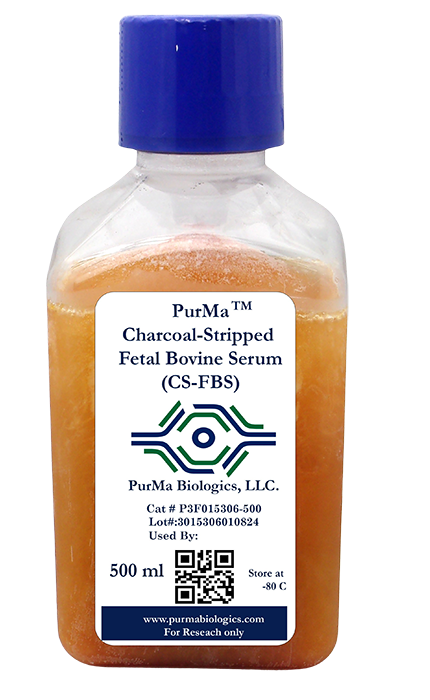
PurMa Biologics manufactures Charcoal-Stripped Fetal Bovine Serum (CS-FBS), purpose-built for hormone-sensitive applications like these. See our product page for full specifications, or our Cell Culture Serum guide for how CS-FBS compares to our other treated serum options.