
In vitro transcription synthesises RNA from a DNA template using a bacteriophage RNA polymerase, most often T7, SP6 or T3, with the corresponding promoter upstream of the sequence. The reaction needs template DNA, the polymerase, ribonucleotides, a buffer containing magnesium, and an RNase inhibitor. Low yield most often traces back to template quality or RNase contamination rather than the enzyme.
In vitro transcription (IVT) is a cell-free method used to synthesize large quantities of specific RNA molecules from a DNA template in a test tube. Think of it as a biological photocopier for RNA, allowing scientists to create millions or billions of RNA copies from a single genetic blueprint without using living cells. This technique is the cornerstone of modern mRNA vaccine and therapeutic development.
From PurMa Biologics
Nuclease free water for IVT
RNase carryover is the usual reason an in vitro transcription reaction underperforms. PurMa makes ultra pure nuclease free water in both DEPC treated and non-DEPC treated grades, so you can pick the one your downstream steps tolerate.
Nuclease Free Water (DEPC Treated)Nuclease Free Water (Non-DEPC)
Made in the USA and manufactured in house. Certificate of Analysis with every lot. Bulk pricing, purchase orders and custom formulations welcome.
What Is In Vitro Transcription and Why Does It Matter
Imagine you have a single, precious blueprint for a vital machine, but you need to build thousands of them. You wouldn't risk the original on the factory floor. Instead, you'd make countless working copies and distribute those. In the world of molecular biology, in vitro transcription (IVT) is that high-speed "photocopier."
It lets researchers take a DNA sequence—the master blueprint—and generate massive amounts of a specific RNA molecule. The whole process happens in vitro, meaning "in glass," or more simply, in a controlled lab environment like a test tube. It's completely separate from the complex, messy, and unpredictable machinery of a living cell.
The Power of Control and Scale
The real power of in vitro transcription is in its precision and scalability. By controlling every single component in the reaction, scientists can churn out pure, well-defined RNA that's tailored for a specific job. This level of control is just not possible inside a cell, where countless other processes are all competing for the same resources.
This capability has been absolutely critical in biotechnology and medicine. Key benefits include:
- High Yield: IVT can generate milligram or even gram quantities of RNA from a tiny amount of DNA template, giving you the material needed for large-scale applications.
- Purity: The final RNA is free from cellular junk and contaminants, which is non-negotiable for therapeutic uses where safety is everything.
- Flexibility: Researchers can easily build modifications into the RNA during synthesis, tweaking it to improve stability or function.
A Technique Decades in the Making
The journey of IVT from a niche lab technique to a global therapeutic engine didn't happen overnight. It was built on decades of foundational research. The story really started over 50 years ago, with early discoveries in the 1960s challenging the purely DNA-centric view of genetics.
By the 1970s, key findings about mRNA structure, like the discovery of the poly(A) tail and the 5' cap, set the stage for a much deeper understanding of RNA's role. A huge breakthrough came when scientists finally used SP6 vector-based synthesis to produce large quantities of functional mRNA, proving IVT’s massive potential.
This long history of incremental discoveries is what ultimately led to the rise of mRNA therapeutics, showing just how reliable and robust the technique is. This evolution also underscores why high-quality, consistent reagents—like those in PurMa Biologics’ portfolio of over 3,030 cell culture products—are absolutely essential for reproducible success in IVT, from initial discovery all the way to large-scale biomanufacturing.
The Essential Components of the IVT Reaction
Every successful in vitro transcription reaction is a masterclass in biochemical precision. Think of it less like a simple recipe and more like a high-performance engine where every component must be perfectly machined and timed. If even one part is low-quality or missing, the entire system grinds to a halt, yielding nothing but failed experiments and wasted time.
To get this right, you have to understand the four non-negotiable players in the reaction: the blueprint, the master worker, the raw materials, and the workshop environment. Getting a handle on what each one does is the first step toward mastering IVT and generating the clean, reproducible RNA your work depends on.
The DNA Template: The Master Blueprint
Your DNA template is the foundational blueprint that dictates the exact RNA sequence you're going to build. This isn't just any chunk of DNA you pull from a prep; it has to be meticulously designed to direct the polymerase exactly where to start and, just as importantly, where to stop.
Most often, this template is either a linearized plasmid or a specific PCR product. For the polymerase to create RNA of a defined length, the template DNA must be cut, or linearized, with a restriction enzyme right after the coding sequence. If you skip this step and use a circular plasmid, the polymerase will just keep chugging along, circling the plasmid endlessly and churning out a useless, heterogeneous mess of long RNA molecules. The quality of this blueprint is everything—nicks, impurities, or residual enzymes in your DNA prep will show up as truncated or incorrect RNA transcripts downstream.
RNA Polymerase: The Master Worker
If the DNA is the blueprint, the RNA polymerase is the tireless, high-speed worker that reads it and assembles the RNA strand. This enzyme is the absolute engine of the IVT reaction. The best and most widely used polymerases are borrowed from bacteriophages—viruses that infect bacteria—because they are astonishingly efficient and highly specific.
The three stars of the IVT world are:
- T7 RNA Polymerase: This is the undisputed workhorse. It's famous for its blistering speed and high processivity, making it the go-to for high-yield reactions.
- SP6 RNA Polymerase: Another hugely popular option, SP6 recognizes its own distinct promoter, giving you flexibility when designing multiple templates.
- T3 RNA Polymerase: Like its cousins, T3 is hyper-specific to its corresponding T3 promoter, completing the trio of essential tools for precise transcription initiation.
Your choice of polymerase is dictated entirely by the promoter sequence you've engineered into your DNA template. The polymerase will only bind to its matching promoter, which is how you guarantee transcription kicks off at the exact right spot, every single time.
A major breakthrough for in vitro transcription came in the 1980s when recombinant DNA technology met purified enzymes. This convergence was a game-changer, allowing scientists for the first time to combine pure gene substrates with highly active polymerases, faithfully recreating the transcription process in a test tube. Later, high-resolution crystal structures revealed the stunning mechanics of how these polymerases grip DNA and initiate synthesis. These discoveries laid the groundwork for the modern, gram-scale IVT protocols that now fuel everything from drug discovery to disease modeling. You can read more about the history and impact of these biochemical reconstructions.
Choosing Your RNA Polymerase: T7 vs SP6 vs T3
Selecting the right polymerase isn’t a matter of preference; it’s a hard requirement dictated by the promoter sequence in your DNA template. Each of these phage polymerases is incredibly specific, binding only to its cognate promoter to initiate transcription. This specificity is a feature, not a bug—it gives you precise control over where transcription begins. The table below breaks down the key differences to help you match the right enzyme to your template design and experimental goals.
| Polymerase | Promoter Sequence | Primary Use Case | Key Feature |
|---|---|---|---|
| T7 | 5’-TAATACGACTCACTATAG-3’ | High-yield mRNA synthesis, RNAi, probes | The industry workhorse; known for high processivity and robust activity. |
| SP6 | 5’-ATTTAGGTGACACTATAG-3’ | Riboprobe synthesis, antisense RNA | Excellent for generating labeled probes; provides an alternative to T7. |
| T3 | 5’-AATTAACCCTCACTAAAG-3’ | Riboprobe synthesis, sense/antisense RNA | Often used in tandem with T7 or SP6 for dual-probe applications. |
Ultimately, the choice is made for you when you design your vector. If your plasmid has a T7 promoter, you use T7 polymerase. If it has an SP6 promoter, you use SP6. Using the wrong one will result in zero transcription. This strict pairing is fundamental to the reliability of the IVT system.
The Supporting Cast: NTPs and Buffer
No worker can build anything without raw materials and a proper workshop. In the world of IVT, these roles are filled by ribonucleoside triphosphates (NTPs) and a precisely formulated reaction buffer.
The Four Building Blocks: The NTPs—adenosine triphosphate (ATP), guanosine triphosphate (GTP), cytidine triphosphate (CTP), and uridine triphosphate (UTP)—are the individual "bricks" that the RNA polymerase snaps together to build the final RNA chain.
The reaction buffer is all about creating the perfect chemical environment for the polymerase to perform at its peak. It contains essentials like magnesium ions (Mg²⁺), which are an absolute requirement for the enzyme's catalytic activity, along with salts to maintain the correct ionic strength. The buffer also keeps the pH locked in a stable, optimal range throughout the reaction. For any serious scientist, sourcing high-purity, endotoxin-free reagents like those from PurMa Biologics isn't a luxury—it's the foundation for ensuring this delicate environment stays pristine and your results are both successful and reproducible.
Your Step-by-Step IVT Workflow
Running a successful in vitro transcription reaction isn't magic. It's a methodical process where every step builds on the last. Precision and control are non-negotiable. This hands-on guide walks you through the four critical stages of the IVT workflow, from your DNA blueprint to the final purified RNA.
Think of it as your lab’s RNA assembly line. You start with a pristine blueprint (your DNA template), move to assembly (the reaction mix), run production (incubation), and finish with cleanup (DNA template removal). Get any of these stages wrong, and you’ll end up with low yields and useless product.
The diagram below shows the three fundamental components that have to come together to kick off the entire process.
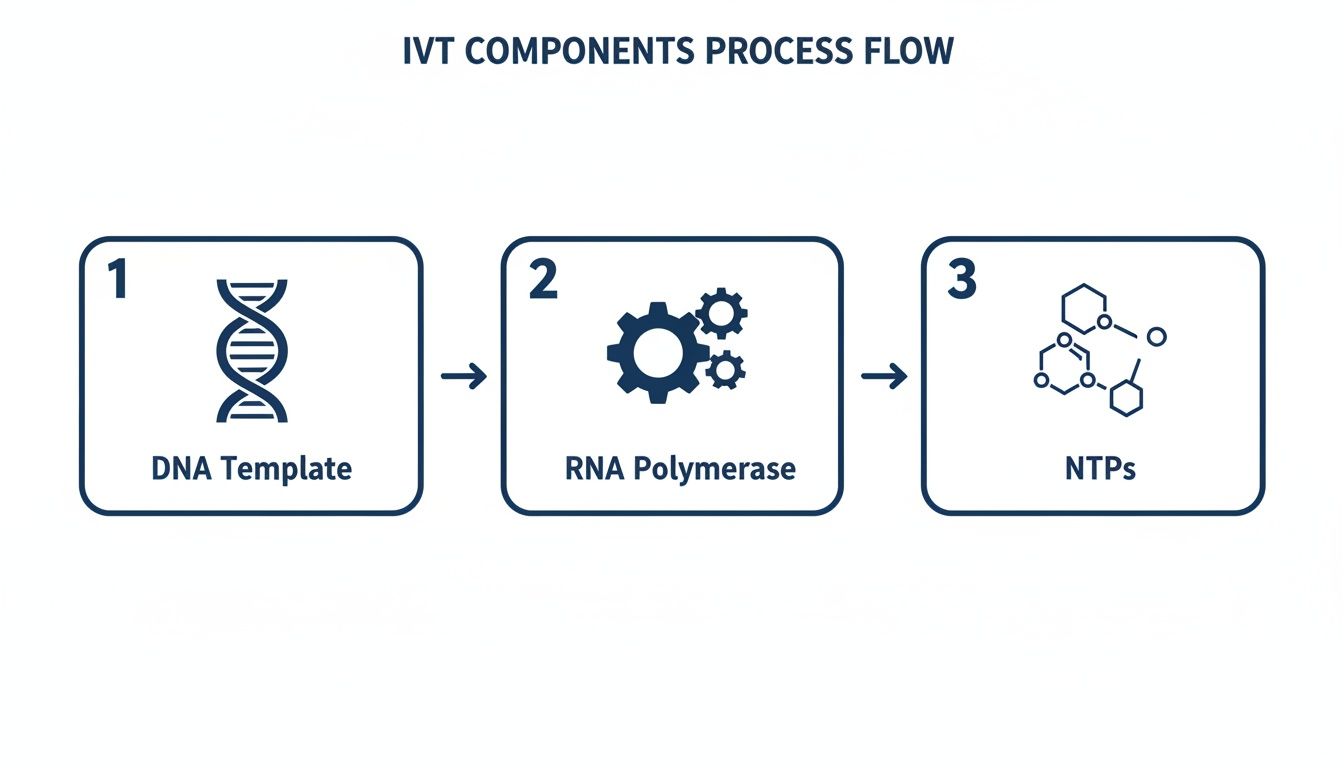
These are the foundational elements: the DNA template, the RNA polymerase enzyme, and the NTP building blocks. Each has a distinct job, but they have to work together perfectly to synthesize your target RNA.
Stage 1: Preparing the DNA Template
Your journey starts with a high-quality DNA template. Frankly, this is the most important step in the entire workflow. The quality of your template directly determines the quality and yield of your RNA. You have two main options here: plasmid linearization or PCR amplification.
If you’re using a plasmid, you must cut the circular DNA with a restriction enzyme at a specific site right after your gene sequence. This linearization step is mandatory. It creates a hard stop for the polymerase, ensuring you get transcripts of a defined, uniform length.
Critical Tip: Always run a gel to confirm 100% linearization. Even a tiny amount of uncut plasmid will let the polymerase run laps around the DNA, churning out long, junk RNA molecules that are useless for downstream work.
Using a PCR product? Make sure your primers added the full promoter sequence (like T7) upstream of your gene. The purity of that PCR product is everything. Leftover primers or garbage amplification products will absolutely interfere with the IVT reaction.
Stage 2: Assembling the Reaction Mix
With a clean template in hand, it’s time to build the reaction. This step demands a sterile environment to keep out contaminants—especially RNases, the enzymes that exist only to destroy your RNA. Use nuclease-free water, tips, and tubes, without exception.
The order you add reagents matters. A good rule of thumb for assembly is:
- Start with nuclease-free water to set the base volume.
- Add the reaction buffer and NTPs. The buffer creates the right chemical environment, and the NTPs are the raw building blocks.
- Add your DNA template. This is the blueprint for the reaction.
- Add the RNA polymerase last. Keep the enzyme on ice and add it just before you start the incubation. This ensures all your reactions kick off at the same time.
Calculate your reagent volumes precisely. Too little polymerase or not enough NTPs will tank your yield. An incorrect magnesium concentration can stall the entire reaction. Using a pre-optimized IVT kit can simplify this step immensely. PurMa Biologics offers a range of endotoxin-controlled water and buffers that provide a reliable, clean foundation for your reaction mix.
Stage 3: Incubation and Transcription
Once the reaction is assembled, you incubate the tube at the right temperature for your specific polymerase—typically 37°C for T7, T3, and SP6. This is the "production" phase. The polymerase gets to work, reading the DNA template and building new RNA strands.
The incubation usually runs for 2 to 4 hours. While you can sometimes push the yield a bit higher with longer times, be careful. Extending the incubation beyond 4 hours can lead to the buildup of nasty byproducts like double-stranded RNA (dsRNA), which can trigger an unwanted immune response in cellular applications.
Stage 4: Terminating the Reaction and Removing DNA
After incubation, your tube is a mix of your newly made RNA, the original DNA template, and leftover reagents. The final step before purification is to stop the reaction and get rid of that DNA template, which will interfere with almost any downstream application.
You do this by adding DNase I, an enzyme that specifically chews up DNA while leaving your precious RNA untouched. A short 15-30 minute incubation is usually all it takes for the DNase I to completely digest the DNA. After this, your raw RNA is ready for purification, where you’ll remove the DNase, salts, and leftover NTPs.
Getting a high yield from your in vitro transcription reaction is a great start, but it's really just the first leg of the race. A raw, unmodified RNA transcript is fundamentally fragile and surprisingly inefficient once it gets inside a cell. To turn it into a high-performance molecule that can actually do its job, you have to add a few critical modifications to make it stable and functional.
Think of a freshly made RNA strand as an unprotected soldier being sent into enemy territory. The cell is full of enzymes called ribonucleases (RNases) that exist specifically to chop up foreign RNA. Without armor, your transcript will be degraded almost instantly. To survive and deliver its message, that RNA needs a helmet and some body armor—in this case, a 5' cap and a 3' poly(A) tail.
The 5' Cap and 3' Poly(A) Tail
The 5' cap is a specially modified guanine nucleotide that gets added to the "front" of the RNA molecule. This molecular helmet does two critical things: it shields the RNA from being chewed up by exonucleases, and it acts as the "load here" signal for the ribosome to bind and start making protein. Without a cap, your RNA is not only vulnerable, it’s also invisible to the cell’s protein-making machinery.
On the other end, the 3' poly(A) tail—a long string of adenine nucleotides—provides a different kind of protection. This tail essentially works like a sacrificial buffer. It gets slowly nibbled away by other enzymes, buying the important message in the middle time to be read and translated. As a rule of thumb, a longer tail means a longer functional lifespan inside the cell, which translates directly to more protein production.
Choosing Your Capping Strategy
Adding the 5' cap can be done in two ways, and the method you choose has real consequences for your workflow and final product.
1. Co-transcriptional Capping with ARCA
This method is all about efficiency in the workflow. You add a cap analog, like an anti-reverse cap analog (ARCA), directly into your IVT reaction mix. As the RNA polymerase chugs along building the RNA strand, it incorporates the cap analog right at the beginning.
- Pros: It’s a straightforward, one-step process. You get capped RNA straight out of the transcription reaction.
- Cons: This approach can hurt your yields. The cap analog has to compete with the regular GTP nucleotide for incorporation, which can be inefficient and reduce the total amount of RNA you produce.
2. Post-transcriptional Enzymatic Capping
The alternative is to first make a batch of uncapped RNA and then add the cap in a separate, second enzymatic reaction.
- Pros: This is the high-performance option. You can achieve nearly 100% capping efficiency, and it doesn't interfere with or lower the yield of your initial IVT reaction.
- Cons: It adds another step to your protocol. You need more time, additional enzymes, and another round of purification.
The right choice really depends on your goal. If you need the absolute highest translational efficiency where every single molecule matters, enzymatic capping is almost always the better path.
Going Stealth with Modified Nucleosides
Beyond the cap and tail, one of the most powerful optimizations you can make is to incorporate modified nucleosides. Our immune system is incredibly good at spotting and destroying foreign RNA, triggering an inflammatory response that can shut down your experiment and even harm the cells.
By swapping out standard nucleosides like uridine for modified versions such as pseudouridine (Ψ) or N1-methylpseudouridine (m1Ψ) during the IVT reaction, you can make your RNA "stealthy." These modifications essentially act as a disguise, letting the synthetic RNA slip past the cell's immune sensors undetected.
The result is a massive boost in both the stability of the RNA and the amount of protein it produces. The RNA simply lasts longer and works harder before it gets cleared, maximizing its impact in research or therapeutic applications.
This kind of structural fine-tuning was a game-changer for the clinical success of mRNA technology. The historic approval of the SARS-CoV-2 vaccines was built on decades of work solving these exact stability and immunogenicity problems, with base modifications playing a starring role. Research shows that including these modified nucleosides can increase protein output by up to 10-fold. These breakthroughs have fueled the mRNA therapeutics market, which is on track to exceed $100 billion by 2030. To dig into the data behind these optimizations, you can explore the full research on advancements in mRNA design. For labs looking to scale up these complex IVT workflows, PurMa Biologics offers support with over 1,500 media formulations and transfection reagents designed to streamline production.
Purifying and Verifying Your Final RNA Product
Once your in vitro transcription reaction is complete, the real work of isolating a clean product begins. What’s in your tube isn’t pure RNA. It’s a messy biochemical soup containing your transcript, leftover NTPs, salts, the polymerase enzyme, and fragments of the digested DNA template.
This cleanup isn't just good lab practice; it's absolutely critical. Leftover contaminants will sabotage your downstream experiments—inhibiting enzymatic reactions, throwing off your concentration measurements, or even proving toxic in cell-based assays. Equally important is the final quality control (QC) check, which confirms you actually made what you think you made, and that it’s intact.
Choosing Your RNA Purification Method
There’s no single "best" way to purify RNA. The right method hinges on your specific needs for purity, yield, speed, and scale. An RNA probe for a quick blot doesn't need the same rigorous cleanup as mRNA destined for therapeutic research. You have to match the technique to the application.
A few workhorse strategies are common in most labs:
- LiCl Precipitation: Lithium chloride is a quick and dirty way to get the job done. It selectively crashes large RNA molecules out of solution, leaving most of the smaller contaminants like NTPs and DNA fragments behind. It’s fast and cheap, making it a solid choice for routine work where absolute purity isn’t the top priority.
- Silica-Based Spin Columns: For most R&D applications, these kits are the go-to choice. They strike an excellent balance between speed, convenience, and purity. In high-salt conditions, RNA sticks to a silica membrane, letting you wash away all the junk before eluting your pure RNA in nuclease-free water.
- Chromatography (e.g., FPLC): When purity is non-negotiable—especially for in vivo studies—fast protein liquid chromatography is the gold standard. This technique separates molecules with incredible precision based on size or charge, stripping away everything from aborted transcripts to residual proteins. The result is exceptionally pure RNA.
For many research teams, the convenience of silica columns makes them an everyday tool. But as you move toward highly sensitive applications or preclinical work, graduating to more advanced methods like chromatography becomes essential for generating reliable, publication-quality data.
Verifying RNA Concentration and Purity
Once your RNA is purified, you have to find out exactly what’s in the tube. This means running QC checks, and the two most fundamental are spectrophotometry and gel electrophoresis.
A spectrophotometer, like a NanoDrop, uses just a tiny drop of your sample to give you two crucial pieces of information:
- Concentration: It measures light absorbance at 260 nm to calculate your RNA concentration, usually reported in ng/µL or µg/µL.
- Purity (A260/A280 Ratio): The ratio of absorbance at 260 nm versus 280 nm is a classic indicator of protein contamination. For pure RNA, you're looking for a ratio of ~2.0.
If you see a low A260/A280 ratio (e.g., below 1.8), that’s a red flag. It’s a telltale sign that your sample is contaminated with leftover polymerase or DNase from the reaction, meaning your cleanup wasn’t as effective as you thought.
Confirming RNA Integrity and Size
A spectrophotometer tells you about quantity and chemical purity, but it has a blind spot: it can't tell you if your RNA is intact or has been chewed up into tiny, useless fragments. For that, you need to actually see your RNA on a gel.
Running your sample on a denaturing agarose or polyacrylamide gel is the moment of truth. A successful in vitro transcription reaction will produce a sharp, distinct band at the correct molecular weight. If you see a smear below that main band, it’s the classic signature of RNA degradation—almost always caused by RNase contamination.
This visual check is your ultimate confirmation of success. It’s the proof that you not only made RNA but produced a full-length, high-quality transcript that’s ready for your downstream experiment. Rigorous QC like this is what ensures your RNA will perform reliably, whether you're using it for transfection, microinjection, or as a qPCR standard. Minimizing risk from the start by using high-quality reagents, like the nuclease-free water and buffers from PurMa Biologics, gives you the best shot at a clean result.
Real-World Applications and Scaling Production
Once you’ve got a handle on the mechanics of in vitro transcription, the real work begins: connecting this powerful lab technique to the breakthroughs it makes possible. IVT is the engine driving some of today’s most advanced biological tools, pushing far beyond the research bench and into clinics and diagnostic labs worldwide.
The versatility of IVT is what makes it so indispensable. It gives scientists the power to generate precisely engineered RNA for a massive range of functions, each with its own non-negotiable requirements for purity, yield, and scale.
From Benchtop to Breakthroughs
The true power of IVT becomes clear when you look at the real-world problems it solves in medicine and fundamental research. Its key uses include:
- mRNA Therapeutics and Vaccines: This is easily the most high-profile application. Using IVT, scientists synthesize mRNA that encodes a specific protein—like a viral antigen for a vaccine or a missing enzyme for a protein replacement therapy.
- RNA Probes: For classic techniques like Northern blotting or in situ hybridization, researchers rely on IVT to create labeled RNA probes. These probes bind to specific target sequences, allowing you to visualize and quantify gene expression right inside cells and tissues.
- qPCR Standards: IVT is perfect for producing large, pure batches of a known RNA sequence. This material then becomes the precise standard needed to calibrate quantitative PCR assays, enabling absolute quantification of gene expression.
Each of these applications hinges on the single greatest value proposition of IVT: the ability to produce a clean, defined RNA molecule on demand. That level of control is what makes it a foundational tool in modern biotechnology.
The Challenge of Scaling Production
Making a few micrograms of RNA in a single tube is one thing. Manufacturing kilograms of it for a global vaccine campaign is a completely different universe of challenges. Scaling up in vitro transcription from the lab bench to large-scale biomanufacturing introduces a whole new set of complex hurdles.
Everything needs to be re-optimized. Reaction volumes, reagent concentrations, and purification methods that work perfectly in a small lab setting have to be completely re-engineered for efficiency, cost, and robustness at an industrial scale.
For any therapeutic application, every single step of the process must comply with Current Good Manufacturing Practice (cGMP) regulations. This is the only way to ensure the final product is safe, pure, and consistent from batch to batch—an absolute requirement for any drug intended for human use.
Maintaining that batch-to-batch consistency is everything. This demands an unwavering focus on the quality of your starting materials. This is where partnering with a supplier like PurMa Biologics becomes critical. A partnership gives you access to scalable, high-purity reagents and the expert support needed for a smooth transition from discovery to full-scale production, ensuring you can meet the stringent quality and regulatory demands of the biopharmaceutical industry.
Frequently Asked Questions About IVT
Even a perfectly written protocol can't account for everything. When you're running an in vitro transcription, a few common hurdles tend to trip up even experienced scientists. Let’s walk through the most frequent sticking points so you can troubleshoot your reactions and get back to generating high-quality RNA.
Solving these issues almost always comes down to a few key principles.
What Is the Most Common Cause of Low RNA Yield?
Poor RNA yield is a familiar frustration, and nine times out of ten, the problem can be traced directly back to your DNA template. If your template isn't fully linearized, is contaminated with leftovers from a prep (like phenol or ethanol), or has nicks and damage, the polymerase simply can't do its job.
Before you start questioning the enzyme or your NTP stock, your first move should always be to scrutinize the template. Run a small amount on a gel to confirm it's 100% linearized and check its purity with a spectrophotometer. A clean, intact template is non-negotiable.
How Can I Prevent RNA Degradation?
RNA is notoriously fragile. RNases—the enzymes that degrade it—are literally everywhere: on your skin, in dust, and on improperly cleaned surfaces. The only effective strategy is a good defense. This means committing to using nuclease-free water, tips, and tubes and maintaining a spotless work area.
Beyond the basics, a few best practices will save you a lot of grief:
- Use an RNase inhibitor: Adding this to your IVT reaction is like hiring a bodyguard for your RNA. It provides an essential layer of protection.
- Purify Immediately: Don't let a finished reaction sit on the bench. As soon as the DNase step is done, move straight to purification.
- Store Properly: For long-term stability, store your purified RNA in nuclease-free water or buffer at -80°C.
For more specific inquiries or troubleshooting tips related to in vitro transcription, you can often find answers to common questions about IVT on specialized company resource pages.
Do I Always Need a Poly(A) Tail?
Not always, but if your RNA is going anywhere near a eukaryotic cell, it’s highly recommended. The poly(A) tail is critical for both protecting the transcript from being chewed up by cellular enzymes and promoting its efficient translation into protein.
If your end goal is protein expression, adding a poly(A) tail is practically mandatory for a good outcome. For other applications, like generating RNA probes for a blot or for certain structural biology work, you can often get by without one.
At PurMa Biologics, we know that great results start with impeccable reagents. From our endotoxin-controlled water to our robust buffers and specialized media formulations, we deliver the clean, high-purity foundation your IVT workflow requires. Ensure consistency from the bench to scale-up by exploring our full product portfolio at https://www.purmabiologics.com.