
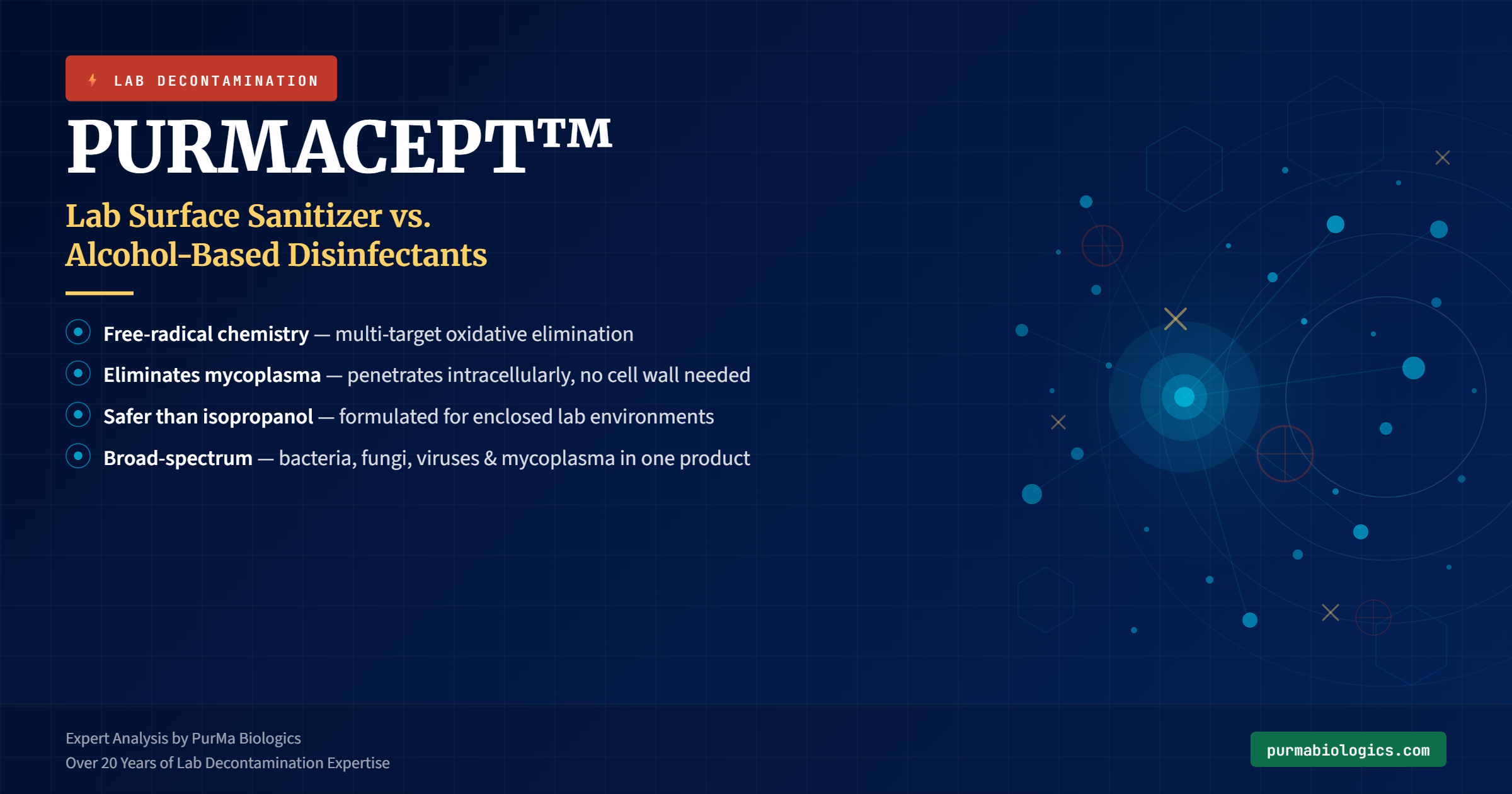
The Sanitizer Already in Your Hood Has a Problem You’re Probably Not Tracking
Isopropanol-based sanitizers are the default in most cell culture labs for one simple reason: they’re cheap and easy. But “default” isn’t the same as “safe,” especially in the enclosed, poorly ventilated spaces where a lot of lab work actually happens — biosafety cabinets, small tissue culture rooms, shared hoods.
Repeated or prolonged inhalation exposure to alcohol-based sanitizers in enclosed lab settings carries documented risks: chronic respiratory irritation, neurocognitive effects (memory and concentration deficits, sleep disturbances, mood changes), potential neurotoxicity with high cumulative exposure, added hepatic and renal metabolic strain, sensory impairment, and worsened symptoms for anyone with a preexisting respiratory or CNS condition.
PurMacept™ Lab Surface Sanitizer (10X) was built from over 20 years of PurMa Biologics’ laboratory experience specifically to remove that tradeoff — delivering broad-spectrum decontamination without asking your personnel to breathe in a known irritant every time they sanitize a bench. PurMacept™ has been formulated for safe use by personnel in enclosed areas when used according to instructions and PPE guidance.
How PurMacept™ Actually Eliminates Pathogens
PurMacept™ is a two-component disinfectant. When you dilute and mix the components, the reaction generates free radicals, and those free radicals do the actual work of destruction, not a single active ingredient acting alone.
Against organisms with a cell wall — bacteria, fungi, yeast — the free radicals attack the wall and membrane directly, causing lysis. Against mycoplasma, which have no cell wall to target, the mechanism shifts: PurMacept™ disrupts the cell membrane and penetrates intracellularly, oxidatively damaging the organism’s nucleoid DNA/RNA and essential macromolecules until it’s eliminated at the genetic level. That’s a meaningfully different mode of action than what most surface disinfectants rely on, and it’s why PurMacept™’s spectrum extends to bacteria (Gram-positive and Gram-negative), molds and yeasts, enveloped viruses including SARS-CoV-2, and mycoplasma — in one formulation.
Built for How Labs Actually Operate, Not Just a Spec Sheet
A disinfectant that works in a beaker but disrupts your workflow doesn’t get used consistently, and a sanitizer that isn’t used consistently doesn’t protect anything. PurMacept™’s practical design choices reflect that:
- Concentrated 10X format — dilute 1:10, which keeps cost per application down and storage footprint small.
- Two-component, on-demand activation — components stay stable in storage and reach full potency exactly when you mix them for use, rather than degrading on a shelf.
- Short contact times — built to minimize disruption to your actual bench workflow.
- Residual activity from double application — applying PurMacept™ twice to a surface helps prevent regrowth of common lab pathogens. (Claim subject to validation and routine environmental monitoring.)
Once mixed, PurMacept™’s free radicals are released gradually and remain active for approximately two weeks. Prepare only the quantity you’ll use within that window, and remix on a two-week cadence to keep potency where it needs to be. (Claim based on internal stability testing; subject to site validation.)
PurMacept™ Lab Surface Sanitizer (10X)
A proprietary two-component free-radical disinfectant designed for twice-weekly application to benchtops, incubator exteriors, equipment surfaces, and other shared contact points — delivering broad-spectrum pathogen control that complements targeted mycoplasma decontamination.
View PurMacept™ Lab Surface Sanitizer →PurMacept™ vs. the Sanitizers You’re Probably Already Using
- vs. quaternary ammonium compounds and alcohols: PurMacept™ delivers meaningfully improved mycoplasma control — an organism most QACs and alcohols were never designed to target in the first place, since they lack a cell wall for these chemistries to disrupt.
- vs. sodium hypochlorite (bleach) and pre-mixed oxidizers: PurMacept™ is less corrosive to lab equipment and surfaces, and more stable in its mixed, ready-to-use form.
- vs. running multiple specialty products: Because PurMacept™’s broad-spectrum coverage already includes bacteria, fungi, enveloped viruses, and mycoplasma, it reduces the need to stock, train on, and rotate between several narrower-spectrum disinfectants.
For contamination that’s already established rather than being routinely prevented, PurMacept™ is optimized for environmental control — not as a rescue treatment for an actively contaminated culture.
PurMa Mycoplasma Removal Spray (Mycospray)
For severe or persistent mycoplasma contamination, Mycospray is the targeted follow-up intervention, formulated specifically to destroy mycoplasma at the DNA level with 100% efficacy against the major species encountered in cell culture. Use it alongside PurMacept™: broad-spectrum environmental control from PurMacept™, targeted mycoplasma elimination from Mycospray.
Learn More About Mycoplasma Removal Spray →Using PurMacept™ Correctly
- Dilution: Prepare your working solution by diluting PurMacept™ concentrate 1:10 (1 part concentrate to 9 parts water), mixing components per label instructions.
- Application: Apply by spray, wipe, or mop, and make sure the full recommended contact time is reached before wiping the surface dry or letting it air dry.
- PPE and controls: Wear gloves and eye protection, work with adequate ventilation, and follow your institution’s chemical handling and disposal policies. Consult the SDS for complete safety information.
Built on two decades of PurMa Biologics’ laboratory experience, PurMacept™ gives labs a single disinfectant that handles the full spectrum of contaminants they actually encounter, without forcing a tradeoff between broad-spectrum efficacy and the health of the people applying it.