
EBSS and HBSS are balanced salt solutions used for washing, transport, dilution, and short-term cell handling. Both help maintain osmotic balance and supply inorganic ions, but their typical bicarbonate concentrations differ.
A standard EBSS formulation commonly contains approximately 2.2 g/L sodium bicarbonate, while standard HBSS commonly contains approximately 0.35 g/L. This generally makes EBSS better suited to CO₂-equilibrated workflows and HBSS convenient for short procedures performed outside the incubator.
Exact formulations vary. Both solutions are available with or without calcium, magnesium, phenol red, glucose, and bicarbonate, so researchers should verify the product formulation against their protocol.
Choose EBSS for workflows designed around a CO₂/bicarbonate buffering system. Choose HBSS for common washing, transport, dilution, and short bench procedures. Always confirm the bicarbonate and calcium/magnesium content of the specific formulation.
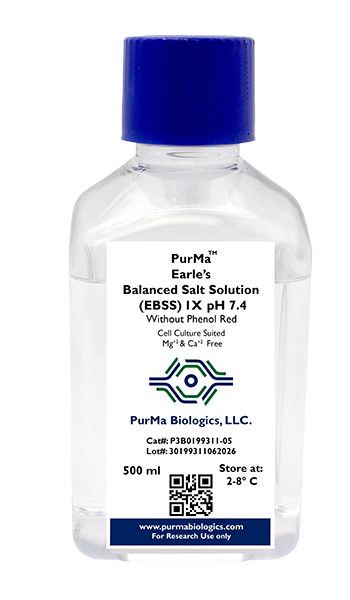
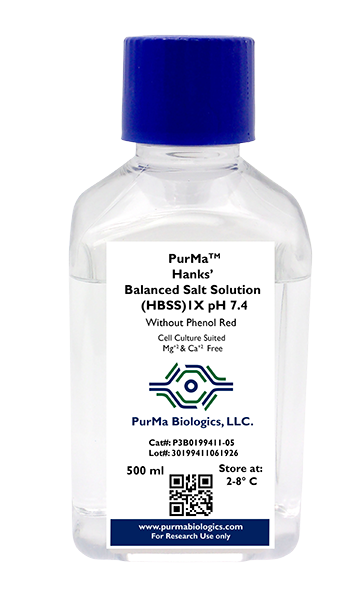
From PurMa Biologics
Both, at 1X pH 7.4
PurMa manufactures Hanks’ and Earle’s balanced salt solutions in house, with and without calcium and magnesium.
Hanks’ BSS (HBSS)Earle’s BSS (EBSS)
Made in the USA and manufactured in house. Certificate of Analysis with every lot. Bulk pricing, purchase orders and custom formulations welcome.
What Is EBSS (Earle’s Balanced Salt Solution)?
Earle’s Balanced Salt Solution contains a high concentration of sodium bicarbonate, which makes it ideal for use inside a 5% CO2 incubator. The CO2 in the incubator works with the bicarbonate to keep pH stable. Because of this, EBSS is often used as the base for CO2-buffered media such as MEM, and for procedures where cells stay in a CO2 environment.
What Is HBSS (Hanks’ Balanced Salt Solution)?
Hanks’ Balanced Salt Solution contains a low concentration of sodium bicarbonate, which lets it hold a stable pH in normal room air without a CO2 incubator. This makes HBSS the go-to choice for bench work — washing cells, preparing for dissociation, or any short procedure done outside the incubator.
EBSS vs HBSS: Key Differences
| Factor | EBSS | HBSS |
|---|---|---|
| Typical sodium bicarbonate | Approximately 2.2 g/L | Approximately 0.35 g/L |
| Common environment | CO₂-equilibrated workflows | Short bench procedures and handling |
| Common uses | Incubator-associated procedures and media preparation | Washing, transport, dilution, and dissociation preparation |
| Calcium/magnesium options | Available with or without | Available with or without |
| Complete growth medium? | No, unless incorporated into a validated complete formulation | No, unless incorporated into a validated complete formulation |
When to Use EBSS
EBSS is the right choice when:
- You’re working inside a 5% CO2 incubator
- You need a base solution for CO2-buffered media like MEM
- Cells will be incubated for longer periods in a CO2 environment
When to Use HBSS
HBSS is the better choice when:
- You’re doing procedures on the open bench, outside the incubator
- You need to wash cells or rinse away residual media
- You’re preparing cells for dissociation or briefly transporting them
- You’re not using a CO2 incubator
Can You Substitute One for the Other?
EBSS and HBSS should not be treated as automatically interchangeable. Their bicarbonate content and other components can affect pH, cell adhesion, and protocol performance. If a solution is used outside its intended gas environment, its pH may drift. Match the exact formulation to the protocol and working conditions.
Frequently Asked Questions
What is the main difference between EBSS and HBSS?
Bicarbonate content. EBSS is high-bicarbonate and made for a 5% CO2 incubator, while HBSS is low-bicarbonate and made for open-air work outside the incubator.
Can I use HBSS in a CO2 incubator?
It’s not recommended. HBSS has low bicarbonate, so in a CO2 incubator it tends to become acidic. Use EBSS for in-incubator work instead.
Why choose a calcium- and magnesium-free version?
Calcium and magnesium promote cell adhesion. Removing them helps cells detach more easily, which is useful when washing cells before trypsinization or dissociation.
Choosing the Right Balanced Salt Solution
The choice between EBSS and HBSS comes down to your working environment: EBSS for the CO2 incubator, HBSS for the bench. PurMa Biologics supplies research-grade Earle’s Balanced Salt Solution (EBSS) and Hanks’ Balanced Salt Solution (HBSS), with and without calcium and magnesium, for reliable, consistent results.