
Heat inactivate FBS at 56°C for 30 minutes, starting the timer once the serum itself, not the bath, reaches that temperature. Most cell lines don't need it, but immunology work and some sensitive cells do.
Labs heat inactivate FBS (fetal bovine serum) to switch off complement, a group of serum proteins that can attack cells and distort immune assays. It is a long-standing habit, and not always a necessary one: for most established cell lines, heat-inactivated and untreated FBS perform the same. This guide covers how to tell whether your work needs it, the protocol done properly, and what to do when serum comes out cloudy, flaky or thick.
Key Facts
- Temperature: 56°C, held within 2°C either way
- Time: 30 minutes, counted from when the serum itself reaches 56°C
- Swirl: every 10 minutes, to spread the heat and limit clumping
- What it does: inactivates complement
- Needed for most cell lines: usually not
- Recommended for: immunological work, embryonic stem cells, insect cells and smooth muscle cells
01 · Decide
Do you actually need to heat inactivate FBS?
The habit dates from when most labs grew cells in newborn calf serum, and heat inactivation removed the complement it contains. The Coriell Institute, a major cell line biobank, heat inactivated all of its serum for that reason. After switching to FBS, it found the step was not necessary for most of its lines.1
Heat inactivate when
- Complement could interfere with what you measure. Active complement can break cells open (lysis) and switch on immune cells such as lymphocytes and macrophages. That is why Thermo Fisher recommends heat-inactivated serum for immunological studies.2
- Your cells are known to need it. Thermo Fisher also recommends it for embryonic stem cells, insect cells and smooth muscle cells.2
- Your protocol, or the paper you are reproducing, specifies it. Matching the original conditions matters more than any general rule.
- A line simply grows better with it. Coriell occasionally finds a differentiated cell line that does.1
You can usually skip it when
- You are doing routine culture of established lines. For most lymphoblast and fibroblast lines, Coriell sees no difference either way.1
- You are measuring lymphocyte function. Even here it is not required. In a direct comparison, lymphocytes worked just as well in untreated fetal calf serum (another name for FBS). In some tests they responded more strongly, with no loss of specificity.3
From the PurMa lab
Our experience matches Coriell’s. For most cell lines heat inactivation makes no measurable difference, while some differentiated lines do noticeably better in heat-inactivated serum. The only reliable way to know for your cells is to grow them side by side in both. We heat inactivate every serum we make. If your work needs it, that step is already done for you. If it does not, Coriell’s advice applies: you can “probably use it without a problem.”1
Heat inactivation changes serum in ways that can shift results. In published studies it changed growth signaling in three cancer cell lines,4 altered the proteins in the vesicles that cells release,5 and reduced how well lipid nanoparticles were taken up.6 Pick one, record it in your methods, and use the same serum treatment for every experiment you plan to compare.
02 · Theory
What heat inactivation does to serum
Complement is a cascade of serum proteins that, once triggered, can punch holes in cell membranes and activate immune cells.2 Heating serum to 56°C destroys that activity, which is the whole point of the procedure.7
The trade-off is that complement is not the only heat-sensitive thing in serum. Heat can also destroy some growth factors, vitamins, amino acids and hormones. Going hotter than 56°C, or longer than 30 minutes, reduces cell growth.7 That is why the time and temperature matter as much as they do.
Where it can change your results
- Attachment under flow. In roller bottles and culture tubes, cells attached less well in heat-inactivated serum. In ordinary dishes there was no difference, and FBS was affected less than calf serum. Coating the surface with gelatin, poly-D-lysine or fibronectin restored attachment, and the cells grew normally once attached.8
- Immune complex assays. Heating at 56°C makes the antibodies in serum clump together, and the clumping grows the longer you heat. Those clumps can show up as false positives. For assays where that matters, 53°C for 90 minutes inactivates complement with far less clumping.9 FBS contains little antibody to begin with, so this is mainly a concern with adult sera.7
- Cell signaling. Heat-inactivated FBS increased the viability of HCT116, HT-29 and HepG2 cells by switching on p38/AKT, signaling pathways that help control cell growth and survival.4
- Extracellular vesicles. These are the tiny membrane particles that cells release. Heat inactivating FBS after removing its own vesicles changed the proteins found in the vesicles the cells then made.5
- Lipid nanoparticles. These are the fat-based particles used to carry RNA into cells. Heat inactivation weakens apolipoprotein E (ApoE), a serum protein that some of these particles rely on to get in. For MC3 particles that meant lower uptake and less siRNA delivered; C12 particles were unaffected.6
It does not sterilize serum. Heat inactivation targets complement. Contaminants such as mycoplasma and viruses are controlled by the manufacturer, through testing, filtration and gamma irradiation. If contamination is your worry, our guide to cell culture contamination covers what actually prevents it.
03 · Protocol
How to heat inactivate FBS, step by step
The 30 minutes starts when the serum itself reaches 56°C, not when the bottle goes into the bath. A bottle of serum can take around an hour to get there. Pull it out after 30 minutes in the bath and it has not been heat inactivated at all.10
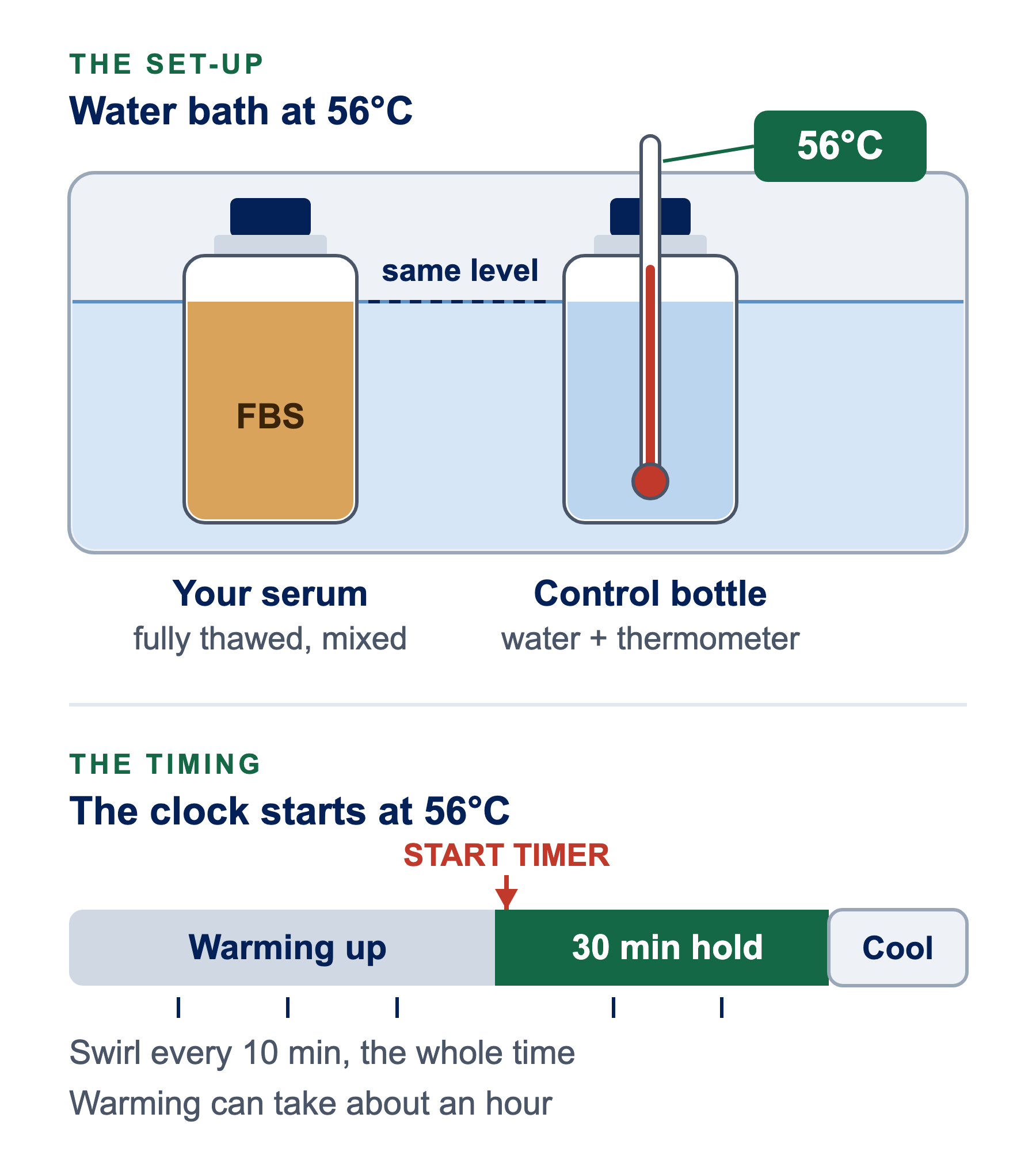
- 56°C
- Temperature. Hold the serum between 54 and 58°C.10
- 30 min
- Time. Counted from when the control bottle reads 56°C.10
- 10 min
- Swirl. Gently, every 10 minutes through the whole process, or use a shaking water bath.2, 10
- Level
- Water line. Level with the serum inside the bottle, never up to the cap.7, 10
What you need
- A water bath that holds 56°C steadily, ideally a shaking bath
- A calibrated thermometer
- A control bottle: the same kind of bottle as your serum, filled with water to the same level. The thermometer goes inside it, without touching the sides or bottom.10
- Your fully thawed serum
- A timer
- Thaw the serum completelyThaw it in the refrigerator, at room temperature, or in a 37°C water bath. If you use a 37°C bath, take the bottle out as soon as it has thawed.7 If it thawed in the refrigerator, let it reach room temperature before it goes into the hot bath.10
- Mix itSwirl gently until the serum looks uniform. Proteins and lipids collect at the bottom of the bottle, and heating them unmixed is what produces white globules.7
- Set up the bath and the control bottleBring the bath to 56°C. Stand the control bottle in the middle of the bath and let its thermometer settle.7, 10
- Put the serum inSet the serum bottle in the bath with the water level even with the serum inside it. Keep the water below the cap, where it could compromise the bottle’s seal.7 In a deep bath, weights keep the bottles upright.10
- Swirl while it warms upSwirl gently every 10 minutes and watch the control thermometer as it approaches 56°C.10
- Start the timer at 56°CWhen the control bottle reads 56°C, start timing 30 minutes. Keep swirling every 10 minutes.10
- Take it out at 30 minutesRemove the bottle promptly. Overshooting the time or temperature costs growth factors and, at worst, turns the serum to gel.2, 7
- Cool it, then aliquot or freezeLet the serum cool to room temperature. Then divide it into smaller working portions (aliquots), or return it to the freezer.10 Label it heat inactivated, with the date, so nobody heats it a second time.
Rather skip the water bath?
Browse all fetal bovine serum
Made in the USA and manufactured in house. Certificate of Analysis with every lot. Bulk pricing, purchase orders and custom formulations welcome.
04 · Troubleshooting
Cloudy, flaky or gelled serum: what went wrong
Most of what turns up in a bottle of serum is harmless. The trick is telling the harmless kinds from the one that means the serum is ruined.
- Flakes
- Fine white flakes after thawing. Usually fibrin, a clotting protein that can form fine flakes in thawed serum. It has no ill effects on cell culture, so use the serum as normal.10
- Lumps
- White globules at the bottom after heating. Proteins and lipids that settled and were heated without enough mixing. Swirl more often next time.7
- Jelly
- A jelly-like layer at the bottom. Protein that the heat has denatured, or unfolded. Pour the liquid serum off the top and use that.10
- Gel
- The whole bottle has thickened. It was heated too long or too hot, and the serum is no longer usable. Discard it.2discard
- Attach
- Cells attach poorly in roller bottles or tubes. Heat inactivation reduces serum’s ability to promote attachment under flow. Coat the surface with poly-D-lysine, gelatin or fibronectin.8
- Growth
- Cells grow more slowly after you switched. Heat-sensitive growth factors may have been lost, especially if the bath ran hot or long.7 Check the bath with a calibrated thermometer, and compare against untreated serum side by side.
Sources
- Coriell Institute for Medical Research. Is heat inactivation of fetal bovine serum necessary or recommended?
- Thermo Fisher Scientific. Fetal Bovine Serum, certified, heat inactivated, United States: FAQs.
- Leshem B, Yogev D, Fiorentini D. Heat inactivation of fetal calf serum is not required for in vitro measurement of lymphocyte functions. J Immunol Methods. 1999;223(2):249-254. doi:10.1016/s0022-1759(98)00214-2
- Geng H, Li R, Feng D, Zhu Y, Deng L. Role of the p38/AKT pathway in the promotion of cell proliferation by serum heat inactivation. Int J Mol Sci. 2023;24(22):16538. doi:10.3390/ijms242216538
- Urzì O, Bergqvist M, Lässer C, et al. Heat inactivation of foetal bovine serum performed after EV-depletion influences the proteome of cell-derived extracellular vesicles. J Extracell Vesicles. 2024;13(1):e12408. doi:10.1002/jev2.12408
- van Straten D, van de Schepop L, Frunt R, Vader P, Schiffelers RM. Serum heat inactivation diminishes ApoE-mediated uptake of D-Lin-MC3-DMA lipid nanoparticles. Beilstein J Nanotechnol. 2025;16:740-748. doi:10.3762/bjnano.16.57
- Corning. Heat Inactivation of Serum: Protocol (CLS-CG-AN-327).
- Giard DJ. Routine heat inactivation of serum reduces its capacity to promote cell attachment. In Vitro Cell Dev Biol. 1987;23(10):691-697. doi:10.1007/BF02620982
- Soltis RD, Hasz D, Morris MJ, Wilson ID. The effect of heat inactivation of serum on aggregation of immunoglobulins. Immunology. 1979;36(1):37-45. PubMed 422227
- Atlas Biologicals. Heat inactivation protocol.