
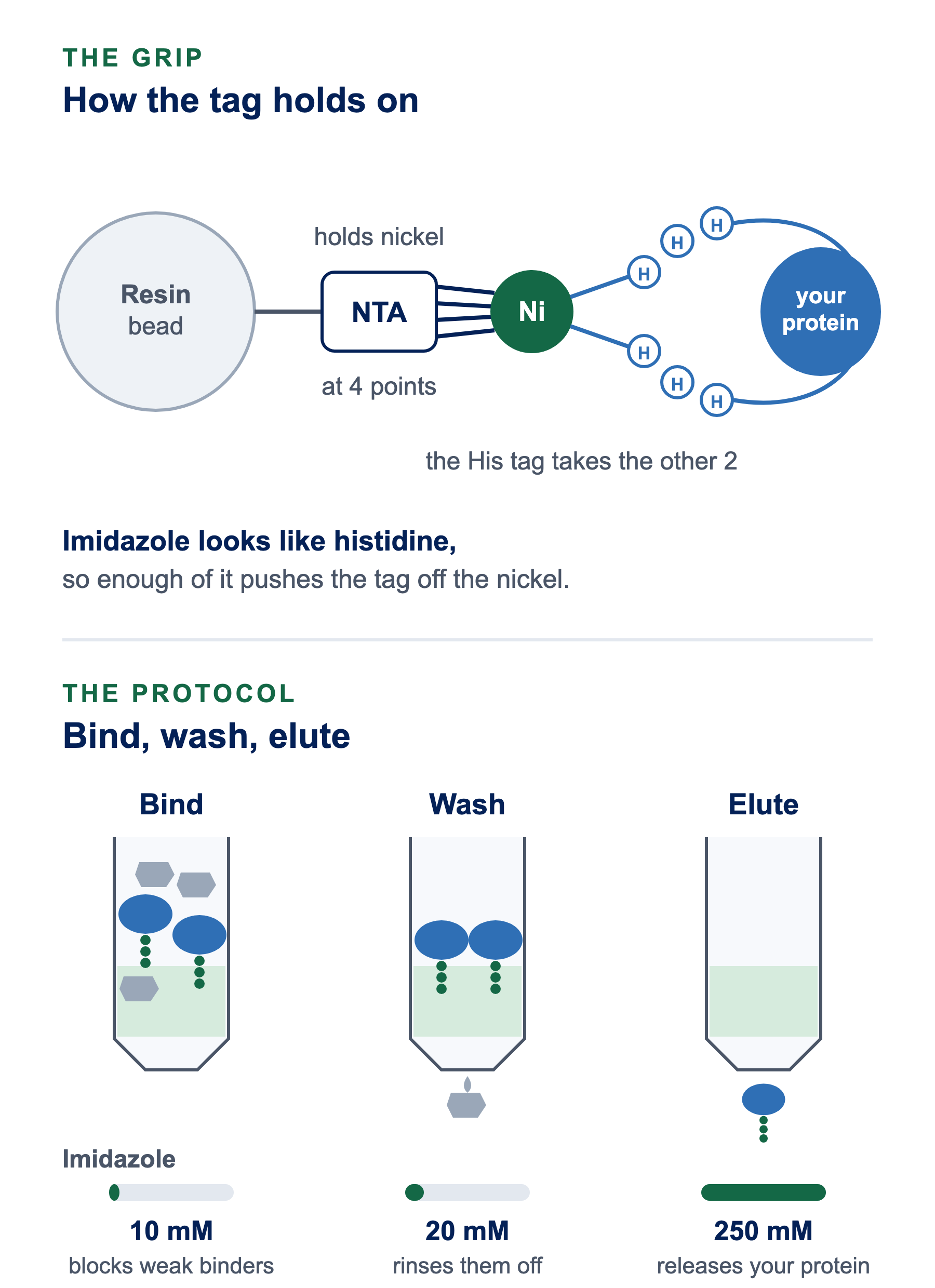
His tag purification binds a protein carrying six histidines to nickel on a resin. Bind with 10 mM imidazole, wash with 20 mM to remove weak binders, and elute your protein with 250 mM.
His tag protein purification pulls one recombinant protein out of a crude cell lysate in a single step. You add a short string of histidines to the protein, let it grip nickel or cobalt held on a resin, rinse away everything else, then release it with imidazole. This guide explains how the grip works, the choices to make before you start, a complete native protocol with volumes, the denaturing version for insoluble proteins, and how to fix a prep that goes wrong.
Key Facts
- Method: immobilized metal affinity chromatography (IMAC)
- Tag: usually six histidines (6xHis), at either end of the protein
- Native buffers: 10 mM imidazole to bind, 20 mM to wash, 250 mM to elute
- Insoluble protein: purify in 8 M urea and elute by lowering the pH
- Keep out: EDTA and DTT strip or reduce the metal, above low limits
01 · Theory
How His tag purification works
The method is immobilized metal affinity chromatography, IMAC. A chelator such as NTA or IDA is fixed to resin beads and holds a metal ion, usually nickel, sometimes cobalt, copper or zinc.1 The imidazole rings of histidine bind that metal. A run of histidines at either end of your protein, most often six (written 6xHis), binds strongly enough to hold the protein while almost everything else in the lysate flows past.2, 1 NTA takes four of nickel’s six binding sites and leaves two for the tag. IDA takes only three, holds the metal less tightly and lets more of it leach off the resin.2, 3
Why imidazole controls every step
Imidazole is the ring at the end of histidine’s side chain, so free imidazole competes with the tag for the metal.2 A little of it, about 10 to 20 mM, stops weakly binding host proteins from sticking. A lot of it, 250 mM in the standard elution buffer, pushes the tagged protein off.2 The same logic runs in reverse: if the tagged protein does not bind at 10 mM, drop the imidazole to 1 to 5 mM and accept a little less purity.4
02 · Decide
Choices to make before you start
- Native
- Your protein is soluble and you need it active. Purify in a mild phosphate and salt buffer and the protein keeps its fold.4start here
- Unfold
- Your protein is in inclusion bodies, or the tag is buried. 8 M urea or 6 M guanidine unfolds the protein and exposes the tag. You get a pure but unfolded protein that may need refolding.4
- Nickel
- Most preps. Ni-NTA binds up to 50 mg of tagged protein per mL of resin; the real figure depends on the protein.5
- Cobalt
- When purity matters more than yield. Cobalt usually gives cleaner purifications, while nickel binds more protein per mL.3 Thermo’s cobalt resin binds at least 10 mg/mL at over 90% purity.6 Never use DTT, DTE or TCEP with cobalt resin.1
- Batch
- Mix resin and lysate in a tube first. Binding happens while the tube turns, then the mixture goes into a column for washing and elution.4 It also avoids high local protein concentrations on the resin.4
- Gravity
- Run the lysate straight through a packed column. Spin the lysate again first so debris does not clog the column.4
What the resin tolerates
Additives decide whether the metal stays on the resin. These limits are for Ni-NTA from IBA and Qiagen.4, 5 Other resins differ: Thermo advises avoiding DTT and β-mercaptoethanol on its Ni-NTA resin, and Cytiva says never to use DTT, DTE or TCEP with cobalt.7, 1 Check your resin’s own manual.
| Additive | Limit | Why it matters |
|---|---|---|
| EDTA, EGTA | Up to 1 mM, with care | Chelators strip nickel off the resin |
| DTT | Up to 10 mM tested | Above 1 mM the resin can turn brown as nickel is reduced |
| β-mercaptoethanol | Up to 20 mM | Reduces nickel at higher concentrations |
| TCEP | Up to 1 mM tested | Reducing agent; do not store resin in it |
| NaCl | At least 300 mM, up to 2 M | Cuts ionic, nonspecific binding |
| Glycerol | Up to 50% | Stabilizes proteins |
| Triton X-100, Tween-20 | Up to 2% | Removes background proteins |
| Urea, guanidine | 8 M, 6 M | For denaturing purification |
| Tris, HEPES, MOPS | Up to 100 mM | Amine buffers can reduce nickel; phosphate is recommended |
03 · Protocol
His tag purification protocol under native conditions
This is Qiagen’s batch method for Ni-NTA under native conditions, which IBA’s manual repeats: 1 mL of 50% resin slurry for every 4 mL of cleared lysate.2, 4
EDTA strips the nickel and turns the resin white; reducing agents reduce it and turn the resin brown. Either way your protein has nothing to bind to. Check your lysis buffer, and use an EDTA-free protease inhibitor cocktail.4, 7
- 10 mM
- Lysis buffer. 50 mM NaH2PO4, 300 mM NaCl, 10 mM imidazole, pH 8.0.4
- 20 mM
- Wash buffer. The same, with 20 mM imidazole.4
- 250 mM
- Elution buffer. The same, with 250 mM imidazole.4
- 1:4
- Resin. 1 mL of 50% Ni-NTA slurry per 4 mL of cleared lysate.4
What you need
- A cell pellet expressing your His-tagged protein
- The three buffers above; nuclease-free water to make them up
- Lysozyme, and a sonicator with a microtip4
- Ni-NTA resin as a 50% slurry, and an empty column with a bottom cap4
- A refrigerated centrifuge and a rotary shaker at 4°C4
- Resuspend the cellsThaw the pellet on ice for 15 minutes and resuspend it in lysis buffer, 2 to 5 mL per gram of wet cells.4
- LyseAdd lysozyme to 1 mg/mL and leave on ice for 30 minutes. Then sonicate on ice: six 10-second bursts with 10 seconds of cooling between them.4 If the lysate is thick and stringy with DNA, add RNase A (10 µg/mL) and DNase I (5 µg/mL) for 10 to 15 minutes on ice.4
- Clear the lysateCentrifuge at 10,000 x g for 20 to 30 minutes at 4°C and keep the supernatant. Some of your protein may stay insoluble in the pellet; keep a sample of it for the gel.4
- BindAdd 1 mL of 50% Ni-NTA slurry to 4 mL of cleared lysate and mix gently on a rotary shaker at 4°C for 60 minutes.4
- Load the columnPour the lysate and resin into a column with the bottom cap on. Remove the cap and collect the flow-through for the gel.4
- WashWash twice with 4 mL of wash buffer, keeping each wash for the gel.4
- EluteElute four times with 0.5 mL of elution buffer, into four tubes.4
- Check every fractionRun the pellet, cleared lysate, flow-through, washes and elutions side by side on SDS-PAGE. That one gel tells you where your protein went.4
Rather hand it off?
PurMa runs protein expression and purification as a contract service, with gene cloning if the construct still needs building. Questions or need a quote? Contact our team.
Denaturing protocol for insoluble proteins
Use this when the protein is insoluble, or when it will not bind under native conditions because the tag is buried.4 Every buffer is 100 mM NaH2PO4, 10 mM Tris-Cl and 8 M urea; only the pH changes. The tag’s histidines have a pKa of about 6, so as the pH falls they pick up a proton and let go of the nickel.2
- pH 8.0
- Buffer B, lysis and binding. Stir the cells in it for 15 to 60 minutes at room temperature, until the solution turns translucent.4, 2
- pH 6.3
- Buffer C, wash. Twice with 4 mL.4, 2
- pH 5.9
- Buffer D, first elution. Four times 0.5 mL.4, 2
- pH 4.5
- Buffer E, second elution. Four times 0.5 mL.4, 2
Spin the lysate at 10,000 x g for 20 to 30 minutes at room temperature, not 4°C, and bind for 15 to 60 minutes at room temperature.4 Urea breaks down in solution and shifts the pH, so adjust each buffer’s pH just before use and never autoclave them.4 Guanidine (6 M) lyses and solubilizes more strongly, but urea lets you load the lysate straight onto an SDS-PAGE gel.4
Watch it done
A short walkthrough of a generic His tag purification protocol, from lysate to purified protein.
After elution
Remove the imidazole. Exchange the protein into its working buffer, such as PBS, by dialysis or on a desalting column.7
Measure it properly. Imidazole absorbs at 280 nm, so read A280 against your elution buffer as the blank, and buy high-purity imidazole, which absorbs far less.2, 1 For a second check, the Bradford assay measures protein with a dye rather than ultraviolet absorbance.
Reuse the resin. Follow your resin maker’s procedure, because they differ. Qiagen washes Ni-NTA with 0.5 M NaOH for 30 minutes after each use, stores it in 30% ethanol, and reuses it at most five times, for the same protein only. If the resin turns brownish gray, it needs Qiagen’s full regeneration, which strips the nickel with EDTA and recharges it with nickel sulfate.2
04 · Troubleshooting
No binding, extra bands or precipitate: what went wrong
- No bind
- The protein is in the flow-through. Check the tag is really there by sequencing the junctions. Rarely, the folded protein hides the tag, which is why Qiagen advises running a denaturing purification alongside as a control; if only that one binds, move the tag to the other end. Then check the buffers: pH, no chelating or reducing agents, and imidazole not too high.4, 2
- Washes off
- The protein elutes in the wash. The wash is too stringent: lower the imidazole or raise the pH slightly. A partly hidden tag behaves the same way.4
- Extra bands
- Contaminants in the elution. Include 10 to 20 mM imidazole in binding and wash buffers, use less resin, and raise the salt or detergent in the wash.4 Some E. coli proteins, including SlyD, ArnA, GlmS and Can, bind nickel on their own.8 Strains built from BL21(DE3) reduce them: LOBSTR carries versions of ArnA and SlyD that bind less,9 and in NiCo21(DE3) GlmS no longer binds nickel while SlyD, Can and ArnA carry a tag that lets a chitin column remove them afterwards.8
- Short bands
- Smaller copies of your protein. Truncated forms from internal start sites or early stops, or degradation. Work at 4°C and add an EDTA-free protease inhibitor cocktail.4, 7
- Cloudy
- The protein precipitates. Try purifying at room temperature, and add 0.1% Triton X-100 or Tween-20, up to 20 mM β-mercaptoethanol or up to 2 M NaCl to every buffer.4
- Stuck
- The protein will not elute. Run a step gradient of imidazole or pH to find where it comes off, or elute under denaturing conditions if it has precipitated on the column.4
- Color
- The resin turned white or brown. White means a chelator stripped the nickel; brown means a reducing agent reduced it. Find the additive and remove it.4
Sources
- Cytiva. Affinity Chromatography Vol. 2: Tagged Proteins (CY13980). 2021.
- QIAGEN. The QIAexpressionist: A handbook for high-level expression and purification of 6xHis-tagged proteins. 5th ed. 2003.
- Thermo Fisher Scientific. Purity, dynamic binding capacity, reusability and chemical compatibility properties of a cobalt-charged IMAC resin (application note).
- IBA Lifesciences. Expression and purification of proteins using 6xHistidine-tag (PR43-0003). 2021.
- QIAGEN. Important note for Ni-NTA users (1053157). 2008. Supersedes the 2003 handbook on binding capacity and DTT.
- Thermo Fisher Scientific. HisPur Cobalt Spin Columns User Guide (MAN0011582). 2024.
- Thermo Fisher Scientific. HisPur Ni-NTA Resin User Guide (MAN0011700). 2021.
- Robichon C, Luo J, Causey TB, Benner JS, Samuelson JC. Engineering Escherichia coli BL21(DE3) derivative strains to minimize E. coli protein contamination after purification by immobilized metal affinity chromatography. Appl Environ Microbiol. 2011;77(13):4634-4646. doi:10.1128/AEM.00119-11
- Andersen KR, Leksa NC, Schwartz TU. Optimized E. coli expression strain LOBSTR eliminates common contaminants from His-tag purification. Proteins. 2013;81(11):1857-1861. doi:10.1002/prot.24364