
Regenerative medicine work built around mesenchymal stem cells (MSCs) has largely converged on one specific MEM variant: MEM Alpha Modification, commonly written as α-MEM. The reason comes down to a formulation detail most standard MEM protocols don’t need at all.
α-MEM’s added nucleosides give mesenchymal stem cells a real proliferation advantage over standard MEM, which is why it’s become the default for MSC expansion protocols.
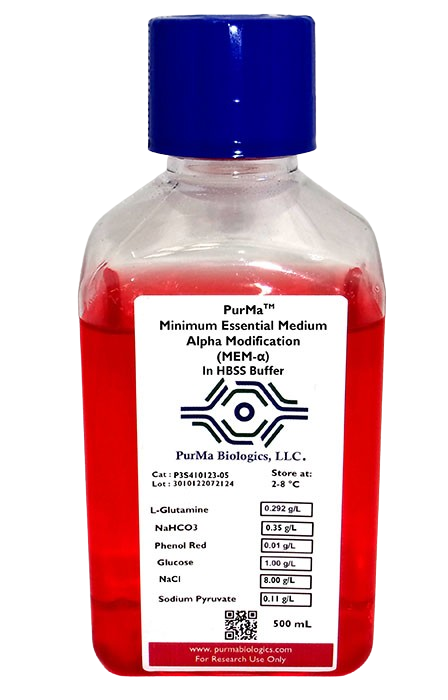
What Sets α-MEM Apart
α-MEM includes both ribonucleosides and deoxyribonucleosides in its formulation, components standard MEM omits. Providing these nucleoside precursors directly reduces the metabolic burden on cells that would otherwise need to synthesize them from scratch, which translates into faster proliferation rates. For MSC expansion protocols, where generating enough cells for a therapeutic or research application in a reasonable timeframe is a real practical constraint, that proliferation advantage is the whole reason α-MEM became the default rather than an incidental benefit.
α-MEM also includes a broader range of amino acids and vitamins than standard MEM, supporting the more demanding nutritional requirements of primary and stem cell populations compared to well-established immortalized lines.
Where α-MEM Fits in Regenerative Medicine Workflows
- Mesenchymal stem cell expansion. The most common and best-established use case, where faster proliferation directly shortens the time needed to reach clinically or experimentally relevant cell numbers.
- Primary cell culture more broadly, where the added nucleosides and broader nutrient profile support cell types that don’t tolerate standard MEM’s more minimal formulation as well as robust immortalized lines do.
- Differentiation protocols that begin with an expansion phase in α-MEM before switching to a lineage-specific differentiation medium.
Validate Before Scaling
Different MSC sources, bone marrow, adipose, umbilical cord, can respond differently even within the same basal medium family. Run a small-scale comparison against your current formulation before committing a full expansion protocol to a new medium, tracking proliferation rate, morphology, and, where relevant, retained differentiation potential.
PurMa Biologics manufactures MEM Alpha Modification in both Hanks’ Buffer and Earle’s Buffer formats, including MAX and chemically defined versions. See our product pages for full specifications.