
A 10X PBS concentrate is prepared so that, once diluted tenfold, it gives standard 1X PBS at pH 7.4. Adjust the pH so it is correct after dilution rather than in the concentrate. Store the concentrate at room temperature rather than refrigerated, because at ten times concentration the phosphate salts sit near their solubility limit and precipitate when cold.
A perfected 10x PBS recipe is the bedrock of reproducible science. It's not just about convenience; a reliable stock solution is your first line of defense for consistency across every experiment, from routine cell washes to complex biopharmaceutical production.
From PurMa Biologics
Or skip the prep entirely
Making 10X PBS in house is easy to do, and easy to do slightly differently each time. PurMa manufactures cell culture grade PBS and DPBS, sterile filtered with a Certificate of Analysis on every lot.
Phosphate Buffered Saline (PBS)Dulbecco’s PBS (DPBS)
Made in the USA and manufactured in house. Certificate of Analysis with every lot. Bulk pricing, purchase orders and custom formulations welcome.
Why Your Lab Needs a Rock-Solid 10x PBS Recipe
Before you even think about reaching for the scales and beakers, let's get one thing straight: a flawless 10x pbs recipe matters. A lot. This isn't just about mixing a few salts in water; it's about establishing the cornerstone for reliable, repeatable results in your lab. Think of it as the unsung hero of cell culture.
The humble Phosphate-Buffered Saline became a lab workhorse for a reason. It underpins an incredible range of applications, and getting it right is non-negotiable.
A well-made 10x PBS stock isn't just a reagent—it's your lab's built-in quality control. It standardizes the starting point for every single experiment, directly impacting data integrity and eliminating batch-to-batch headaches.
The Real Power of Standardization
Standardizing your 10x PBS concentrate prevents countless downstream problems. Even tiny variations in pH or osmolarity from one prep to the next can introduce hidden variables that will quietly sabotage your findings. When you nail this recipe, your cells thrive, and your experiments start on solid ground.
The modern 10x PBS recipe was developed specifically to ensure that the final 1x working solution hits a physiologically perfect state every time. The benefits are obvious to anyone who's spent time at the bench:
- Serious Space Savings: The 10-fold concentration is now an industry standard because it lets labs slash storage needs by 90% compared to keeping the equivalent volume of 1x PBS on hand.
- Bulletproof Reproducibility: A single, large, validated batch of 10x stock guarantees that every 1x working solution you make from it is identical. This single step eliminates a huge source of experimental noise.
- More Time for Actual Research: Making one big batch of stock less often frees up hours of valuable time for the critical experiments that actually move your projects forward.
Global Adoption and Why It Matters
This standardized approach has been embraced almost universally. In fact, 10x PBS stock solutions have become the go-to format in roughly 85% of research institutions and biomanufacturing facilities around the world. The formulation, with its precise salt molarities, is designed to maintain the isotonic balance essential for keeping cells alive and happy. You can dig into more of the specifics on the standard 10x PBS recipe and its history over at Alfa Chemistry.
Ultimately, you need to stop seeing your 10x PBS prep as a chore. It’s a critical quality control step. It’s a mindset shift that minimizes contamination risks, saves precious bench space, and provides the stable foundation upon which all great science is built.
The Complete Recipe and Ingredient Checklist
This is the exact, no-nonsense formula for a perfect 10x pbs recipe. Forget the slight variations you might find in old lab manuals; this is the definitive recipe that experienced technicians rely on for rock-solid consistency in their experiments.
First things first, let's get your reagents in order. At its core, PBS is built from just four essential, high-purity salts. The quality you start with directly dictates the reliability of your final buffer, especially when you're working with anything sensitive like primary cells or nucleic acids.
You'll need these on your bench:
- Sodium Chloride (NaCl): The workhorse salt that sets the solution’s fundamental isotonicity.
- Potassium Chloride (KCl): Works in tandem with NaCl to mimic the physiological salt balance your cells expect.
- Disodium Phosphate (Na₂HPO₄): This is the basic component of the critical phosphate buffering system.
- Monopotassium Phosphate (KH₂PO₄): The acidic counterpart to Na₂HPO₄, working with it to lock in the target pH.
Beyond the salts, the single most important ingredient is your water. Don't even think about using standard deionized water. You must use high-purity, nuclease-free water. Using anything less introduces a universe of unknown variables—contaminants, metals, and enzymes—that can quietly sabotage your experiments and leave you with questionable data.
The Master Recipe Table
Doing the math by hand is an invitation for error. To eliminate any guesswork and ensure your stock is perfect every single time, this table has the precise gram measurements you need for the most common batch sizes.
This recipe is formulated to produce a standard 10x PBS stock solution. After you dilute it to 1x for use, the final pH will land right around 7.4, which is exactly what you want for most cell culture applications.
10x PBS Recipe Mass per Liter
| Reagent | Molar Mass (g/mol) | Final Molarity (in 10x) | Grams per 1L | Grams per 5L | Grams per 10L |
|---|---|---|---|---|---|
| NaCl | 58.44 | 1370 mM | 80.0 g | 400.0 g | 800.0 g |
| KCl | 74.55 | 27 mM | 2.0 g | 10.0 g | 20.0 g |
| Na₂HPO₄ | 141.96 | 100 mM | 14.4 g | 72.0 g | 144.0 g |
| KH₂PO₄ | 136.09 | 18 mM | 2.4 g | 12.0 g | 24.0 g |
This table should be your single source of truth. Whether you're in a small academic lab making a liter or a bioproduction facility prepping a 10L carboy, these values are your foundation for a trustworthy stock. For a complete portfolio of quality-tested reagents like these, you can check out the catalog at PurMa Biologics.
Think of this recipe as more than just a list of ingredients. It's a protocol for consistency. By precisely following these measurements, you are actively removing a significant variable from your experimental workflow, allowing you to trust your results.
With your reagents weighed out, you're ready to get them into solution. The next step is all about the how—combining them correctly to avoid common pitfalls like salt precipitation.
From Powder to Sterile Solution Step by Step
With your reagents weighed out and your high-purity water ready, it's time to actually make the 10x PBS. This isn't a "dump-and-stir" operation. The order you add the salts, the way you adjust the pH, and how you sterilize the final solution are all critical steps that separate a reliable stock from a cloudy, precipitated mess.
First, pour about 80% of your final water volume into a clean beaker. Make sure it's large enough to prevent splashing once you get the stir bar going. You'll add the remaining water later to hit your final volume precisely.
The Art of Dissolving Salts
Now comes the most important part of avoiding that dreaded white precipitate. You have to add the salts one by one, and you must let each one dissolve completely before adding the next. Patience here will save you a lot of headaches.
If you add the phosphate salts too quickly or out of order, they will crash out of the solution, and you’ll have to start over. This is the sequence that works every time.
- Start with Sodium Chloride (NaCl). It’s the biggest component by mass, so give it a few minutes to dissolve completely on the stir plate.
- Next, add the Potassium Chloride (KCl). This one will dissolve much faster.
- Then, add the Disodium Phosphate (Na₂HPO₄). Wait for the solution to become perfectly clear again.
- Finally, add the Monopotassium Phosphate (KH₂PO₄). This specific order is your best defense against precipitation.
This simple workflow is the key to a successful batch of 10x PBS.
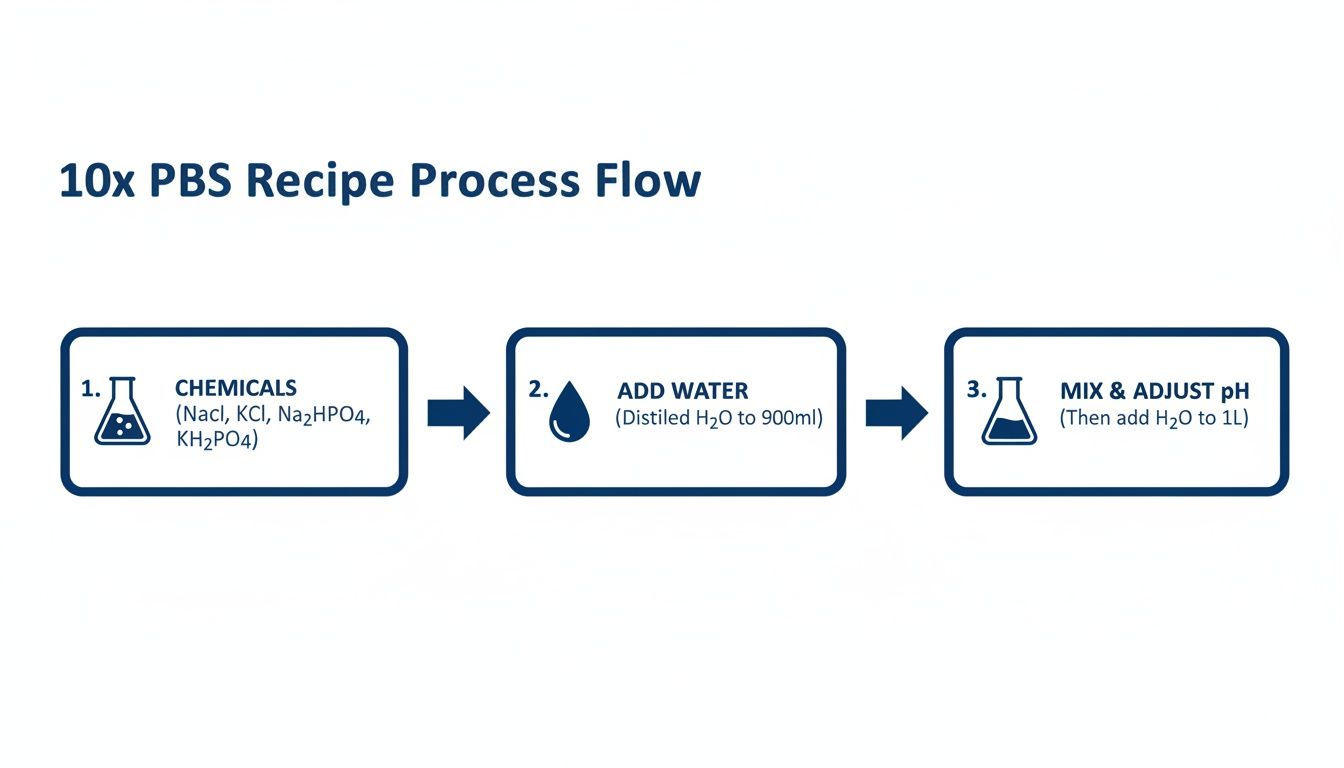
The process is straightforward: start with pure reagents, add them to water in the correct order, and mix thoroughly before moving on.
Achieving the Perfect pH
Once every crystal of salt is dissolved, pour the solution into a graduated cylinder and bring it up to the final volume (e.g., exactly 1L) with more nuclease-free water. Pour it back into your beaker, and drop in your calibrated pH probe.
You’ll notice the pH of the 10x stock is slightly acidic, usually somewhere between 6.8 and 6.9. This is exactly what you want. The buffer chemistry is designed so that when you dilute it 1:10 to make your 1x working solution, the pH will naturally rise to the physiological target of ~7.4.
Do not try to adjust your 10x stock solution to pH 7.4. This is a common rookie mistake that guarantees your 1x working solution will have an overly basic pH that can damage or kill your cells. Trust the buffer chemistry.
Sterilization: Autoclave vs. Filtration
The final step is making your PBS sterile. The method you choose here depends on your application, your budget, and the level of quality control you need.
- Autoclaving: This is the workhorse method for most academic labs. You simply autoclave the solution at 121°C and 15 psi for 20 minutes. It’s cheap, effective for killing microbes, and perfect for large volumes.
- Sterile Filtration: This is the gold standard for biopharma, GMP environments, or any work involving sensitive primary cells. Passing the PBS through a 0.22 µm filter not only sterilizes it but also removes fine particulates and, most importantly, can help reduce endotoxin levels.
A university core facility making 20 liters of PBS for general student use will almost always autoclave it. But a company manufacturing a clinical-grade antibody will absolutely insist on sterile filtration to meet regulatory standards and ensure the final product is clean. Choosing the right method is a critical part of managing risk in your specific workflow.
Choosing the Right PBS Variant for Your Experiment
It’s just a buffer, right? Wrong. Thinking that all PBS is created equal is one of the most common—and costly—mistakes made in the lab. The specific variant you choose isn't a minor detail; it can be the single factor that determines whether your experiment works or fails spectacularly for reasons that aren't immediately obvious.
The first, most critical decision point you'll face is whether to include divalent cations: calcium (Ca²⁺) and magnesium (Mg²⁺). These ions can be your best friend or your worst enemy, depending entirely on what you’re trying to accomplish.
The Great Divide: With or Without Ca²⁺/Mg²⁺
Think about the most routine task in any cell culture lab: passaging adherent cells. You add trypsin to get them to detach, but first, you do a wash. That wash must be with a buffer that lacks Ca²⁺ and Mg²⁺. Why? Because those cations are potent inhibitors of trypsin. Use the wrong PBS here, and you'll be staring at a flask of cells stubbornly refusing to let go.
On the flip side, if you're running certain immunoassays or cell aggregation studies, you might be working with cell-surface proteins that absolutely require Ca²⁺ and Mg²⁺ to maintain their functional shape. Using a cation-free buffer in that scenario could dismantle the very interactions you’re trying to measure, leading to junk data.
Here’s a quick mental checklist:
Use Ca²⁺/Mg²⁺-Free PBS for:
- Washing cells right before you hit them with trypsin or EDTA.
- Resuspending cells for counting, especially if you want to prevent clumping.
- Any protocol where divalent cations are known to interfere with your enzymes or reagents.
Use PBS with Ca²⁺/Mg²⁺ for:
- Washing cells when you need them to stay put on a surface.
- Cell-based assays where adhesion molecules need to stay intact and functional.
- Maintaining the physiological integrity of cells for live imaging studies.
Molecular Biology vs. Cell Culture Grade
The second critical distinction is the grade of the buffer, a choice that hinges on a simple question: are you working with whole cells or the delicate nucleic acids inside them?
The market has exploded with specialized buffers for a reason. Commercially, these variants now make up about 40% of total PBS sales. The demand for nuclease-tested PBS, in particular, has seen a mind-boggling 175% growth, driven by its absolute necessity in NGS library prep and mRNA research. For a sense of what's out there, you can see the specialized options from suppliers like Thermo Fisher Scientific.
Choosing the wrong grade is a classic unforced error. Using a standard cell-culture grade PBS for RNA work is like inviting a fox into the henhouse—you’re risking complete degradation of your precious sample by contaminating nucleases.
If you're doing RNA extraction, qPCR, or next-generation sequencing, you have no choice. You must use a molecular biology-grade, nuclease-free PBS. Anything less is just asking for trouble.
However, for finicky stem cell cultures or large-scale bioproduction, the priority shifts. Here, you need a high-purity, cell culture-grade PBS that has been sterile-filtered through a 0.1 or 0.22 µm filter to guarantee sterility and keep endotoxin levels vanishingly low. Getting this decision right from the start protects your experiment before it even begins.
Storing Your PBS and Fixing Common Problems
You’ve followed your 10x pbs recipe to the letter, and now you have a carboy filled with perfectly clear stock solution. Don't put it away just yet. The job isn’t finished until you’ve verified the batch and stored it correctly.
These next steps—QC, storage, and knowing how to troubleshoot—are what separate a reliable reagent from a future failed experiment.
Before you even think about shelving that big bottle, you need to run a quick quality check. Pull a small aliquot and perform a test dilution. Just mix one part of your 10x stock with nine parts of your high-purity water to create a 1x solution.
Now, grab your pH meter. The 1x solution should land squarely at your target pH of ~7.4. If the meter agrees, your batch is validated and ready for storage.
Guidelines for Storage and Shelf Life
Once your solution passes its QC check, it’s time to store it. How long your PBS lasts depends entirely on whether it’s the concentrated stock or the ready-to-use working solution.
Your sterile 10x PBS stock is incredibly stable. Kept in a tightly sealed, sterile container, it will be perfectly fine at room temperature for several months. A cool, dark cabinet is best to prevent any potential issues over the long haul.
The rules change completely for your 1x working solutions.
- 10x Stock Solution: Store at room temperature for 2–3 months.
- 1x Working Solution: Store at 4°C (refrigerated) and use within 1–2 weeks.
The diluted 1x solution is a much more inviting environment for microbial growth, especially if you’re opening and closing the bottle frequently. Keeping it cold slows things down, but you should always plan on making fresh 1x PBS from your stock as needed.
Don’t get caught in the trap of using old 1x PBS to save a few minutes. A contaminated buffer is one of the fastest ways to ruin weeks of cell culture work. When in doubt, make a fresh dilution from your trusted stock. It’s not worth the risk.
Solving Common PBS Problems
Even with the most careful technique, things can go wrong. Knowing how to spot and fix these issues quickly will save your batch and, more importantly, your experiments. Let's walk through the problems you’re most likely to see.
Why Is There a White Precipitate?
You open the autoclave, and your once-clear PBS is now cloudy with a fine white powder. This is the classic sign of phosphate salts precipitating out of the solution, and it’s almost always for one of two reasons.
- Improper Sterilization: If you autoclaved a 10x PBS that already contained divalent cations like calcium and magnesium, precipitation is practically guaranteed. Those salts just don't stay in solution at high temperatures and concentrations. Always autoclave your base PBS and your cation solutions separately, then combine them aseptically after they’ve cooled down.
- Poor Water Quality: Using water with a high mineral content can also cause salts to crash out. Stick to high-purity, nuclease-free water for your 10x pbs recipe from start to finish. It’s non-negotiable.
What to Do About a Drifting pH
If you test your 1x dilution and the pH is way off, something went wrong during preparation. The number one mistake is trying to adjust the 10x stock to a pH of 7.4. The buffer chemistry is designed to sit around a pH of 6.8 at the 10x concentration, which naturally rises to 7.4 upon dilution.
If you’ve already made this mistake, the buffer system is compromised. The safest and only real option is to discard the batch and start over. It’s a frustrating lesson, but one you’ll only need to learn once.
If you notice the pH of your stored 1x solution is drifting over time, throw it out immediately. This is a tell-tale sign of microbial growth, as bacterial metabolism will quickly alter the buffer's chemistry and ruin its effectiveness.
Common Questions About Preparing 10x PBS
Even a simple protocol like making 10x pbs recipe can stir up questions. When you’re dealing with a buffer this fundamental to your work, you need clear, direct answers to be confident and consistent at the bench. Let's dig into some of the most common issues that pop up.
One of the first points of confusion is the alphabet soup of saline solutions. You’ll see PBS, DPBS (Dulbecco's Phosphate-Buffered Saline), and HBSS (Hanks' Balanced Salt Solution) thrown around, and it's easy to think they’re all interchangeable. They are not.
Standard PBS is a simple phosphate buffer. DPBS and HBSS, on the other hand, are more complex. They often include extras like glucose for cell energy and are sometimes bicarbonate-buffered, meaning they need a CO₂ environment to hold their pH. The right choice depends entirely on what you’re doing—a quick wash versus keeping cells happy long-term outside an incubator.
Make or Buy: The Eternal Lab Budget Question
This is the question every lab manager wrestles with. Is it actually cheaper to follow a 10x pbs recipe and make it yourself, or should you just buy it pre-made? The answer isn't as simple as comparing sticker prices.
- Making In-House: Sure, the raw chemical cost is much lower. But you have to add in the real-world costs of high-purity water, electricity for the autoclave or the price of sterile filters, glassware, and—most critically—your technician's time. If you’re a large facility burning through tens or hundreds of liters, the economy of scale makes this a no-brainer.
- Buying Pre-Made: Yes, the upfront cost per liter is higher. But for a smaller lab, or one needing absolute lot-to-lot consistency for sensitive or GMP work, buying is often the smarter move. It completely removes the labor cost, eliminates the risk of someone making a mistake, and gives you a certificate of analysis that guarantees quality and sterility.
The hidden cost of a badly made buffer is astronomical. A single failed experiment from a contaminated or out-of-spec buffer can torch thousands of dollars in wasted reagents, precious cell lines, and a researcher's time—a loss that makes any savings from DIY prep look trivial.
So, What's the Final Verdict?
Ultimately, choosing between making and buying PBS comes down to a risk-benefit analysis for your specific lab. If you have a dedicated tech and solid quality control, making your own 10x PBS can be incredibly efficient.
But if your team is small, juggling multiple sensitive experiments, or working under tight regulatory scrutiny, the reliability of a commercially prepared solution offers invaluable peace of mind. It frees up your team to do the actual research, not prep reagents. You have to look at the whole picture before deciding which path really serves your lab’s goals and budget.
For labs that demand uncompromising quality and reproducibility, PurMa Biologics offers a comprehensive portfolio of sterile, ready-to-use buffers and reagents. Explore our high-purity solutions at https://www.purmabiologics.com and take the guesswork out of your cell culture workflow.