

In the world of cell culture, a one-size-fits-all approach just doesn't cut it. That's where custom cell culture media comes in. This isn't just about tweaking a formula; it's about building a precision nutrition plan designed specifically for your cell line and your application, moving far beyond the limitations of generic, off-the-shelf options.
The Power of Precision in Cell Culture
Sure, standard commercial media works fine for plenty of routine applications. But too many researchers and biomanufacturing teams hit a wall, facing frustrating roadblocks like inconsistent cell growth, disappointingly low protein expression, and baffling batch-to-batch variability. These problems don't just compromise your data; they can completely derail production timelines.
This is exactly where a custom cell culture media strategy becomes non-negotiable. By methodically optimizing the mix of nutrients, growth factors, and other critical components, you create an environment that caters to the unique metabolic demands of your specific cells.
To put the choice in perspective, here’s a quick comparison of what you get out of the box versus what you can build.
Standard vs Custom Media at a Glance
| Attribute | Standard Media | Custom Media |
|---|---|---|
| Formulation | Generic, one-size-fits-many | Specific to a single cell line or process |
| Performance | Adequate for general use, often suboptimal | Optimized for peak viability, density, and yield |
| Consistency | Can be high, but serum introduces variability | Extremely high, especially in chemically defined formats |
| Regulatory | Can be complex with animal-derived components | Streamlined for GMP and regulatory submissions |
| Cost | Lower initial purchase price | Higher initial investment, lower long-term process cost |
| Control | Limited; you work with what you get | Total control over every component |
Ultimately, standard media gets you started, but a custom formulation gives you control over the finish line.
Overcoming Common Research Hurdles
A custom formulation is more than a simple upgrade—it's a direct solution to the pain points that stall progress in both the lab and the manufacturing suite. It's a strategic move to:
- Boost Performance: Tailoring the media can dramatically increase cell density, viability, and the final yield of valuable proteins like monoclonal antibodies.
- Guarantee Consistency: By shifting to a chemically defined, serum-free formulation, you eliminate the notorious variability that comes with animal-derived serums. The result is far more reliable and reproducible data.
- Meet Regulatory Demands: For any therapeutic application, a fully defined and documented medium is a game-changer. It vastly simplifies regulatory submissions and improves the safety profile by removing all undefined animal components.
This shift isn't just a niche trend; it's a fundamental movement across the entire industry. The global market for cell culture media was valued at a staggering $4.75 billion in 2025 and is on track to grow at a compound annual growth rate of 13.54% through 2033. This explosive growth is fueled by biopharmaceuticals and cell therapies, where the pivot to chemically defined media is absolutely critical for safety and consistency. You can explore the market dynamics in this comprehensive report.
A custom medium is more than just another reagent; it's a direct investment in the accuracy, scalability, and ultimate success of your cell-based projects. It empowers you to seize full control of your culture environment, moving from frustrating variability to predictable, high-quality outcomes.
By understanding when and how to implement a custom media strategy, your lab can unlock entirely new levels of performance and dramatically shorten the journey from discovery to production. This guide will walk you through every step of that process.
From Plasmatic Medium to Precision Formulations
The story of modern cell culture media is a century-long quest for one thing: control. It all began with a simple, almost impossible goal—to keep cells alive outside the body. Early attempts were more like biological guesswork than science, using natural concoctions of plasma, lymph, and tissue extracts.
These undefined "soups" were rich in nutrients, sure, but they were also wildly inconsistent. Every batch was different, making it a nightmare to reproduce experiments. Scientists knew cells needed a liquid environment to survive, but they had no idea what that liquid truly needed to contain.
The Dawn of Defined Media
The first real leap forward came when scientists decided to replace these unpredictable biological fluids with something they could actually measure. This was the beginning of the shift from natural brews to defined chemical recipes. By painstakingly identifying the essential nutrients one by one, researchers started building media from the ground up.
The motivation was clear. To get reliable data and draw firm conclusions, you have to eliminate as many variables as possible. The unknown stuff in early plasmatic media was the biggest variable of all, constantly muddying the waters and slowing down progress.
The driving principle behind this entire evolution is still the heart of cell culture today: greater control over the culture environment leads to more reliable, reproducible, and meaningful science.
This historical push for precision is exactly what led to the custom cell culture media that powers modern biomanufacturing and advanced research.
From Basal Formulas to Serum-Free Systems
This journey wasn't a single event but a series of crucial breakthroughs. It all traces back to innovators like Alexis Carrel in the early 20th century, who first proved long-term in vitro culture was even possible with his work on chicken heart tissue. It was rudimentary, but it set the stage.
A huge milestone landed in the 1950s when Harry Eagle developed what we now call basal media, including the famous Eagle's Minimum Essential Medium (MEM). These formulas created a standardized baseline of essential amino acids and vitamins—a foundation still used in many media today. The catch? They still needed a hefty dose of animal serum to work.
The real turning point came in 1965. Richard G. Ham developed Ham's F12, the first-ever fully synthetic, serum-free medium specifically designed for Chinese hamster ovary (CHO) cells. This was a watershed moment. It proved that cells could not only survive but thrive in a completely defined environment, with no animal parts required. You can see how these discoveries connect over time in more detail.
This shift was monumental. It didn't just get rid of the primary source of batch-to-batch chaos—animal serum—it blew the door wide open for optimizing media for specific cell types and applications. The advanced, chemically defined media we rely on today are the direct descendants of these foundational efforts, representing the culmination of a century-long mission for ultimate precision in cell culture.
Defining Your Needs and When to Choose Custom Media
Deciding to go with a custom cell culture media is a pivotal moment. It’s the point where you stop putting up with standard performance and start designing for optimal results. The trick is knowing when your off-the-shelf media has gone from being a useful tool to a major roadblock.
This isn’t about chasing some abstract ideal of perfection. It’s about solving very real problems that are holding back your project, wrecking your timelines, and draining your budget. When your cells are struggling, the medium is one of the first—and most powerful—variables you can actually control.
Telltale Signs You Need a Custom Formulation
The need for a custom medium usually shows up as a set of frustrating, persistent issues that standard solutions just can't fix. These problems are clear signals that a generic nutritional plan is failing your specific cells.
- Low Cell Viability or Slow Growth: Your cells are barely surviving or proliferating, leading to longer doubling times and never having enough cells for your experiments or production runs.
- Inconsistent Batch-to-Batch Results: You see wild performance swings every time you open a new bottle of serum or lot of media. Your data becomes unreliable, and your process, unpredictable.
- Subpar Protein or Product Yield: In biomanufacturing, even a tiny percentage point increase in protein expression can mean millions in revenue. If your yields have hit a wall, the medium is the first place you should look.
- Difficulty Culturing Unique or Primary Cells: Finicky cells, like primary neurons or patient-derived organoids, have very specific metabolic needs that a one-size-fits-all medium will never satisfy.
These aren't just minor headaches. They are direct threats to your project’s success, eating up valuable time, resources, and confidence in your own results.
Critical Scenarios for Making the Switch
Beyond fixing day-to-day problems, there are several strategic moments that practically demand a move to a custom formulation. In these situations, "good enough" is no longer an option. Precision is everything.
1. Preparing for Regulatory Submission
When your work is heading toward clinical applications—like cell and gene therapy—regulatory bodies such as the FDA demand a well-defined and controlled process. This makes shifting to a chemically defined, serum-free medium an absolute necessity.
By eliminating undefined animal components, you get rid of a huge source of contaminants and batch-to-batch variability. This move dramatically simplifies your documentation and de-risks your entire regulatory submission.
2. Scaling Up Production from Lab to Bioreactor
The environment inside a 50L bioreactor is a world away from a T-75 flask. A medium that works perfectly on the bench might fail spectacularly under the physical and chemical stresses of a large-scale suspension culture.
Developing a custom cell culture media specifically for your bioreactor conditions is the only way to ensure a smooth, predictable transition and prevent catastrophic large-batch failures. It's no surprise that for many advanced bioprocesses, over 70% now depend on chemically defined media to guarantee scalability and safety.
3. Maximizing Therapeutic Potency
For cell therapies, the medium does more than just keep cells alive; it actively shapes their therapeutic function. A custom T-cell medium, for instance, can be designed to promote a specific cell phenotype that is far more effective at killing tumors.
By carefully tuning the components, you can directly influence the potency and clinical efficacy of your final cellular product.
Ask yourself this: Is my current media just supporting cell survival, or is it actively driving the specific biological outcome I need? If it's not doing the latter, it's time for a change.
Choosing to go custom is about taking full control of your process. It's a strategic decision to stop working around your media’s limitations and start making your media work for you. By finding expert partners who get this, you can turn your cell culture from a source of frustrating variability into a model of consistency and peak performance.
The Anatomy Of A Custom Media Formulation
Crafting a custom cell culture media isn't about throwing a bunch of ingredients into a vat and hoping for the best. It's a precise, deliberate process, almost like a master chef developing a signature recipe for a high-stakes client. You begin with a solid foundation—the basal medium—but the real art is in how you adjust every single component to get a specific outcome. For your cells, that outcome is peak growth, productivity, and function.
Think of your basal medium as the broth for a complex cellular soup. Standard formulations like DMEM, RPMI-1640, or Ham's F-12 are fantastic starting points. They provide the essentials: salts, a primary sugar like glucose, and a buffering system to keep the pH stable. But for high-performance work, that foundation alone is almost never enough.
This is where the fine-tuning starts. Every single component added to that basal broth serves a specific purpose, and each one is a lever you can pull to direct cellular behavior. The goal isn't just to pile on more nutrients; it's about finding the exact balance that unlocks your cells' true potential.
Building The Perfect Cellular Recipe
The power of custom formulation comes from knowing how these key ingredients interact to achieve your specific goals. While a seasoned media partner can adjust dozens of components, the most impactful changes usually fall into a few critical categories.
Let's break down some of the most common variables and why they get modified.
| Component | Reason for Customization | Example Outcome |
|---|---|---|
| Amino Acids | To match the metabolic demands of the cell line and target protein. | Optimizing glutamine and asparagine to boost monoclonal antibody (mAb) yield in CHO cells. |
| Vitamins | To support specific enzymatic pathways or reduce cellular stress. | Enriching B-vitamins to drive rapid proliferation or adding Vitamin C as an antioxidant. |
| Growth Factors | To provide direct instructions for cell behavior (divide, differentiate, survive). | Adding FGF or EGF to culture sensitive primary cells or removing specific factors to maintain a stable phenotype. |
| Trace Metals | To ensure vital enzyme cofactors are present at optimal, non-toxic levels. | Fine-tuning iron, zinc, or selenium concentrations for peak enzymatic function and cell integrity. |
| Lipids | To provide energy and building blocks for cell membranes without relying on serum. | Adding a defined lipid supplement to improve cell density and viability in high-density perfusion cultures. |
| Carbohydrate Source | To control metabolic byproducts like lactate. | Substituting a portion of glucose with galactose to shift metabolism and reduce lactate accumulation. |
Each of these adjustments is a deliberate choice. You don’t just add more amino acids; you create a specific profile that maps directly to the protein you need your cells to produce.
The infographic below shows the common triggers—low yield, stubborn variability, and challenges with scale-up—that tell you it's time to consider a custom media approach.
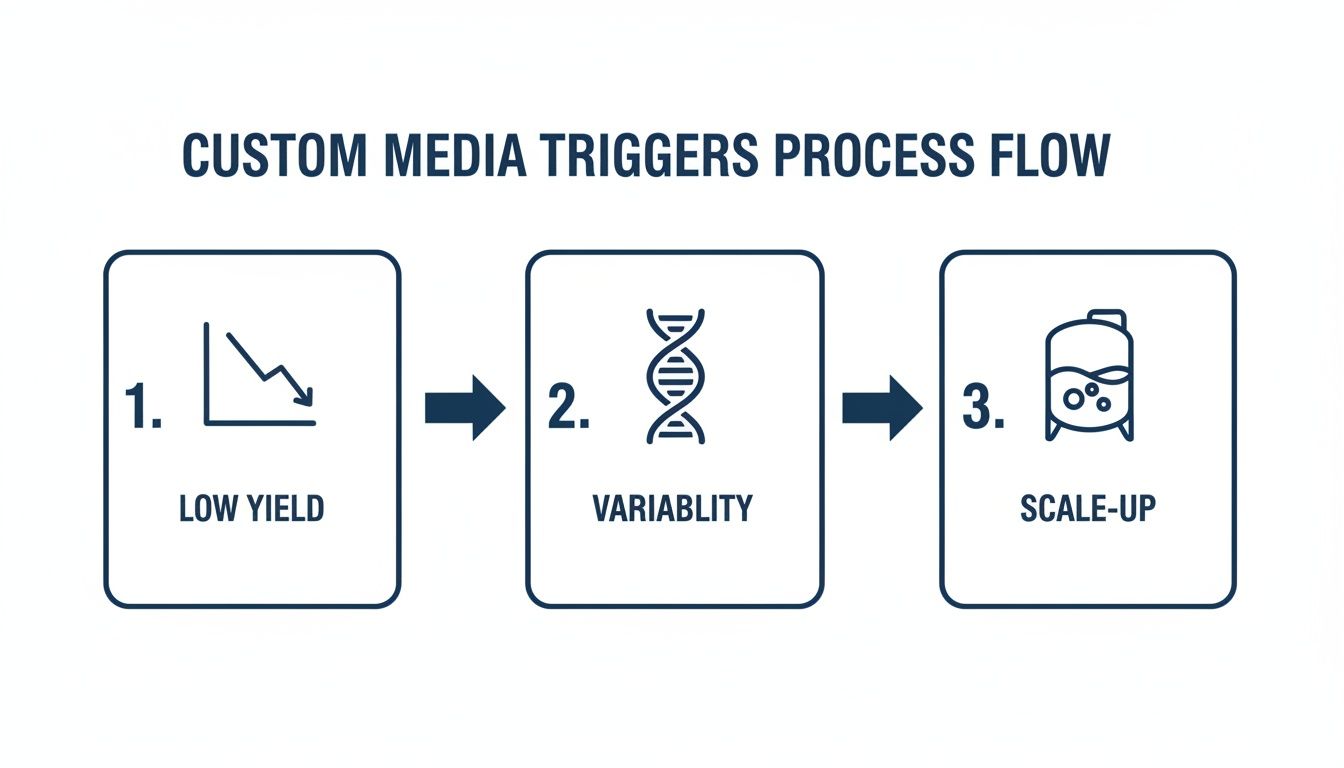
As you can see, a custom solution isn't just a minor improvement. It’s a direct strategy to solve the core bottlenecks that hold back both research and biomanufacturing.
Ensuring Safety And Consistency Through Quality Control
Getting the formula right is only half the battle. Without obsessive, rigorous quality control (QC), even the most brilliant media recipe is useless. Every single batch has to be identical, safe, and effective. This is where analytical testing becomes the gatekeeper for your entire process.
A custom media formulation is an intellectual asset, but it’s the accompanying QC testing that transforms that recipe into a reliable, consistent, and safe biological tool.
Comprehensive QC isn't just a box-ticking exercise. It's the critical safety net that prevents catastrophic batch failures, guards against tainted results, and protects the massive investment you've made in your cell culture work.
These are the non-negotiable QC tests for any custom cell culture media:
- pH and Osmolality: These are the most basic physical vital signs. Even tiny deviations can put immense stress on cells, tanking viability and growth. Testing confirms the medium is a stable, physiological environment.
- Endotoxin Levels: Endotoxins from bacteria are a massive safety risk, especially in therapeutic applications where they can trigger severe inflammatory reactions. Strict testing ensures levels are far below regulatory red lines.
- Sterility Testing: This is a simple but critical check to confirm the absolute absence of microbial contaminants like bacteria or fungi, which can wipe out a culture in days.
- Performance Assays: This is the ultimate proof. The new media batch is used to culture your actual target cell line to prove it supports growth and productivity on par with, or better than, a previously qualified standard.
When you partner with a provider like PurMa Biologics that lives and breathes robust QC and documentation, you gain something invaluable: the confidence that your custom medium will work the same way, every single time, from the first discovery experiment to full-scale production.
Real-World Impact of Custom Media
The true value of a custom cell culture media isn’t found on a spec sheet; it's proven in the lab and the clinic. When you move from theory to practice, you start to see how tailored formulations aren't just an incremental improvement—they're a fundamental driver of success across biomanufacturing, advanced therapies, and critical disease research.
This is where precision nutrition for cells translates into tangible breakthroughs.
These applications show how moving beyond a generic, one-size-fits-all medium solves specific, high-stakes challenges that were once major roadblocks. Let’s walk through a few mini case studies that bring these benefits to life.
Powering Biomanufacturing Success
In the world of biomanufacturing, Chinese Hamster Ovary (CHO) cells are the undisputed workhorses, pumping out a huge portion of the therapeutic proteins and monoclonal antibodies on the market. The challenge has always been pushing these cellular factories to their absolute production limits. Standard media often forces yields to plateau, creating an expensive bottleneck.
A custom cell culture media solution tackles this problem head-on. By systematically analyzing the metabolic profile of a high-producing CHO clone, developers can build a formula that precisely matches its nutritional demands. This often means:
- Boosting Amino Acids: Increasing the concentration of specific amino acids that are the direct building blocks of the target antibody.
- Controlling Lactate: Tweaking the carbohydrate source to shift metabolism away from producing toxic lactate, which allows for higher, healthier cell densities.
- Adding Specific Supplements: Incorporating trace elements or lipids that improve cell robustness under the high-stress conditions of a bioreactor.
The outcome is dramatic. It’s not uncommon to see a 30-50% increase in final product titer, which directly translates to more doses produced per batch and a lower cost of goods. This optimization also simplifies downstream processing, since a healthier culture produces fewer impurities that need to be filtered out later.
Ensuring Safety in Cell and Gene Therapy
The stakes get even higher in cell and gene therapy, where the cells themselves are the therapeutic product. Here, the primary concerns are patient safety, therapeutic potency, and bulletproof regulatory compliance. Using standard media with animal-derived serum is a non-starter; it introduces massive variability and an unacceptable risk of contamination.
Take CAR-T cell therapy. The whole game is to expand a patient's T-cells ex vivo in a way that preserves, and even enhances, their tumor-killing function.
A custom, chemically defined medium is designed not just for growth but for function. It guides the cells toward a specific, potent phenotype while eliminating all undefined components, providing a clean, safe, and effective path to treatment.
The solution is a completely serum-free, cytokine-rich formula. This custom cell culture media is engineered to promote the proliferation of T-cells with a specific memory phenotype known to be more persistent and effective once infused back into the patient. The result is a more potent, safer cellular product that meets the strict demands of regulatory bodies like the FDA.
Advancing Disease Modeling in Research
In academic and hospital labs, researchers often work with primary cells—cells taken directly from tissue, like neurons, hepatocytes, or endothelial cells. These cells are notoriously finicky and difficult to culture because they're far more sensitive than immortalized cell lines. Standard media often fails to support their long-term survival and function, making it nearly impossible to create physiologically relevant disease models.
For instance, a neurology lab studying Alzheimer's needs to keep primary neurons alive and healthy for weeks to watch disease progression unfold. A custom formulation makes this possible by including specific neurotrophic factors, antioxidants, and a finely tuned balance of ions to mimic the brain's natural environment.
This isn't just a niche approach; it reflects a broad industry shift. For hospital labs and diagnostics firms studying disease mechanisms, custom solutions can cut experimental variability by up to 50%. In gene therapies, over 70% of advanced processes now rely on chemically defined options to slash the risks that come with serum. You can discover more about these custom media market insights and see how this trend is accelerating our understanding of complex human diseases by enabling reliable cultures that were previously out of reach.
How to Choose Your Custom Media Partner
Choosing a partner to develop your custom cell culture media is as critical as the formulation science itself. This isn't about finding a simple vendor to mix ingredients; it’s a strategic alliance that can make or break the success and scalability of your entire project.
The right partner brings far more than just manufacturing capacity. They offer the deep, hard-won expertise needed to translate your biological goals into a consistent, effective, and regulatory-friendly product. They become an extension of your own team.
Making the wrong choice can trap you in a cycle of prolonged development timelines, costly formulation failures, and a final product that falls short of quality standards. In stark contrast, a strong partner anticipates challenges and guides you from the initial concept all the way to large-scale production. Think of it as choosing an architect for a skyscraper—you need someone with a proven blueprint for success.
Evaluating Formulation Experience and Capabilities
The first, and most important, criterion is the partner's depth of formulation experience. A team with a vast library of existing formulas and decades of experience, like the one at PurMa Biologics, can dramatically shorten your development timeline. They've seen similar challenges before and have a massive knowledge base to draw from, helping you sidestep common pitfalls.
When you're vetting potential partners, ask them specific questions about their background with your cell type—whether it’s CHO, primary T-cells, or another specialized line. Their ability to speak fluently about the unique metabolic needs of your cells is a dead giveaway of their competence. A partner who has already developed thousands of formulations has a monumental head start.
A truly valuable partner doesn't just mix the ingredients you ask for. They challenge your assumptions, suggest improvements, and use their expertise to build a better formula than you could have designed alone.
This collaborative dynamic is the key difference between a mere service provider and a genuine development partner. They should present a clear, structured workflow that moves from small-scale testing and optimization to full-scale validation.
Scrutinizing Quality Systems and Regulatory Support
A brilliant formulation is worthless if it isn't backed by a rock-solid Quality Management System (QMS). Your partner’s commitment to quality is what guarantees that every batch of your custom cell culture media will be identical, safe, and effective.
Here’s a checklist of non-negotiable quality and regulatory criteria:
- Comprehensive Documentation: Can they provide detailed Certificates of Analysis (CofA) for every lot? What about complete raw material traceability records and support for your regulatory filings (e.g., Master Files)?
- Manufacturing Capacity and Scalability: Do they have the facilities to produce your media at the volumes you need—both now and in the future? Make sure they can handle small R&D batches just as well as large-scale GMP production runs.
- Rigorous QC Testing: Ask about their standard QC procedures. Do they include tests for pH, osmolality, endotoxin levels, sterility, and, critically, cell-based performance assays?
- Complementary Services: Do they offer additional support, like cell line adaptation, process optimization, or protein expression services? These integrated offerings can massively simplify your workflow.
Choosing the right partner is ultimately about building unshakable confidence in your supply chain. When you find a company that combines world-class formulation science with impeccable quality control, you get more than just a custom product—you get the peace of mind to focus on your science.
Frequently Asked Questions About Custom Media
Making the switch to custom media often brings up a few final, practical questions. Even after you see the benefits, it's the real-world details—cost, time, and paperwork—that matter. Let's tackle the most common ones head-on.
How Long Does It Take To Develop Custom Media?
The honest answer? It depends. A simple tweak to an existing formula might only take a few weeks. But if you're starting from scratch to build a completely new, highly optimized medium, you should plan for a timeline spanning several months.
The process isn't random. It starts with a deep dive into your goals, moves to small-scale formulation tests, and then enters a series of optimization cycles driven by hard performance data. Once we nail the formula, it's validated for scale-up. Working with an experienced partner can cut this time down considerably, as their deep library of past formulations gives you a much more advanced starting point.
The optimization cycle is almost always the most time-consuming part of the journey. This is where a partner’s experience really pays off. An expert can zero in on the most impactful formulation changes to test, dramatically shortening the path to your final, validated medium.
While it's a thorough process, every step is designed to do one thing: deliver a final product that is robust, reliable, and perfectly engineered for your cells.
Is Custom Media Always More Expensive?
If you only look at the upfront development fee and the per-liter price, then yes, custom media can appear more expensive than an off-the-shelf product. But that’s a dangerously shortsighted view. For biomanufacturing and critical research, custom media almost always delivers a lower total cost of ownership.
Here’s why that initial price tag is misleading:
- Massive Productivity Gains: A finely-tuned formulation can lead to stunning increases in cell densities and protein yields. You simply produce more product with less media and fewer bioreactor runs.
- Fewer Failed Batches: By creating an environment where your cells thrive, you slash the risk of costly batch failures that burn through time, materials, and morale.
- Simpler Downstream Processing: Healthier, more productive cultures generate fewer impurities. This directly translates to a less complex, less expensive purification process for your final product.
When you account for the boosts in productivity and the reduction in risk, a custom formulation often proves to be the smartest economic decision you can make, especially for large-scale and high-value work.
What Documentation Comes With A Custom Formulation?
The paperwork is just as critical as the media itself. Any reputable custom media partner will provide a comprehensive documentation package to guarantee quality, traceability, and regulatory peace of mind.
You should always expect to receive these three things:
- Certificate of Analysis (CofA): This non-negotiable document arrives with every single batch. It details the QC test results for critical parameters like pH, osmolality, sterility, and endotoxin levels.
- Formulation Details: The specific components and their exact concentrations will be fully documented, typically under a confidentiality agreement to protect your valuable intellectual property.
- Regulatory Support: Your partner must provide full traceability records for every raw material. They should also be prepared to support your regulatory filings, which often means providing access to a Master File.
This complete documentation package is what ensures batch-to-batch consistency and gives you the clear paper trail required for GMP manufacturing and clinical submissions.
At PurMa Biologics, we bring over 30 years of formulation expertise and uncompromising quality control to every project. We deliver custom media solutions that don't just work—they accelerate your science. Explore our custom media services and start building a formulation that meets your exact needs.