

If you've ever tried to separate microscopic particles from a complex biological soup, you know the frustration. It can feel like trying to sort sand from pebbles in a murky jar of water. This is where density gradient centrifugation comes in—a technique that lets us elegantly separate tiny components like cells, viruses, or even organelles based on their size, shape, and density.
The method relies on spinning a sample in a tube that contains a solution of increasing density, called a gradient. This gradient allows different particles to settle into distinct, harvestable layers.
Decoding The Science Of Separation
At its core, density gradient centrifugation is a more sophisticated version of standard centrifugation. While a regular centrifuge is great for pelleting heavy material, it often fails when you need to separate particles with similar densities. That’s where the gradient—a carefully constructed column of liquid with increasing density—changes the game entirely.
Think of it like a layered cocktail. The densest liquid, maybe a heavy sugar syrup, sits at the bottom, while lighter liquids float on top. When you layer your sample on this gradient and spin it at high speeds, each particle begins its journey downward. It will travel until it either hits a "cushion" of liquid that matches its own density or is separated from its neighbors based on its travel speed.
This level of precision is absolutely non-negotiable in the modern lab. Whether you're purifying viral vectors for gene therapy or isolating specific immune cells for a new study, getting a high-purity separation is fundamental. Without it, you're looking at contaminated samples, unreliable data, and experiments that are doomed from the start.
The Two Core Strategies
The true power of density gradient centrifugation lies in its two different approaches. Each strategy uses a different physical principle to achieve separation, making the technique incredibly versatile. Understanding when to use which is the first step toward a successful experiment.
The two primary methods are:
- Rate-Zonal Centrifugation: This method separates particles based mostly on their size and shape. You can think of it as a race—larger, more hydrodynamic particles will move through the gradient much faster than smaller ones. The key is to stop the centrifuge before anything reaches the bottom, capturing the particles in distinct zones based on how far they've traveled.
- Isopycnic Centrifugation: This technique is all about buoyant density. Here, particles are spun until they reach the point in the gradient where their density is identical to the surrounding liquid. At this equilibrium point, they stop moving and form a sharp, stable band. It doesn't matter how big they are or how much longer you spin; they've found their home.
The core principle is simple yet incredibly effective: particles with different physical properties (size, shape, density) will behave differently when subjected to centrifugal force within a density gradient. This allows for their precise separation into distinct, harvestable layers.
This dual capability is what allows scientists to isolate everything from large organelles down to the tiniest viruses with incredible fidelity. The choice between rate-zonal and isopycnic depends entirely on your goal—are you trying to sort by size, or by intrinsic density?
Quick Guide to Centrifugation Methods
To help you decide which approach is right for your experiment, the table below breaks down the core principles and common applications for each method. Choosing correctly is the difference between a messy smear and a perfectly resolved band.
| Method Type | Separation Principle | Gradient Type | Primary Application |
|---|---|---|---|
| Rate-Zonal | Size and Shape | Shallow Gradient | Separating particles of similar density but different sizes (e.g., ribosomes, polysomes). |
| Isopycnic | Buoyant Density | Steep Gradient | Separating particles with different densities (e.g., DNA, organelles, viruses). |
Ultimately, having both of these strategies in your toolkit makes density gradient centrifugation one of the most powerful separation techniques available in the lab.
Isopycnic vs. Rate-Zonal: Two Races, Two Different Finish Lines
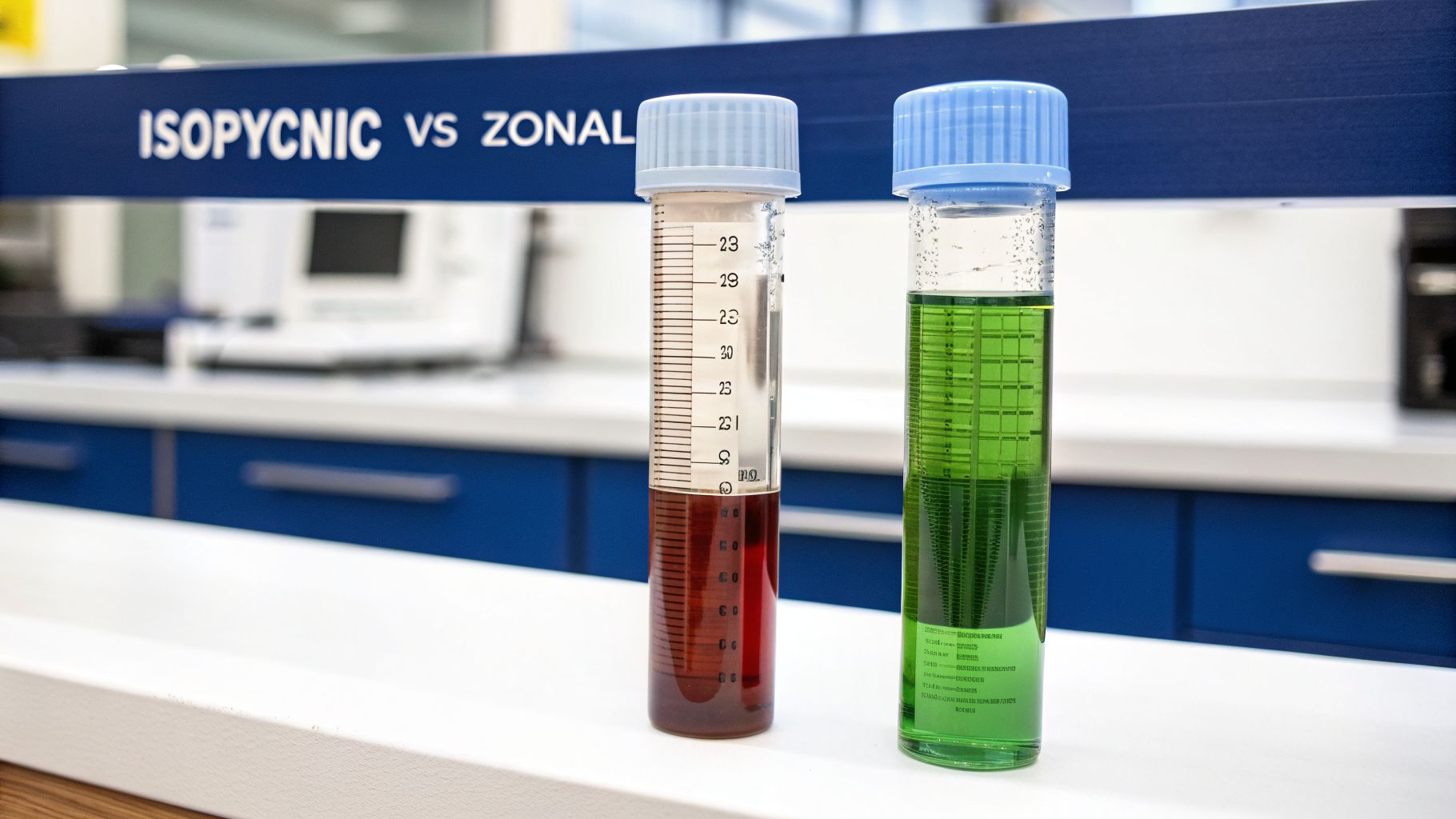
While it's all done in a centrifuge, "density gradient centrifugation" isn't a single method. It's two fundamentally different strategies, each designed to solve a unique separation problem. Getting this choice right from the start is non-negotiable—it's the difference between a clean, pure isolate and a tube full of useless, cross-contaminated mush.
The two workhorses of the field are isopycnic separation and rate-zonal separation. Let’s break down what they do and when to use them.
Isopycnic Separation: Finding Equilibrium
Isopycnic separation, sometimes called buoyant density separation, is all about equilibrium. In this technique, you spin your sample through a steep density gradient until every particle finds its own personal sweet spot—the exact point where its density matches the density of the gradient medium around it.
Picture swimmers in a pool that gets saltier and denser the deeper you go. A person wearing a high-flotation life vest will settle near the top. Someone with less buoyancy will sink until they reach a deeper, denser layer where they float effortlessly. Each person finds their unique equilibrium point and just stays there, no matter how much longer the pool is open.
In isopycnic centrifugation, particles migrate to a position in the gradient where their buoyant density is equal to the density of the gradient medium. At this point, the net force on the particle is zero, and it stops moving.
This is what makes the method so powerful for separating particles based on density differences, regardless of their size. It’s an equilibrium technique, which means you can spin for longer without fear of pelleting your sample. The particles will simply park themselves in their designated density bands and wait for you.
This is the go-to method for jobs like:
- Separating DNA: Isolating plasmid DNA from denser chromosomal DNA.
- Purifying Viruses: Viruses have specific buoyant densities, making it possible to pull them out cleanly from host cell contaminants.
- Isolating Organelles: Mitochondria, lysosomes, and peroxisomes all have distinct densities and can be separated this way.
Rate-Zonal Separation: A Race Against Time
Rate-zonal separation, on the other hand, is a timed race. Here, particles are separated based on their size and shape (their sedimentation coefficient), not their density. The biggest and most compact particles move fastest, while smaller or more irregularly shaped ones lag behind.
Think of it as dropping a handful of different rocks through layers of water and mud. Big, heavy boulders will plummet toward the bottom almost instantly. Smaller pebbles will travel slower, and fine sand will barely move at all. If you stop the process after a few seconds, you'll find the rocks sorted into layers based on how far they traveled in that time.
That's rate-zonal in a nutshell. You carefully layer a small amount of sample on top of a shallow gradient. Critically, the density of your particles must always be greater than any part of the gradient. The gradient itself isn't there to make things float; its job is to prevent the zones from mixing as they separate.
This is a kinetic, time-dependent process. Spin too short, and your separation is incomplete. Spin too long, and everything—big and small—ends up in a single, useless pellet at the bottom of the tube. Precise control over spin time and speed is everything.
Choosing Between Isopycnic And Rate-Zonal
So, how do you choose? It all comes down to a single question: what's the primary difference between the particles you need to separate?
| Method | Best For Separating Particles… | Separation Principle | Key Analogy |
|---|---|---|---|
| Isopycnic | …of different densities. | Buoyant Density (Equilibrium) | Swimmers finding their float level. |
| Rate-Zonal | …of different sizes. | Sedimentation Rate (Time-Dependent) | Rocks falling through mud. |
For example, if your goal is isolating Peripheral Blood Mononuclear Cells (PBMCs) from whole blood, you're separating based on density. Lymphocytes and monocytes have a density around 1.077 g/mL, while red blood cells and granulocytes are denser and will sink. That’s a classic job for isopycnic separation.
But if you want to separate large and small ribosomal subunits, you're separating based on size (sedimentation coefficient). That's a textbook case for rate-zonal separation.
Choosing The Right Gradient Medium
Getting your gradient medium right isn't a minor detail—it’s the foundation of your entire experiment. This medium creates the very "staircase" your particles will travel down, and choosing the wrong one can lead to poor separation, damaged cells, or results that are flat-out wrong.
Think of it like choosing the right tool for the job. You wouldn't use a sledgehammer for delicate woodwork, and you definitely wouldn't use a tiny screwdriver to change a tire. The same logic applies here. The dense, rugged medium perfect for separating viruses is completely wrong for isolating fragile immune cells. Each medium has its own unique fingerprint—density, viscosity, and osmolarity—that makes it ideal for some jobs and a disaster for others.
This choice has a direct impact on your sample’s integrity and the health of your cells. Starting with a high-quality, sterile, and endotoxin-controlled medium is non-negotiable for clean, reproducible separations and for keeping your cells viable for downstream analysis.
Profiling The Lab Workhorses
A few media have become the go-to standards in labs all over the world. Knowing their strengths, weaknesses, and quirks is the key to matching the right one to your experimental goals.
Sucrose Gradients
Sucrose is the old classic. It’s cheap, it’s easy to work with, and it’s been a lab staple for decades, especially for separating things that don't mind a little osmotic stress, like nucleic acids, ribosomes, and some viruses.
The big catch? Its high osmolarity is brutal on most mammalian cells. It will literally suck the water out of them, causing damage and compromising viability. It's a great tool, but use it for the right job—not for isolating happy, healthy cells.
Ficoll Gradients
If sucrose is the workhorse, Ficoll is the gentle giant of cell separation. It's a high-molecular-weight synthetic polymer of sucrose that is non-toxic and physiologically inert.
- Key Advantage: Ficoll creates a low-osmolarity solution, which is absolutely critical for maintaining the viability and function of cells. This gentleness is what makes it the undisputed gold standard for isolating peripheral blood mononuclear cells (PBMCs).
- Common Use: You've almost certainly encountered Ficoll-Paque. It's a commercial formulation with a density of 1.077 g/mL, perfectly tuned to float mononuclear cells while letting denser red blood cells and granulocytes pellet at the bottom.
Percoll Gradients
Percoll is a different beast altogether. Made of silica nanoparticles coated with polyvinylpyrrolidone (PVP), it's non-toxic and has a low osmolarity. But its real magic is its ability to form its own gradient.
You don't have to painstakingly layer a Percoll gradient. You can simply mix it with your sample, put it in the centrifuge, and let it create a "self-forming" gradient in situ. As the rotor spins, the silica particles sediment on their own, automatically generating a smooth, continuous density ramp. This is a game-changer for isopycnic separations of cells, organelles (like mitochondria), and even larger viruses.
The Power of Cesium Chloride
When you need ultimate precision, especially for separating nucleic acids and viruses, you bring out the big gun: cesium chloride (CsCl). Under high centrifugal force, CsCl solutions form incredibly steep, high-resolution gradients that can separate particles with minuscule differences in buoyant density.
Its place in history is legendary. The famous Meselson-Stahl experiment of 1958 used CsCl gradients to prove, once and for all, that DNA replication is semi-conservative. They grew E. coli in a "heavy" nitrogen isotope, switched to a "light" one, and centrifuged the DNA at a blistering 44,770 rpm. The resulting DNA bands—one hybrid, and later, one hybrid and one light—were a perfect match for their theory, forever changing molecular biology. It’s a beautiful example of how the right centrifugation technique can lead to monumental discoveries.
Making The Right Choice
So, how do you decide? It's a trade-off. You have to weigh the properties of each medium against the specific demands of your sample and your downstream goals. Using a high-quality medium from a trusted supplier like PurMa Biologics is your first line of defense, ensuring your gradient’s starting material is sterile, pure, and consistent, batch after batch.
| Medium | Primary Use | Key Advantage | Key Disadvantage |
|---|---|---|---|
| Sucrose | DNA, RNA, ribosomes, some viruses | Very low cost, easy to prepare | High osmolarity can damage cells |
| Ficoll | PBMC and other viable cells | Isotonic; very gentle on cells | Higher cost than sucrose |
| Percoll | Organelles, cells, some viruses | Can self-form gradients, low osmolarity | Can be difficult to remove from sample |
| Cesium Chloride | Nucleic acids, plasmids, viruses | Forms very steep, high-resolution gradients | Corrosive and relatively expensive |
Ultimately, your choice of gradient medium is just as critical as your centrifuge or your sample prep. By truly understanding the properties of these common reagents, you can design a separation protocol that is not just adequate, but robust—delivering the pure, viable fractions you need for data you can trust.
Your Step-By-Step Workflow For Successful Separation
Knowing the theory is one thing, but getting clean, high-purity fractions at the end of a run comes down to mastering the workflow. Translating the principles of density gradient centrifugation into a repeatable, reliable process is what separates publication-ready data from a wasted afternoon.
This is the battle-tested workflow we use in our own labs. It breaks down each stage, turning a complex procedure into a series of manageable steps and minimizing the variables that can ruin a separation. Follow it, and you’ll have confidence in your results every single time.
Step 1: Prepare Your Gradient With Precision
Everything hinges on the quality of your gradient. This is the single most critical step, and even small errors here will compromise the entire run. Whether you’re pouring a continuous gradient with a gradient maker or hand-layering a discontinuous (step) gradient, precision is non-negotiable.
For a step gradient, you’ll use a sterile pipette to carefully layer solutions of decreasing density, starting with the heaviest, highest-density solution at the very bottom of the centrifuge tube.
- Pro Tip: To prevent the layers from mixing, always place the pipette tip against the inside wall of the tube, just above the liquid’s meniscus. Dispense the next solution slowly and steadily. A smooth, unhurried motion is your best friend here.
This quick guide helps you match your starting material to the right gradient medium, getting your workflow started on the right foot.
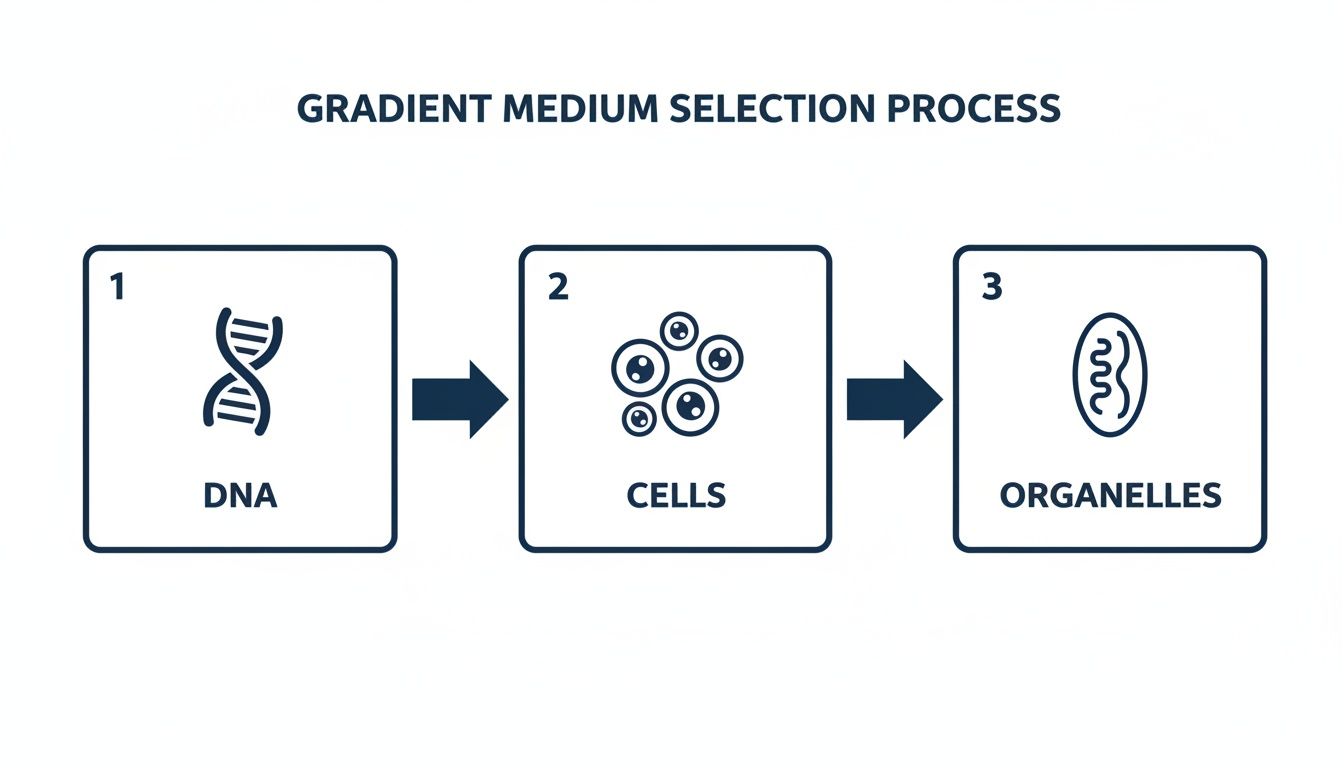
The choice of medium is dictated entirely by what you're trying to separate—from tough DNA to fragile organelles—and getting it right from the start is half the battle.
Step 2: Carefully Layer The Sample
With your gradient built, it's time to add your sample. The goal here is the same as before: avoid disturbing the interface between your sample and the top layer of the gradient. A disrupted interface means poor resolution and cross-contaminated bands.
Gently and slowly layer your prepared sample on top. Again, keep the pipette tip pressed against the inside wall of the tube just above the liquid surface. Make sure the volume of your sample is appropriate for your tube and gradient; overloading is one of the most common reasons for a failed run.
Step 3: Optimize Centrifugation And Select Hardware
Now for the spin. Your choice of rotor is a critical decision that depends entirely on your separation goal.
- Swinging-Bucket Rotors: These are the gold standard for rate-zonal separations. As the rotor spins, the tubes swing out to a horizontal position. This applies the centrifugal force directly along the length of the gradient, allowing particles to form sharp, distinct bands.
- Fixed-Angle Rotors: These are often the go-to for isopycnic separations, especially for high-g-force applications like purifying plasmids with Cesium Chloride. While the bands will form on an angle, they reorient themselves into flat bands when the rotor stops.
Set your speed (RPM or RCF) and time based on your protocol. For rate-zonal separations, time is a critical variable you must control precisely. For isopycnic runs, you just need to spin long enough for every particle to find its equilibrium point.
The roots of this process stretch back to the 1920s, when Theodor Svedberg invented the ultracentrifuge, a machine generating forces up to 900,000 x g. His work, which earned a Nobel Prize, laid the groundwork for modern density gradient centrifugation by enabling precise molecular weight analysis and proving concepts like hemoglobin's 68,000 Da weight. You can explore more about centrifugation’s fascinating history and its early pioneers.
Step 4: Harvest Your Separated Bands
After the centrifuge stops, handle your tubes with extreme care. A single clumsy move can disturb the bands you just worked so hard to separate. There are two main ways to collect your fractions.
- Top Pipetting: The simplest method. Carefully insert a micropipette through the top meniscus and slowly withdraw your target band. This works well for the topmost bands but risks contamination when trying to get to lower ones.
- Side-Wall Puncture: Using a syringe with a needle, pierce the side of the tube just below your target band and slowly aspirate the fraction. This method is excellent for cleanly harvesting lower bands with high purity.
By methodically following these steps, you build a robust and repeatable workflow for density gradient centrifugation—your key to consistent, high-quality separations.
Real-World Applications In Research And Bioproduction
A technique is only as good as what it can accomplish in the real world. Outside the neat diagrams in a textbook, density gradient centrifugation is a workhorse, quietly powering breakthroughs in immunology, virology, and biomanufacturing. It’s the essential bridge from a messy, heterogeneous biological sample to the pure, specific population of cells or particles you actually need to study.
From academic labs dissecting cellular machinery to industrial facilities producing biologics, the ability to separate things by density is fundamental. Let's look at where this technique really shines.
Isolating Immune Cells From Blood
One of the most routine—and critical—applications is pulling Peripheral Blood Mononuclear Cells (PBMCs) out of whole blood. These are the lymphocytes and monocytes at the heart of immunology research, vaccine development, and clinical diagnostics.
The problem is that whole blood is a crowded, messy place. To get to the PBMCs, you first have to get rid of all the dense red blood cells and granulocytes. This is where a density gradient medium like Ficoll becomes indispensable.
- You start with a medium precisely formulated to a density of 1.077 g/mL.
- Anticoagulated blood is carefully layered on top, and the tube is centrifuged.
- The heavy stuff—red blood cells and granulocytes—pellets hard at the bottom.
- The lighter PBMCs, however, can't penetrate the dense medium. They stop and collect in a distinct white layer, the "buffy coat," right at the plasma-gradient interface.
This clean separation is what allows researchers to harvest a pure, viable population of immune cells, ready for downstream work like flow cytometry, cell-based assays, or cryopreservation.
Purifying Viruses And Extracellular Vesicles
Whether you're developing a vaccine or a diagnostic test, you need pure viral particles. Crude preparations from host cells are full of protein and debris that can tank a product's efficacy and safety. Density gradient centrifugation is the go-to method for cleaning them up.
The technique's journey from an analytical curiosity to a preparative powerhouse really took off in 1950. That’s when Myron K. Brakke first used a sucrose gradient to separate a plant virus, a rate-zonal approach that was a huge leap forward in resolution. That single innovation paved the way for its use across virology. To see more of the history, you can learn about the pioneers who shaped this field.
Today, isopycnic separation with sucrose or cesium chloride gradients is standard practice for virus manufacturing. The process involves spinning the sample in a gradient until the viruses form a sharp, concentrated band at their exact buoyant density, cleanly separating them from all the junk. The same principle is now being applied to purify Extracellular Vesicles (EVs), which are gaining huge traction as potential biomarkers and drug delivery systems.
Studying Cellular Disease And Function
To figure out how a cell works—or what’s breaking down in disease—you often have to take it apart piece by piece. Density gradient centrifugation is the gold standard for isolating subcellular organelles like mitochondria, nuclei, and lysosomes.
Each tiny organelle has its own unique density, which allows for remarkably precise separation. A researcher studying mitochondrial dysfunction in Alzheimer's, for example, can use a gradient to pull pure, intact mitochondria from brain tissue.
By isolating these tiny cellular powerhouses from everything else, they can analyze their metabolic health and genetic integrity directly. It’s this ability to pinpoint the source of a problem that moves research forward and opens the door for targeted new therapies.
Troubleshooting Common Problems In Your Workflow
Even when you follow a protocol to the letter, a density gradient run can go wrong. You pull the tube out of the centrifuge only to see faint, smeared bands, or find that your precious sample has all but vanished. It’s a frustrating moment that can stop an entire experiment in its tracks.
The good news is that most of these problems trace back to a handful of common, fixable mistakes. The real skill isn't just running the gradient, but knowing how to read the results when they're bad and diagnose exactly what happened. Let's walk through the most common issues and how to get your separations back on track.
Diagnosing Poorly Defined Bands
This is the number one complaint: fuzzy, smeared, or completely non-existent bands. When your fractions aren't sharp and well-resolved, it’s a clear signal that something went wrong during the setup or the spin itself.
Before you blame the centrifuge, consider these culprits:
- Incorrect Gradient Slope: Your gradient needs to match your particles. If the density range is too narrow (shallow) or too wide (steep) for your specific sample, the particles will either bunch up or spread out too much to form distinct bands.
- Sample Overloading: It’s tempting to load as much sample as possible, but this is a classic recipe for failure. Too much material causes clumping and mixing right at the start, preventing particles from entering the gradient as a clean, thin layer.
- Gradient Disturbance: A density gradient is a delicate, layered system. Any sudden jolt while pouring the layers, loading the sample, or even just carrying the tube to the rotor can disrupt the interfaces and lead to a messy, ineffective separation.
A critical but often overlooked quality control step is to verify your gradient's density profile. Using a refractometer to check the refractive index of your highest and lowest density solutions before you start ensures your gradient is correct from the beginning.
Addressing Low Recovery And Sample Loss
The second most frustrating outcome is when your sample simply disappears. You might see a ghost of a band, or worse, find that nearly all of your material has formed a hard pellet at the bottom of the tube when it was supposed to be floating in the gradient.
This almost always points to an issue with your spin parameters. In rate-zonal runs, spinning too long or too fast will cause your particles to fly right past their separation zone and pellet. Conversely, for an isopycnic run, a spin that’s too short or too slow means your particles never get the chance to travel to their buoyant density layer.
Cross-contamination between your carefully separated layers is another major headache. This is usually a harvesting problem. When you go to collect your bands, any shaky movements or sloppy pipetting will mix the layers you worked so hard to separate. For lower bands, try piercing the side of the tube with a syringe to collect them cleanly without disturbing the layers above.
And of course, starting with pure, sterile reagents is non-negotiable. Using high-purity media and solutions, like those from PurMa Biologics, ensures you aren’t introducing external contaminants that can interfere with separation and ruin your results.
Frequently Asked Questions
The protocol looks perfect and the theory makes sense, but what about those small, practical details that can make or break your run? When you're at the bench, getting straight answers to common questions can be the difference between a clean separation and a wasted afternoon.
Here are the answers to the hurdles we see most often in density gradient centrifugation.
Swinging-Bucket or Fixed-Angle Rotor: Which One Do I Need?
This isn’t a matter of preference—it’s about matching the hardware to the physics of your separation. Your choice of rotor directly dictates the quality of your results.
Swinging-Bucket Rotors: These are the gold standard for rate-zonal separations. As the rotor gets up to speed, the buckets swing out completely horizontal. This means the g-force is applied perfectly down the length of the tube, giving you those sharp, distinct, and flat bands you need for clean harvesting.
Fixed-Angle Rotors: These are workhorses for isopycnic separations, especially when you need to hit extremely high g-forces to pellet things like plasmid DNA. While the bands form at an angle, don't worry—as the rotor decelerates, they neatly reorient into flat layers, ready for collection.
Can I Just Reuse My Density Gradient?
While it's tempting to save a bit of time or reagent, reusing a density gradient is a bad idea for any serious application. The risks are just too high.
The two biggest problems are cross-contamination and gradient degradation. Every time you run a sample, you’re introducing biological material. Even microscopic traces left behind can wreck the purity of your next experiment and make your results completely unreliable. It’s just not worth it.
What's the Best Way to Collect My Bands?
Harvesting the bands without mixing them is an art. The two most common methods each have their place, and choosing the right one depends entirely on which layer you're after.
Top Pipetting: This is the most straightforward approach. You carefully slide a pipette tip through the top surface and slowly draw up your target band. It works perfectly for collecting the uppermost layers.
Side-Wall Puncture: For any band in the middle or at the bottom, this method gives you far better purity. You take a syringe with a needle, pierce the side of the plastic tube just below your target band, and carefully aspirate the layer. This avoids dragging your precious sample through all the layers above it.
How Important Is Temperature Control, Really?
It’s not just important—it’s absolutely critical. Temperature directly controls the viscosity of your gradient medium, and even a small change can throw off your entire experiment.
If the run is too warm, the gradient will be less viscous, and your particles will travel much faster and farther than your protocol expects. For a time-sensitive rate-zonal separation, this can completely ruin the run.
And for any work involving live cells or delicate proteins, holding a constant, cool temperature (usually 4°C) is non-negotiable for preserving sample integrity and biological function. Inconsistent temperature leads to inconsistent science.
From preparing your media to harvesting your cells, using high-purity, sterile reagents at every step is the best insurance you can buy against variability. PurMa Biologics provides a full portfolio of cell culture media, balanced salt solutions, and separation reagents to make sure your results are always consistent and reliable. Explore our complete range of products to standardize your separations at https://www.purmabiologics.com.