

In the world of molecular biology, some tools are so fundamental they're like the alphabet. The EcoRI restriction site is one of them. It’s a specific DNA sequence—5'-GAATTC-3'—that acts as a precise landmark where a molecular scalpel can make a cut.
Think of it as a pre-defined "cut here" line printed on a long strand of DNA, one that a special enzyme called EcoRI is trained to find and slice every single time.
What Is The EcoRI Restriction Site?

Imagine you need to edit a massive book by swapping out a single sentence. You wouldn't just tear the page. You'd need a tool that cuts in a very specific, predictable place. For a genetic engineer, the EcoRI restriction site provides exactly that level of precision.
It's not just any random sequence. It's a palindromic sequence, which means it reads the same forwards on one DNA strand as it does backward on the complementary strand (3'-CTTAAG-5'). This symmetry is the key to how the enzyme works. EcoRI recognizes this six-base-pair sequence and makes a staggered cut between the Guanine (G) and Adenine (A) bases on each strand.
This specific cutting action is what makes EcoRI so powerful. It doesn't create a clean, blunt break. Instead, it leaves short, single-stranded overhangs called "sticky ends"—and these sticky ends are the bedrock of modern gene cloning.
The Power of Sticky Ends
The real magic is in those sticky ends. In the case of EcoRI, the cut leaves a four-base overhang of AATT. These single-stranded tails have a natural chemical attraction, a "stickiness," for any other DNA fragment with a complementary AATT overhang.
If you cut both your gene of interest and a circular piece of DNA called a plasmid with EcoRI, they will both have perfectly matching sticky ends. This allows you to "paste" the gene into the plasmid with incredible efficiency, creating a new, recombinant DNA molecule. This is the core principle behind everything from producing insulin in bacteria to creating transgenic models for studying disease.
The discovery of enzymes like EcoRI, isolated from Escherichia coli strain RY13, was a true turning point in science. Its ability to act as a reliable DNA-cutting tool was so revolutionary that its pioneers were awarded the 1978 Nobel Prize. You can explore the fascinating history of this discovery in more detail within the scientific literature.
EcoRI At A Glance
For a quick reference, here are the essential properties of the EcoRI enzyme and its recognition site.
| Characteristic | Description |
|---|---|
| Enzyme Name | EcoRI (from Escherichia coli R strain) |
| Recognition Site | 5'-GAATTC-3' |
| Cut Pattern | Staggered cut between the G and A bases |
| Resulting Ends | 4-base sticky ends (5'-AATT overhang) |
This simple set of features has made EcoRI one of the most indispensable enzymes in any molecular biology lab, providing a reliable and predictable way to manipulate DNA.
How The Molecular Scissors Actually Work
To get a handle on how EcoRI pulls off such a precise cut, you have to look at its structure. The enzyme doesn't work alone; it operates as a homodimer, which means two identical protein subunits work together as a single functional unit.
This protein pair travels down the DNA double helix, scanning the sequence as it goes. It keeps moving until it hits its exact target: the palindromic 5'-GAATTC-3' sequence. The moment it finds the site, the two subunits clamp down onto the DNA, with each one grabbing one half of that symmetric sequence. This two-part recognition is a built-in quality check, preventing the enzyme from cutting somewhere it shouldn't.
A Coordinated Cut
Once it's locked in place, the two halves of the enzyme get to work. Each subunit has its own active site—the "blade"—that slices the DNA's backbone right between the Guanine (G) and the Adenine (A) bases on its strand.
The two cuts happen at the same time. This coordinated strike on both strands ensures you get a clean, predictable break every single time.
This is exactly why researchers trust the EcoRI restriction site for high-stakes work, like building gene therapy vectors or creating stable cell lines. In those applications, a single off-target cut can ruin an entire project.
The enzyme’s structure is what makes this all possible. Each subunit, with a molecular weight of about 31 kDa, has a specific catalytic motif known as the PD..D/EXK active site that gives it such sharp sequence specificity. Crystal structures have even revealed that specific amino acid residues on each protein half form a "crosstalk ring," which perfectly synchronizes the two active sites to make a symmetric cut on both strands at once. You can dig deeper into its complex structure and how it enables safe gene manipulation in research.
This finely tuned mechanism is your guarantee that cuts are made only at the correct EcoRI restriction site, producing the distinct sticky ends that are so critical for the next steps in your cloning workflow.
Putting EcoRI To Work In Your Cloning Workflow
This is where the theory hits the lab bench. Before you even think about un-capping a tube, the first step in any modern cloning workflow is a “virtual digest.” Fire up your sequence analysis software—something like SnapGene or Benchling—and plan your attack.
By loading your plasmid map and your gene of interest, you can simulate the entire experiment digitally. The software will instantly pinpoint every 5'-GAATTC-3' site and show you exactly what DNA fragments you should expect to see. This is non-negotiable. It’s the single best way to confirm your cloning strategy makes sense on paper before you waste time, money, and precious reagents.
Setting Up a Successful Restriction Digest
Once your virtual plan checks out, it’s time to set up the real reaction. A clean, efficient digest is all about creating the perfect environment for EcoRI to do its job without getting sloppy.
A typical digest is a simple cocktail with just a few key players:
- DNA: Your plasmid or PCR product.
- Restriction Enzyme: EcoRI, or a high-fidelity version like EcoRI-HF for critical applications.
- Buffer: The specific 10X buffer that provides the right pH and salt concentration for your enzyme.
- Nuclease-Free Water: To bring the reaction to its final volume.
A classic rookie mistake is dumping in too much enzyme, thinking more is better. This leads to "star activity"—where the enzyme gets sloppy and starts cutting at non-target sites. Stick to the manufacturer's protocol, which is almost always 1 unit of enzyme per 1 microgram of DNA for a one-hour incubation.
Visualizing The Process And Results
The diagram below breaks down exactly what's happening in the tube. It’s a beautifully simple three-step process.
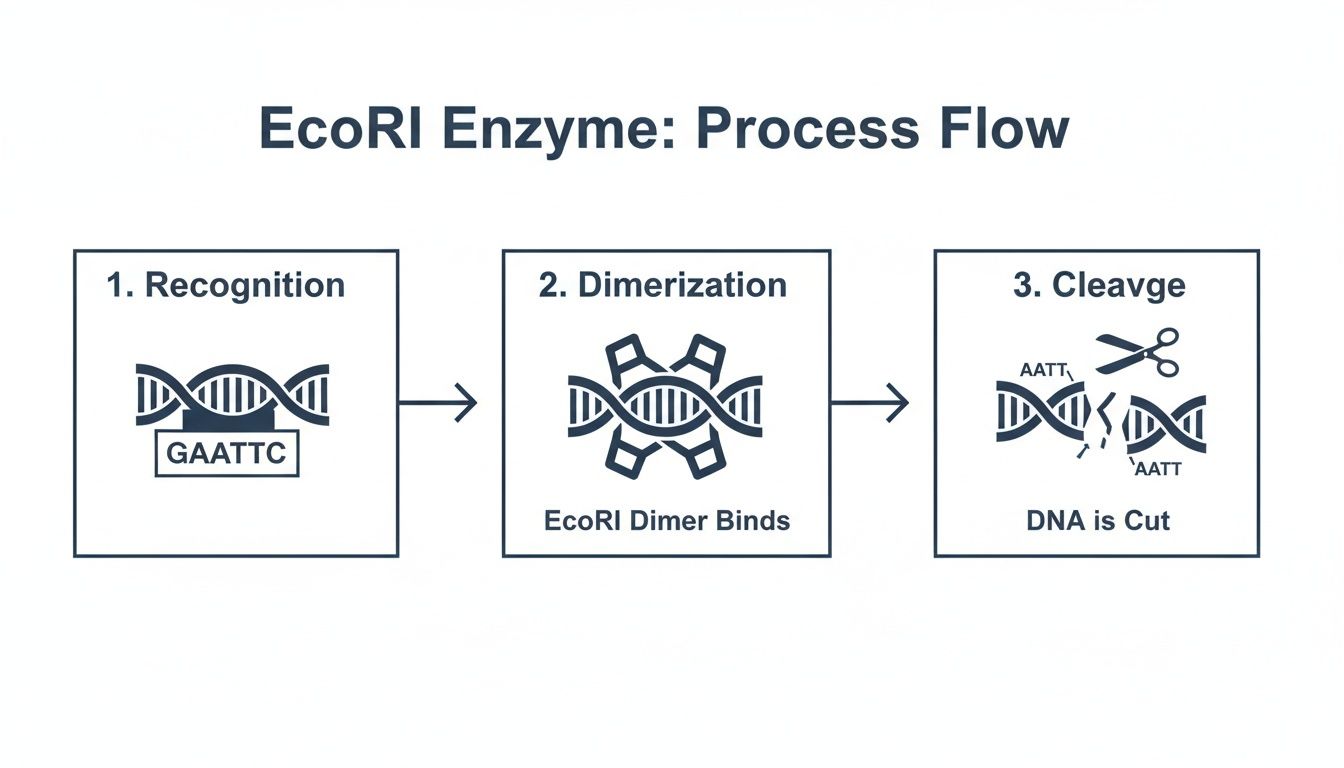
First, the enzyme finds its target sequence. Then, it pairs up with another EcoRI molecule (dimerizes). Finally, it makes a synchronized cut on both strands to generate those all-important sticky ends.
After your incubation is complete, you’ll run the reaction out on an agarose gel. This is your moment of truth. If the digest worked, the bands on the gel should match the fragment sizes you predicted back in your virtual digest, giving you the green light to proceed with your cloning.
From Gene Cloning To DNA Fingerprinting
The precision of the EcoRI restriction site isn't just some abstract biological trivia—it's the workhorse behind powerful, real-world techniques that are fundamental to modern molecular biology. Its most famous role, without a doubt, is in gene cloning, a foundational procedure happening every day in thousands of labs worldwide.
Think of it as a biological "cut and paste." Scientists use EcoRI to snip a gene of interest out of its source DNA while, in a separate tube, using the exact same enzyme to cut open a circular piece of DNA called a plasmid. Since both the gene and the plasmid now have identical, "sticky" AATT overhangs, the gene can slot perfectly into the opened plasmid, where another enzyme seals it shut. This elegant process is the gateway to everything from manufacturing therapeutic proteins like insulin in bacteria to studying what a newly discovered gene actually does.
Verifying Your Work With Restriction Mapping
Beyond just building things, the EcoRI restriction site is also essential for a classic quality control check: restriction mapping. This technique is your insurance policy, verifying that you actually built the plasmid you intended to. After digesting your newly made plasmid with EcoRI (and perhaps other enzymes), you run the resulting DNA fragments out on an agarose gel.
By comparing the pattern of bands on your gel to the predicted pattern from your in silico digest, you can confirm the plasmid’s identity and the orientation of your insert. If the bands don't match, you know something went wrong—a lifesaver that prevents you from wasting weeks on downstream experiments with a faulty construct.
Another major application is in DNA fingerprinting, a technique formally known as Restriction Fragment Length Polymorphism (RFLP) analysis. Because of natural genetic variation, the exact DNA sequences between individuals differ slightly. This means an EcoRI site might be present in one person's DNA but completely absent in another's.
When DNA from different people is digested with EcoRI, it generates a unique pattern of fragments for each individual. These distinct patterns were one of the original methods used in forensic science and paternity testing to link a biological sample to a specific person.
These applications make it clear: the EcoRI site isn't just a sequence. It’s a versatile and indispensable tool that enables precision genetic engineering.
Even a workhorse enzyme like EcoRI can give you a headache. When your digest doesn't look right on the gel, it almost always comes down to one of two things: an incomplete reaction or the dreaded "star activity."
An incomplete digest, where the enzyme just gives up before cutting all the available EcoRI restriction site targets, is usually due to a simple mistake. Double-check your enzyme concentration, make sure it hasn't expired, and confirm you grabbed the right buffer. Using too little enzyme for your amount of DNA is a classic rookie error.
What is Star Activity?
A more frustrating problem is star activity. This is when the enzyme gets sloppy and starts cutting at DNA sequences that are similar but not identical to the proper GAATTC sequence. It’s like a tired worker making mistakes at the end of a long shift.
The most common culprits behind star activity are:
- Prolonged incubation time: Leaving a reaction to run overnight is a frequent cause.
- Too much enzyme: Using more than the recommended 1 unit of enzyme per microgram of DNA can push it into overdrive.
- The wrong buffer: Sub-optimal pH or salt concentrations will stress the enzyme out.
- High glycerol content: The enzyme is stored in glycerol, so pipetting more than 5% of your total reaction volume from the enzyme tube can trigger star activity.
The easiest way to sidestep this is to follow the manufacturer's protocol to the letter.
Best Practices For Clean Digests
For any critical experiment, the simplest fix is to just use an engineered high-fidelity (HF) version of the enzyme. EcoRI-HF is specifically designed to eliminate star activity, giving you a much wider margin for error in your reaction setup.
This is a key reason for EcoRI's dominance in biotechnology. Commercial suppliers have optimized enzymes that can digest DNA in ≤15 minutes with near-100% activity, while high-fidelity versions make star activity, which affects less than 1% of reactions, a non-issue. This reliability is vital for workflows like constructing vectors for protein expression. Learn more about these advanced enzyme formulations.
Another smart practice is to use a universal buffer system. If you're running a "double digest" with a second enzyme like NotI, a universal buffer lets both enzymes work optimally without you having to do any complicated adjustments. It simplifies your workflow, saves time, and ensures you get clean, predictable results every time you cut at an EcoRI restriction site.
Frequently Asked Questions About The EcoRI Site
Even after you’ve got the basics of EcoRI down, questions always pop up when you're at the bench planning an experiment or staring at a confusing gel. Here are some quick, practical answers to the most common queries we hear from scientists, designed to help you sidestep common issues and get your work done faster.
Let’s get right to it.
What Happens If My DNA Is Methylated?
This is a great question. While some restriction enzymes are completely blocked by DNA methylation, EcoRI is generally unfazed by the common types found in E. coli—specifically dam and dcm methylation. This makes it a very reliable choice for plasmids grown in your standard lab strains.
However, be aware that CpG methylation, which you'll find in DNA from mammalian cells, can sometimes inhibit EcoRI activity. If you run a digest and get incomplete cutting, and you suspect this is the problem, there's an easy fix: just PCR amplify your gene or region of interest. The PCR product will be completely unmethylated and ready for a clean, efficient digest.
Can I Use EcoRI In A Double Digest?
Absolutely. EcoRI is a fantastic team player and works perfectly in double digests with many other lab workhorses like HindIII or NotI. This is the standard way to generate cloning fragments with two different sticky ends, giving you precise control over the orientation of your insert.
The good news is that most suppliers now have universal buffer systems, like NEB's popular CutSmart Buffer, where over 200 enzymes, including EcoRI, are nearly 100% active. This completely streamlines your workflow, eliminating the old headache of checking buffer compatibility charts or doing clunky sequential digests.
What Is The Difference Between EcoRI And EcoRI-HF?
The "HF" in EcoRI-HF stands for "High-Fidelity." It’s a genetically engineered version of the original enzyme, specifically designed to eliminate "star activity." Star activity is the enzyme's annoying tendency to cut at non-target sites when reaction conditions aren't perfect—think high glycerol concentrations, incorrect pH, or leaving your digest to run overnight.
Using EcoRI-HF gives you a much bigger safety margin, leading to cleaner gels and far more reproducible results. It's a lifesaver for high-stakes cloning projects or if you're just getting started and still fine-tuning your technique.
Why Are The Ends EcoRI Creates Called Sticky?
EcoRI doesn't make a simple, blunt cut. Instead, it makes a staggered cut across the two DNA strands, leaving a short, single-stranded overhang at each end. For EcoRI, that overhang sequence is 5'-AATT-3'.
These overhangs are called "sticky" because they are complementary to each other. They can naturally base-pair, or "anneal," with any other DNA fragment that has the same compatible overhang. This sticky-end attraction is the key to making ligation—the process of joining DNA fragments together with DNA ligase—so incredibly efficient during molecular cloning.