

A failed cell culture run is often blamed on the visible variables. The cells looked stressed. The transfection underperformed. The antibody staining was weak. But one of the least suspected causes is often the reagent used in the highest volume: PBS.
That is counterintuitive because PBS gets treated like background chemistry. It is not. Standard 1X PBS is a tightly defined formulation of 137 mM NaCl, 2.7 mM KCl, 10 mM Na₂HPO₄, and 1.8 mM KH₂PO₄ at pH 7.4, designed to create an isotonic environment of about 280 to 300 mOsm/L that matches physiological conditions and supports cell viability during washing, dilution, and transport, as outlined in this detailed guide to PBS solution.
In practice, that means PBS is not “just salt water.” It is a control point. When teams prepare it casually, small errors in composition, pH, water quality, or sterilization can introduce variability long before anyone notices a problem at the assay readout.
The Unsung Hero of Your Cell Culture Workflow
A lot of expensive failure starts with a cheap reagent.
Cells may detach poorly, clump after washing, or lose viability after what should be a harmless rinse. Researchers often look first at serum lot, incubator performance, media age, or handling technique. They should. But PBS belongs on that list every time.
pbs solution composition matters because PBS touches cells at vulnerable moments. It is present during wash steps, sample dilution, transport between manipulations, and pre-analytical handling before staining, counting, sorting, or passaging. Those are exactly the moments when osmotic stress, pH drift, or contamination can alter the biology you think you are measuring.
Why small buffer errors become large biological errors
Cells do not experience a buffer as an abstraction. They experience ionic strength, osmotic pressure, and pH in real time.
A preparation that is slightly off may still look clear in a bottle. That does not make it acceptable. If the salt ratios are wrong, cells can shrink or swell. If the pH is off, membrane proteins, adhesion behavior, and staining performance can shift. If water quality is poor, the damage may not announce itself until later, when growth slows or assay noise increases.
Three habits usually create the trouble:
- Approximating the recipe: Rounding weights, skipping calibration, or adjusting pH by guesswork.
- Ignoring raw material quality: Technical-grade salts and inconsistent water introduce avoidable variability.
- Treating QC as optional: Labs often verify only after a problem appears.
Practical takeaway: PBS should be handled like a process reagent, not a convenience solution. If it touches valuable cells, it deserves specification control.
The teams that get reproducible results usually do one thing consistently. They remove “good enough” from buffer preparation.
The Standard PBS Solution Composition Unpacked
A standard PBS recipe looks simple. That simplicity is exactly why preparation errors are so costly.
For routine mammalian cell work, 1X PBS is typically prepared at 137 mM NaCl, 2.7 mM KCl, 10 mM Na₂HPO₄, and 1.8 mM KH₂PO₄, adjusted to pH 7.4 and brought to a final volume of 1 liter with distilled or purified water. In bench terms, that corresponds to 8 g NaCl, 0.2 g KCl, 1.44 g Na₂HPO₄, and 0.24 g KH₂PO₄ dissolved in about 800 mL water, with pH set before final volume adjustment. 10X PBS uses the same component ratios at tenfold concentration.
That recipe is familiar. Reproducibility depends on whether the actual bottle matches the label. A practical formulation summary is outlined in this PBS formulation reference.
Quick reference table
| Component | Chemical Formula | 1X PBS (g/L) | 1X PBS (mM) | 10X PBS (g/L) |
|---|---|---|---|---|
| Sodium chloride | NaCl | 8 | 137 | 80 |
| Potassium chloride | KCl | 0.2 | 2.7 | 2 |
| Disodium phosphate | Na₂HPO₄ | 1.44 | 10 | 14.4 |
| Monopotassium phosphate | KH₂PO₄ | 0.24 | 1.8 | 2.4 |
What each component does
NaCl controls most of the tonicity.
This is the largest contributor to ionic strength in PBS. Small weighing errors here change what cells experience during wash steps, resuspension, and short holds.
KCl fine-tunes the extracellular ionic balance.
The concentration is low, but it is part of the formulation cells are routinely exposed to in standard handling workflows. Omitting it or substituting carelessly changes the ionic profile, even if the solution still looks acceptable.
Na₂HPO₄ and KH₂PO₄ provide the phosphate buffer system.
Their ratio determines how well PBS resists pH drift around physiological conditions. A bottle can hit the target pH at preparation and still perform poorly if the phosphate pair was weighed incorrectly or replaced with the wrong hydrate form.
The ions matter, not just the recipe card
A correctly prepared PBS solution delivers a defined ionic environment, including 157 mM Na⁺, 140 mM Cl⁻, 4.45 mM K⁺, 10.1 mM HPO₄²⁻, and 1.76 mM H₂PO₄⁻. Those values explain why one PBS performs consistently in cell washes and another produces harder-to-trace variability in recovery, staining, or attachment. "Good enough" preparation therefore creates real risk. Teams often treat PBS as a low-concern buffer because the formula is short and the reagents are common. In practice, high-value cultures are often exposed to PBS at handling points where cells are already vulnerable. An error in salt identity, hydration state, final volume, or water quality shifts the ionic environment immediately.
Common failure points are predictable:
- Using the wrong phosphate salt form or hydrate
- Adjusting pH before all salts fully dissolve
- Bringing to volume by eye instead of with calibrated glassware
- Assuming tablet, powder, and in-house liquid preparations are automatically equivalent
- Preparing from contaminated or repeatedly opened stock
Why this section matters in real lab work
Two PBS bottles can both be labeled pH 7.4 and still behave differently in cell culture support steps. One may be made with high-purity raw materials and tight process control. The other may carry small composition errors, endotoxin burden, or trace contaminants that only show up later as lower consistency, noisier assays, or weaker post-handling recovery.
That is the hidden risk in pbs solution composition. The formula is standard. The execution determines whether the buffer protects reproducibility or erodes it.
Key point: In PBS preparation, small composition errors are process deviations, not harmless lab variation.
Mastering pH and Osmolality for Cell Viability
Minor PBS errors damage cell culture outcomes fast. Cells see the mistake before the assay does.
For routine cell handling, 1X PBS at pH 7.4 is expected to deliver the standard ionic environment of 137 mM NaCl, 2.7 mM KCl, 10 mM Na₂HPO₄, and 1.8 mM KH₂PO₄. As noted on the AAT Bio PBS preparation page, that formulation sits at about 280 to 300 mOsm/L, which is close to the osmotic range cells encounter in physiological conditions.
That target is tighter than many labs treat it.
A bottle can read pH 7.4 and still perform poorly if the actual ion balance is off, the osmolality drifted during preparation, or trace contamination altered the phosphate chemistry. In high-value cell culture work, those are process faults. They show up later as weaker recovery after washes, less consistent staining, altered attachment, or unnecessary variability between operators and sites.
Why pH control directly affects cell handling
The phosphate buffer works because the H₂PO₄⁻/HPO₄²⁻ pair resists pH change near the range used for cell handling. The same AAT Bio reference notes a phosphate pKa of about 7.2, which explains why PBS holds near physiological pH when it is prepared correctly. For this reason, pH is an input parameter, not a box to check after the bottle is made.
What matters on the bench is simple. If the pH shifts outside the intended range, cell-facing steps stop being neutral. Adhesion can change during rinses. Antibody binding can become less consistent. Downstream enzyme-dependent steps can behave differently even when the biology has not changed.
The same source reports pH drift under 0.1 units over 24 hours at 37°C for sterile-filtered PBS under its benchmark conditions. That kind of stability depends on controlled preparation and clean handling. Labs that adjust pH before full dissolution, use poorly calibrated meters, or store solutions carelessly should not expect the same result.
Why osmolality decides whether cells recover or rupture
Osmolality controls water movement across the cell membrane. If PBS is too dilute, cells take up water and swell. If it is too concentrated, cells lose water and shrink. Neither condition is acceptable during washing, resuspension, or short handling steps that are supposed to preserve the culture state.
The AAT Bio page also notes that osmotic imbalance can reduce CHO-cell yield by 15 to 20%. That is a useful reminder that small formulation errors do not stay small in production-relevant systems. A wash buffer that is only slightly off-spec can reduce viable recovery, distort process comparisons, and create false signals during method troubleshooting.
Sterility alone does not make a buffer safe for cell culture use. Composition still has to be right.
Lab rule: If viability drops after routine washing, verify osmolality and pH before changing media, supplements, or seeding density.
This walkthrough is useful if you train junior staff or need a visual refresher on buffer handling and isotonicity.
What good control looks like on the bench
Reliable PBS control usually includes:
- Calibrated pH measurement: Use a calibrated meter at the point of preparation, with documented calibration status.
- Final volume set after pH adjustment: Concentration errors start when teams q.s. too early or estimate volume instead of measuring it.
- Osmolality verification for sensitive workflows: This matters for primary cells, stem cells, and any process where post-wash recovery affects the final readout.
- Contamination control: The AAT Bio reference flags Zn²⁺ contamination as a precipitation risk in phosphate-containing buffers.
- Disciplined stock handling: The same source notes that 10X stock can be stored for more than 12 months at room temperature if it remains endotoxin-free at under 0.1 EU/mL. That only helps if dilution accuracy and container hygiene are controlled every time.
Teams that care about reproducibility treat pH and osmolality as controlled manufacturing parameters. They do not treat them as cleanup work after the solution is already on the shelf.
A Practical Guide to PBS Preparation Sterilization and Storage
If you make PBS in-house, the procedure should be boringly consistent. That is the goal.
The recipe is short. The control points are not. Most preparation problems come from sequence errors, poor measurement discipline, or careless storage after the solution is made.
A reliable 1 L workflow
For 1 L of 1X PBS, weigh the standard salts exactly and dissolve them in less than the final volume of water first. Starting below final volume matters because pH adjustment changes volume, and final concentration only becomes correct after q.s. to the mark.
Use this sequence:
- Add water first. Start with high-purity distilled or equivalent lab-grade water in a clean vessel. Use about 800 mL so you have room for dissolution and pH adjustment.
- Dissolve the salts fully. Add sodium chloride, potassium chloride, disodium phosphate, and monopotassium phosphate. Mix until the solution is clear.
- Measure pH with a calibrated meter. Adjust carefully with HCl or NaOH until the solution reaches the target.
- Bring to final volume. After pH adjustment, add water to 1 L.
- Sterilize. Choose autoclaving or membrane filtration based on application.
- Label like a controlled reagent. Include formulation, pH target, date of prep, sterilization method, and preparer identity.
What usually goes wrong during preparation
The most common mistakes are operational, not theoretical.
- Incomplete dissolution: Undissolved salts give a false sense of accuracy because the weighed mass looks right while the dissolved composition is wrong.
- Adjusting pH before full mixing: The reading can drift after salts fully dissolve.
- Making volume too early: If you top up to final volume first and then add acid or base, the finished concentrations are no longer exact.
- Using marginal water: Even when conductivity seems acceptable, poor water quality can carry contaminants that complicate downstream cell handling.
- Poor container hygiene: Reusing bottles without strict cleaning control invites residue and contamination.
Bench tip: Clear solution is not the same as correct solution. Verify pH after full dissolution and again after final volume adjustment if your SOP requires it.
Sterilization choice changes the use case
Both common sterilization routes can be valid. They are not interchangeable in every workflow.
Autoclaving
Autoclaving is practical for bulk preparation when the container and downstream use are compatible with heat sterilization. It simplifies large-batch processing and is often favored for routine stock buffer production.
The trade-off is that heat exposure can interact with container quality and storage conditions. Labs should inspect for clarity after sterilization and cooling, especially if the solution sat under poor conditions before use.
Sterile filtration
Filtration through a 0.22 μm membrane is often the cleaner choice when you want precise sterile handling with minimal thermal stress. It is also a straightforward fit for workflows that already rely on aseptic transfer and sterile bottles.
Filtration depends on disciplined aseptic technique. A perfect filter step can still fail if the receiving bottle or transfer process is careless.
Storage discipline keeps prepared PBS usable
Storage is where many “good” preps degrade into unreliable ones.
Good practice includes:
- Use sealed containers: Minimize repeated opening and environmental exposure.
- Store under defined conditions: Follow your lab’s approved storage approach and container compatibility.
- Watch for precipitate: If you see cloudiness or crystals, investigate before use.
- Avoid informal top-offs: Never add water to compensate for evaporation in a used bottle.
- Segregate working aliquots from stock: Protect the main batch from repeated contamination risk.
When to stop troubleshooting and replace the buffer
Discard and replace PBS when any of the following appear:
- unexpected turbidity
- visible precipitate
- uncertain preparation history
- mislabeled or partially labeled containers
- pH outside target on recheck
- evidence of contamination during dispensing
In these situations, commercial options become attractive for regulated or high-value work. PurMa Biologics offers PBS in defined pH 7.4 ± 0.01 and 7.2 ± 0.01 at 25°C formulations, with regular and cell culture-suited or endotoxin-depleted grades and different sterilization methods. That does not eliminate the need for handling discipline, but it removes several in-house preparation variables before the bottle reaches the bench.
Common PBS Variants and When to Use Them
“Use PBS” is not a complete instruction. In high-value cell culture work, the variant matters because small differences in ion content can change cell behavior during washing, dissociation, counting, staining, and assay setup.
Different formulations solve different problems. Treating them as interchangeable is one of the ways reproducibility slips.
Ca and Mg free DPBS for single-cell handling
For routine mammalian cell dissociation and wash steps, DPBS without Ca²⁺ and Mg²⁺ is usually the safer default. A common formulation uses 137 mM NaCl, 2.7 mM KCl, 8 mM Na₂HPO₄, and 1.5 mM KH₂PO₄.
The reason is practical, not theoretical. Calcium and magnesium support adhesion pathways, including cadherin-mediated cell-cell interactions. If the goal is a clean single-cell suspension after trypsinization, those ions work against the process.
This matters in workflows such as cell counting, reseeding, transfection setup, and flow cytometry sample preparation. Residual aggregation can skew viability reads, distort event counts, and increase well-to-well variability before the actual experiment even starts. The effect is easy to miss because the buffer still looks clear and the cells may still appear acceptable under a quick visual check.
For that reason, Ca/Mg-free PBS should be selected intentionally for dissociation-adjacent steps, not used interchangeably with other bottles already on the bench.
Ca and Mg containing PBS for adhesion-preserving contexts
Some workflows benefit from keeping divalent cations in the buffer.
Examples include tissue handling, selected wash steps designed to preserve surface architecture, and procedures where unnecessary disruption of adhesion-dependent structures can create artifacts. In these cases, PBS with Ca²⁺ and Mg²⁺ may be appropriate, but only if the assay has been validated around that condition.
The key trade-off is straightforward. The same ions that help preserve structural interactions can also make cell separation less clean. That is acceptable in some protocols and a problem in others.
Selection rule: Use Ca/Mg-free PBS when you need efficient dissociation or a uniform single-cell suspension. Use Ca/Mg-containing PBS only when preserving adhesion-related structure is part of the method.
Microbiology and specialized assay variants
PBS is also modified for non-mammalian and assay-specific use cases. Those formulations may differ in salt balance, phosphate ratio, or target pH because the biological system is different.
That does not make them broadly transferable.
A PBS prepared for microbial dilution, analytical binding work, or a custom process assay may perform poorly in mammalian cell culture even if the label still says PBS. The risk is not only obvious failure. More often, the problem is drift in assay background, cell recovery, staining consistency, or process output that gets blamed on cells or operators instead of the buffer.
This causes expensive confusion. A buffer can be close enough to function and still far enough off to change the result.
The practical rule is simple. Match the PBS variant to the biological question, validate it in the actual workflow, and avoid importing recipes across domains without checking the ion composition, pH target, and material grade. For regulated work or sensitive cell-based processes, that is one reason many teams prefer qualified commercial PBS lots over in-house substitutions.
How PBS Compares to Saline and HBSS
Researchers often treat PBS, saline, and HBSS as near substitutes. They are not.
The right choice depends on whether you need buffering, how long cells will remain outside their normal culture environment, and whether the solution is only for washing or for more active short-term handling.
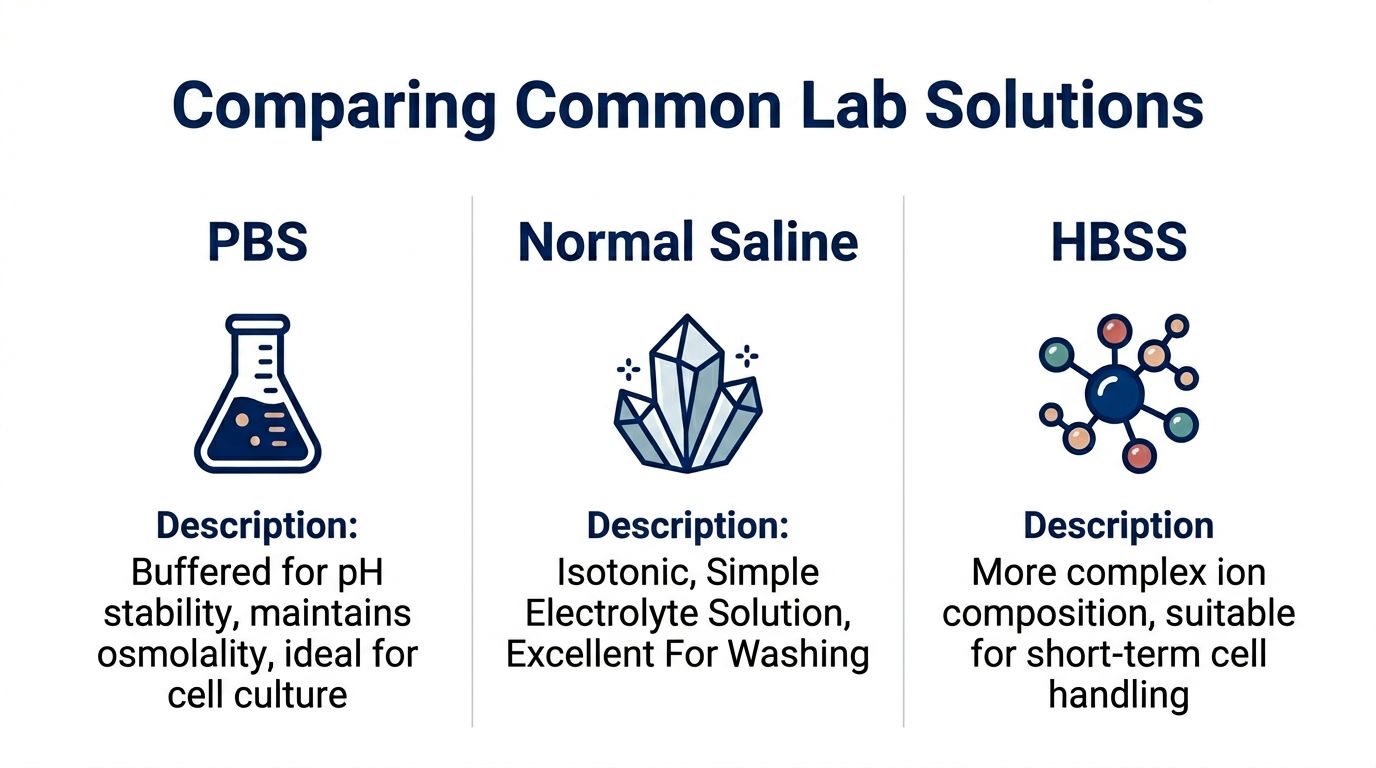
The practical differences
PBS
PBS is the default choice when you need a buffered isotonic solution for washing, dilution, and routine cell handling. Its advantage is pH stability combined with physiological salt balance. That makes it well suited for many mammalian cell culture workflows.
What PBS does not provide is metabolic support. It is a handling buffer, not a complete maintenance medium.
Normal saline
Normal saline is simpler. It is useful when you need an isotonic rinse or electrolyte solution and buffering is not central to the step.
Its limitation is exactly that simplicity. Without phosphate buffering, saline does not give the same pH control that PBS provides during manipulations where cells or reagents may shift the chemical environment.
HBSS
HBSS is the more complex handling solution in this comparison. It typically serves situations where cells need short-term support outside standard growth media and the protocol benefits from a broader ion composition.
That added complexity makes HBSS useful, but it also means it is not a casual substitute for PBS when your SOP was validated around phosphate buffering.
A simple selection framework
Use this decision logic:
- Choose PBS when pH stability during washing or dilution matters.
- Choose saline when you need a straightforward isotonic wash and buffering is not required.
- Choose HBSS when cells need more supportive short-term handling outside complete medium.
Operational warning: If a protocol was optimized in PBS, switching to saline or HBSS changes more than convenience. It changes chemistry.
The best labs standardize this choice in SOPs so technicians do not make substitutions on the fly.
Ensuring Quality from the Benchtop to Biomanufacturing
Buffer quality is not a finishing detail. It is part of process control.
That is the hidden risk in homemade PBS. The apparent simplicity masks multiple variability points: reagent purity, water quality, weighing accuracy, pH meter calibration, filtration discipline, container cleanliness, and storage history. If any one of those drifts, the final bottle may still look acceptable while the biology moves off target.
Why quality control belongs at the front of the process
In R&D, poor PBS can waste time and obscure root cause. In manufacturing and GMP-aligned environments, the same variability becomes a documentation and reproducibility problem.
Teams that treat PBS as a controlled input usually work with a short checklist:
- Defined formulation
- Verified pH
- Qualified water
- Controlled sterilization
- Lot traceability
- Storage discipline
Commercially prepared, quality-controlled PBS is often the practical answer when experiments are high value, samples are limited, or the workflow must stand up to audit and transfer. That choice is less about convenience than risk reduction.
The point is not that every lab must stop making buffers. The point is that no lab should pretend buffer quality is too basic to matter. It matters precisely because it sits underneath everything else.
If PBS preparation is consuming staff time or introducing uncertainty into your workflow, PurMa Biologics offers cell culture-focused PBS and related reagents with defined pH options, grade selection, and manufacturing support for research and bioproduction teams that need tighter control over reproducibility.