
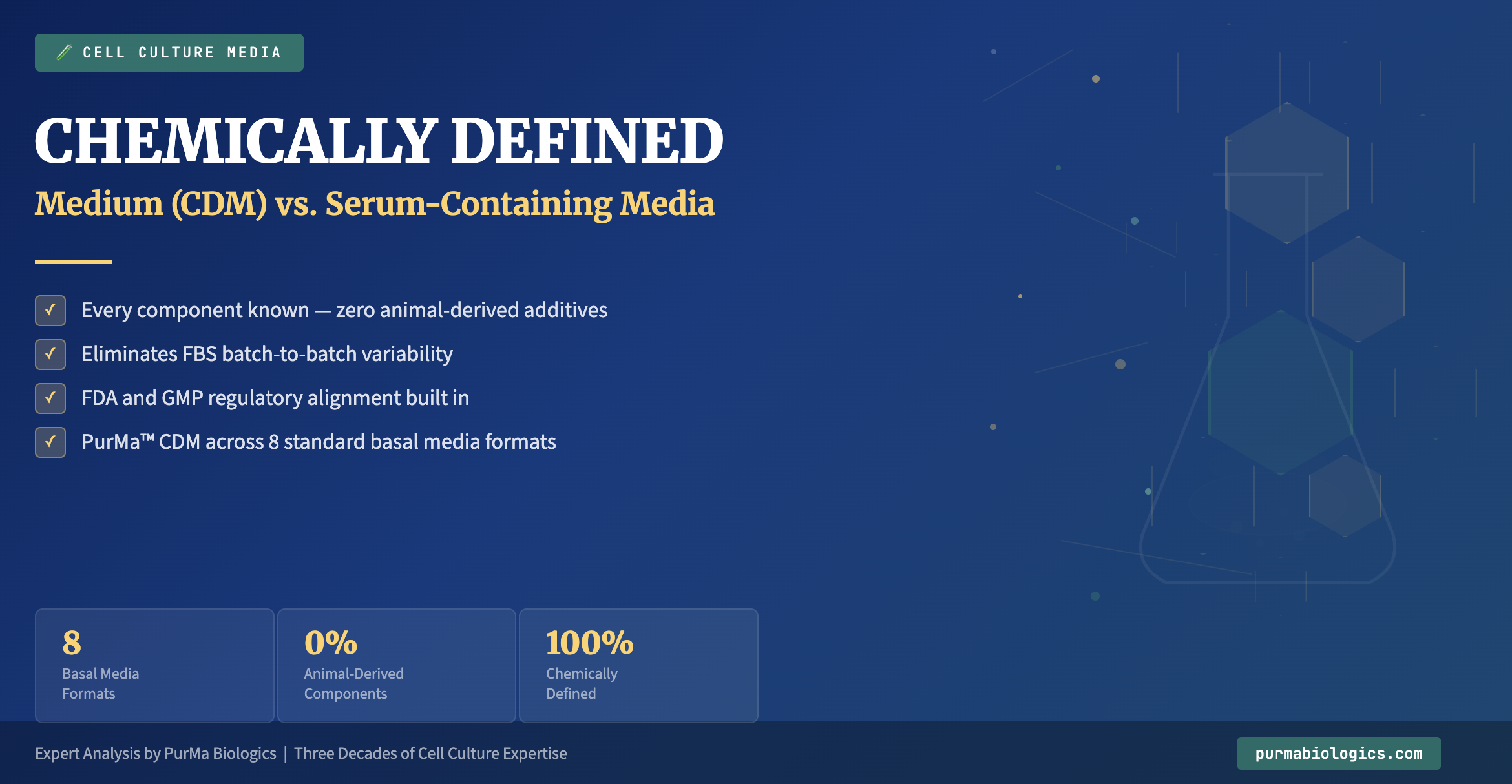
Chemically Defined Medium (CDM) and Its Advantages Over Conventional Serum-Containing Media
Every component known. Every concentration defined. No animal-derived additives. Chemically Defined Media eliminate the variability and regulatory burden of FBS — giving researchers full control over the cellular microenvironment.
🧪 Key Takeaways
Every component defined: CDMs contain only pure, characterized chemicals — amino acids, vitamins, salts, trace elements, and recombinant growth factors — with no animal-derived or undefined additives.
FBS variability eliminated: Batch-to-batch differences in fetal bovine serum alter growth rates, gene expression, and drug responses. CDMs remove this variable entirely.
Regulatory-ready: CDMs simplify FDA submissions, GMP compliance, and clinical trial workflows by eliminating concerns about adventitious agents and animal-derived components.
Scalable and robust: Defined formulations offer greater lot-to-lot consistency, easier process validation, and more predictable bioreactor performance for manufacturing.
PurMa™ CDM portfolio: PurMa Biologics produces CDM versions of DMEM, DMEM/F-12, IMDM, RPMI-1640, William’s E, Ham’s F-12K, MEM, and MEM-α — each with a tailored, animal-free PurMa™ Growth Supplement.
Customizable: PurMa™ CDM formulations can be adapted for specific cell types — stem cells, immune cells, hepatocytes — and unique metabolic or differentiation requirements.
Cell culture media are fundamental to modern biological research, biopharmaceutical development, and clinical applications. Traditionally, most in vitro cell culture has relied on basal media such as DMEM, DMEM/F-12, IMDM, RPMI-1640, William’s E, Ham’s F-12K, MEM, and MEM-α, supplemented with 10% fetal bovine serum (FBS). While effective in supporting cell growth, serum introduces significant variability and regulatory challenges. Chemically Defined Media (CDM) have emerged as a sophisticated alternative designed to address these limitations.
What Is a Chemically Defined Medium (CDM)?
A Chemically Defined Medium is a cell culture medium in which every component and its concentration is known. Critically, CDMs:
- Contain no animal-derived or undefined components (e.g., FBS, serum albumin, tissue extracts, or hydrolysates).
- Are formulated from pure, characterized chemicals, such as:
- Amino acids
- Vitamins
- Inorganic salts
- Trace elements
- Defined energy sources (e.g., glucose, alternative sugars)
- Synthetic or recombinant growth factors and hormones
This level of definition allows for precise control over the cellular microenvironment, enabling reproducibility and deeper mechanistic understanding of cellular behavior.
Limitations of Conventional Serum-Containing Media
Conventional media such as DMEM, DMEM/F-12, IMDM, and others typically require 10% FBS to support robust cell growth. While FBS is a rich source of growth factors, hormones, proteins, and micronutrients, it presents several key problems:
1. Batch-to-Batch Variability
Each lot of FBS can differ in its composition of growth factors, cytokines, lipids, and other bioactive molecules. Even with lot testing and qualifications, subtle differences can:
- Alter cell growth rates
- Shift gene expression patterns
- Affect differentiation status
- Change responses to drugs or stimuli
This variability can compromise reproducibility across experiments, laboratories, and time.
2. Undefined Composition
Serum is a complex, only partially characterized mixture. The presence of unknown or poorly quantified components:
- Introduces confounding variables into experimental design
- Makes it difficult to attribute observed effects to specific molecules
- Limits mechanistic interpretation of data
3. Regulatory and Safety Concerns
For clinical, GMP, and regulatory-sensitive applications, serum poses potential risks and complications:
- Risk of adventitious agents (e.g., viruses, prions, mycoplasma)
- Ethical concerns related to animal-derived products
- Regulatory pressure to minimize or eliminate animal components in cell therapies, biologics production, and clinical trial materials
4. Standardization Challenges in Biomanufacturing
Industrial and clinical-scale cell culture processes must be robust and tightly controlled. FBS-dependent systems:
- Are harder to validate
- Complicate process transfer between facilities
- Increase the burden of quality control and supply chain management
Advantages of Chemically Defined Media
CDMs are increasingly adopted to overcome the limitations of serum-containing media, offering several important advantages:
1. High Reproducibility and Experimental Control
Because every component is known and consistent:
- Experimental conditions can be accurately reproduced
- Inter-lot variability is significantly reduced
- Subtle differences in cell behavior are less likely to be masked by serum variability
- Data become more directly comparable across experiments and laboratories
2. Improved Interpretation of Cellular Responses
Defined composition allows researchers to:
- Attribute observed cellular effects to specific medium components
- Systematically modify and optimize formulations for particular cell types or processes
- Dissect signaling pathways and metabolic requirements without interference from undefined serum factors
3. Regulatory Alignment and Clinical Suitability
For applications involving:
- Cell and gene therapies
- Biopharmaceutical production
- Clinical trial materials
- FDA and other regulatory submissions
the absence of animal-derived serum is a major benefit. CDMs:
- Simplify regulatory documentation and risk assessments
- Reduce concerns about transmission of animal-borne pathogens
- Align with evolving guidelines encouraging animal-free components in clinical and GMP workflows
4. Scalability and Process Robustness
In bioprocessing and large-scale manufacturing, CDMs offer:
- Greater lot-to-lot consistency
- Easier process validation and tech transfer
- More predictable performance in bioreactors and automated culture systems
5. Ethical and Sustainability Considerations
Eliminating FBS:
- Supports the move toward animal-free research and production
- Addresses ethical concerns associated with serum collection
- Contributes to more sustainable and humane biotechnology practices
Composition of CDM vs. Conventional Media
Traditional basal media provide essential nutrients but rely on serum to supply the majority of growth factors and attachment-promoting components. In a typical CDM:
Basal Medium Components
Similar to conventional media, including:
- Amino acids (essential and non-essential)
- Vitamins
- Inorganic salts (e.g., sodium, potassium, calcium, magnesium, phosphate)
- Buffering agents (e.g., bicarbonate, HEPES)
- Carbohydrates (primarily glucose)
Synthetic or Recombinant Growth Supplements
These replace FBS and are specifically formulated for defined performance:
- Growth factors (e.g., EGF, FGF variants, insulin-like components)
- Hormones and hormone mimetics
- Lipids and carrier molecules
- Attachment and survival factors (where needed)
This design provides all the functional benefits of serum—support for proliferation, survival, and phenotype maintenance—without the compositional uncertainty.
PurMa Biologics: CDM Versions of Conventional Media
PurMa Biologics has developed Chemically Defined Medium (CDM) formulations corresponding to widely used conventional basal media formats. According to the company’s positioning, PurMa produces CDM versions of:
- DMEM
- DMEM/F-12
- IMDM
- RPMI-1640
- William’s E Medium
- Ham’s F-12K
- MEM
- MEM-α
Each of these CDMs is supplemented not with FBS, but with a proprietary, animal-free PurMa™ Growth Supplement that functionally replaces serum while maintaining a fully defined formulation.
Importantly:
Medium-Specific Growth Supplements
The PurMa™ Growth Supplement is tailored for each basal medium. While the core CDM principles are consistent, the supplement composition is adjusted to:
- Match the nutrient profile and buffering characteristics of each base medium
- Support the typical cell types and applications associated with that medium
- Optimize cell growth, viability, and phenotype stability
This modular approach allows users to transition from their familiar basal media to a fully defined, serum-free format with minimal disruption to existing protocols.
Applications of PurMa™ CDM
PurMa™ CDM is designed to support both commercial cell lines and primary cells. Key application areas include:
Basic and Translational Research
- Studies requiring stringent reproducibility
- Mechanistic investigations of signaling, metabolism, and differentiation
- High-content screening and functional genomics, where variability must be minimized
Preclinical and Clinical Development
- Workflows that must exclude animal-derived components to align with FDA and other regulatory expectations
- Process development for cell therapies, biologics, and advanced medicinal products
- Clinical trial material production where defined, serum-free conditions are essential
Biomanufacturing and GMP
- Large-scale expansion of cell lines or primary cells under controlled, defined conditions
- Seamless integration into validated, scalable processes with reduced risk and variability
Customization for Specific Cell Types
While CDM versions of standard media address a broad range of needs, certain cell types require highly specialized environments. PurMa™ CDM is described as being adaptable for:
Custom Formulations
Tailored to:
- Specific cell lines or primary cells (e.g., stem cells, immune cells, hepatocytes)
- Distinct differentiation routes or activation states
- Unique metabolic or environmental requirements
By adjusting defined components—such as particular growth factors, cytokines, or nutrient concentrations—media can be optimized for performance while retaining chemical definition and regulatory compatibility.
Conclusion
Chemically Defined Media represent a critical evolution beyond traditional serum-containing culture systems. By eliminating animal-derived, undefined components such as FBS, CDMs:
- Enhance experimental reproducibility
- Enable precise mechanistic studies
- Simplify regulatory compliance
- Support ethically and scientifically robust cell culture practices
PurMa™ CDM extends these advantages across a broad portfolio of conventional basal media formats, combining known quantities of pure chemicals with proprietary, synthetic growth supplements. This provides researchers and developers with consistent, controlled environments suitable for basic research, preclinical development, FDA-regulated workflows, and clinical trial applications—while also enabling customized, cell type–specific formulations when required.
Frequently Asked Questions
A Chemically Defined Medium is a cell culture medium in which every component and its exact concentration is known. CDMs contain no animal-derived or undefined components such as FBS, serum albumin, tissue extracts, or hydrolysates. Instead, they are formulated entirely from pure, characterized chemicals — including amino acids, vitamins, inorganic salts, trace elements, defined energy sources, and synthetic or recombinant growth factors and hormones.
FBS introduces significant batch-to-batch variability in growth factors, cytokines, and lipids that can alter cell growth rates, shift gene expression patterns, affect differentiation status, and change responses to drugs or stimuli. CDMs eliminate this variability entirely, providing consistent, reproducible conditions. Additionally, CDMs remove regulatory concerns about adventitious agents (viruses, prions, mycoplasma) and align with FDA and GMP requirements for animal-free components in clinical applications.
Yes. PurMa Biologics has developed CDM formulations corresponding to all widely used conventional basal media formats — including DMEM, DMEM/F-12, IMDM, RPMI-1640, William’s E, Ham’s F-12K, MEM, and MEM-α. Each is supplemented with a proprietary, animal-free PurMa™ Growth Supplement tailored to that specific base medium, allowing you to transition from serum-containing to fully defined media with minimal disruption to existing protocols.
Absolutely. CDMs are specifically designed for regulatory-sensitive workflows. By eliminating animal-derived serum, they simplify regulatory documentation and risk assessments, reduce concerns about transmission of animal-borne pathogens, and align with evolving guidelines encouraging animal-free components in cell therapies, biologics production, and clinical trial material manufacturing.
PurMa™ CDM is designed to support both commercial cell lines and primary cells. For cell types requiring highly specialized environments — such as stem cells, immune cells, or hepatocytes — PurMa offers custom CDM formulations tailored to specific differentiation routes, activation states, or unique metabolic requirements while retaining full chemical definition.
The PurMa™ Growth Supplement is a proprietary, animal-free formulation that functionally replaces fetal bovine serum. It is tailored for each specific basal medium format to match its nutrient profile and buffering characteristics, support the typical cell types associated with that medium, and optimize cell growth, viability, and phenotype stability — all while maintaining a fully defined, serum-free composition.
Because every component in a CDM is known and consistent, experimental conditions can be accurately reproduced across experiments, laboratories, and time. Inter-lot variability is significantly reduced, subtle differences in cell behavior are no longer masked by serum variability, and data become more directly comparable. This allows researchers to attribute observed cellular effects to specific medium components rather than unknown serum factors.
References
-
Gstraunthaler G, et al. A plea to reduce or replace fetal bovine serum in cell culture media. PMCID: PMC3967615. PMID: 23975256.
https://pmc.ncbi.nlm.nih.gov/articles/PMC3967615/ - van der Valk J, et al. Optimization of chemically defined cell culture media — replacing fetal bovine serum in mammalian in vitro methods. The Faculty of Health Sciences, Neurobiology Research Unit.
- Brunner D, Frank J, Appl H, Schöffl H, Pfaller W, Gstraunthaler G. Serum-free cell culture: the serum-free media interactive online database. ALTEX. 2010;27(1):53-62. doi: 10.14573/altex.2010.1.53. PMID: 20390239.
- Tharakan JP, Lucas A, Chau PC. Hybridoma growth and antibody secretion in serum-supplemented and low protein serum-free media. J Immunol Methods. 1986 Nov 20;94(1-2):225-35. doi: 10.1016/0022-1759(86)90237-1. PMID: 3782812.
- van der Valk J, Mellor D, Brands R, Fischer R, Gruber F, Gstraunthaler G, Hellebrekers L, Hyllner J, Jonker FH, Prieto P, Thalen M, Baumans V. The humane collection of fetal bovine serum and possibilities for serum-free cell and tissue culture. Toxicol In Vitro. 2004 Feb;18(1):1-12. doi: 10.1016/j.tiv.2003.08.009. PMID: 146300.
- Jacquemart R, Vandersluis M, Zhao M, Sukhija K, Sidhu N, Stout J. A Single-use Strategy to Enable Manufacturing of Affordable Biologics. Comput Struct Biotechnol J. 2016 Jul 5;14:309-18. doi: 10.1016/j.csbj.2016.06.007. PMID: 27570613.
- Robertson JS. Bovine serum — regulatory issues. Dev Biol (Basel). 2006;123:269-72; discussion 291-308. PMID: 16566452.
- Lipsitz YY, Timmins NE, Zandstra PW. Quality cell therapy manufacturing by design. Nat Biotechnol. 2016 Apr;34(4):393-400. doi: 10.1038/nbt.3525. PMID: 27054995.