
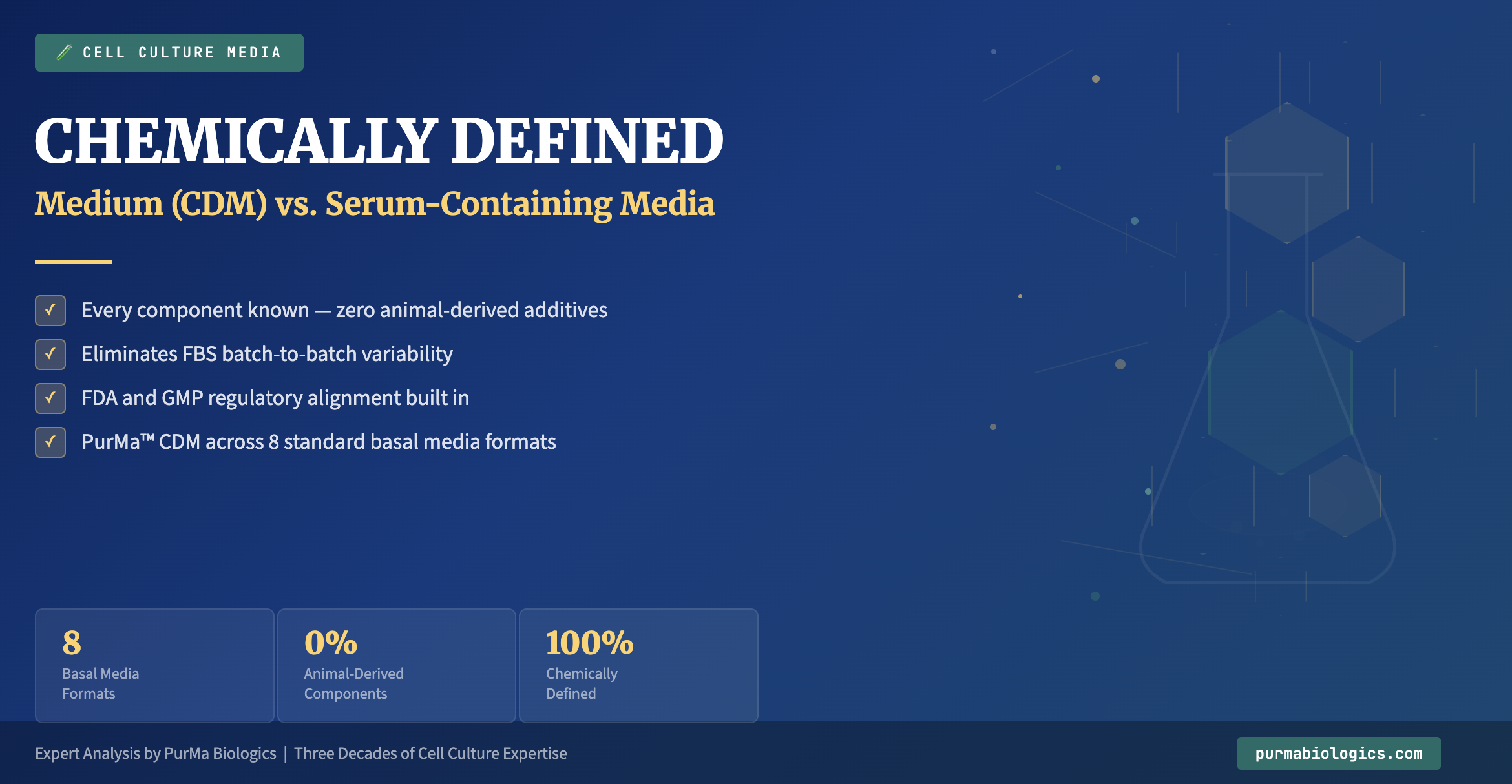
What “Chemically Defined” Actually Means — and Why the Distinction Matters
Every reagent in a Chemically Defined Medium (CDM) has a name, a concentration, and a certificate of analysis behind it. No serum. No pooled animal-derived extract of unknown composition. No lot-to-lot guessing game. A CDM replaces fetal bovine serum (FBS) with a fully characterized set of amino acids, vitamins, inorganic salts, trace elements, and synthetic or recombinant growth factors — every one of them known, quantified, and reproducible.
That single distinction, defined versus undefined, is the difference between a medium you can fully explain and one you can only partially trust. Researchers have publicly called for reducing or eliminating FBS from cell culture altogether, and the reasoning isn’t cosmetic: serum’s undefined composition is a measurable source of variability in the same way an unlabeled reagent bottle would be. You cannot control what you cannot define.
The Real Cost of Serum: What FBS Is Actually Doing to Your Data
Most labs don’t question FBS because it “works.” Cells attach, proliferate, and pass through routine QC. But underneath that surface-level performance, standard serum introduces four distinct problems into every experiment that uses it.
Batch-to-Batch Variability
Each lot of FBS differs in its exact mix of growth factors, cytokines, lipids, and hormones, even when it passes the same specification sheet. That variability is enough to alter cell growth rates, shift gene expression patterns, change differentiation status, and skew how cells respond to drugs or stimuli. Two labs running the “same” protocol with different serum lots are not, biologically speaking, running the same experiment.
Undefined Composition
Serum is a complex biological mixture that has never been fully characterized. Every unidentified component is a confounding variable you can’t account for, and a signal you can’t attribute to a specific cause. If you can’t name what’s in your medium, you can’t fully explain what’s driving your results.
Regulatory and Safety Exposure
FBS carries a documented risk of adventitious agents — viruses, prions, and yes, mycoplasma — because it is an animal-derived biological product. For clinical, GMP, and regulatory-sensitive work, that risk isn’t theoretical. It’s a line item regulators ask about, and one CDM removes from the conversation entirely by eliminating the animal-derived component altogether.
Standardization Challenges at Scale
What’s a manageable inconsistency in a 6-well plate becomes a validation headache in a bioreactor. FBS-dependent processes are harder to validate, harder to transfer between facilities, and heavier on quality control and supply chain management, precisely because the input material itself isn’t standardized.
What Replaces FBS: Inside a Defined Formulation
A CDM doesn’t simply remove serum, it replaces its function with components that are individually understood. The basal layer looks familiar: amino acids, vitamins, inorganic salts, buffering agents, and carbohydrates, largely the same backbone as conventional media. What’s different is the supplement layer that used to be FBS’s job: synthetic or recombinant growth factors, hormones and hormone mimetics, lipids and carrier molecules, and attachment or survival factors where the cell type requires them.
PurMa Biologics builds this supplement layer as a proprietary, animal-free PurMa™ Growth Supplement, formulated specifically for each basal medium format rather than as a one-size-fits-all additive.
PurMa™ Chemically Defined DMEM (CD-DMEM)
A fully chemically defined, serum-free, animal-component-free version of the most widely used basal medium in cell culture. Built for demanding research and bioprocessing applications, with a transparent, fully disclosed formulation designed to eliminate the lot-to-lot variability FBS introduces.
View CD-DMEM →PurMa™ Chemically Defined RPMI-1640 (CD-RPMI-1640)
A 100% synthetic, FBS-free RPMI-1640 formulation that replaces unstable L-glutamine with L-alanyl-L-glutamine for a longer shelf life and better buffering capacity. A proprietary mix of synthetic growth factors delivers the lot-to-lot consistency that regulatory-sensitive workflows require.
View CD-RPMI-1640 →PurMa™ Chemically Defined DMEM/F-12
A serum-free DMEM/F-12 medium with L-alanyl-L-glutamine and a proprietary synthetic growth factor mix, giving you a fully controlled, animal-component-free environment and a smooth, stepwise transition away from serum-containing media.
View CD-DMEM/F-12 →PurMa™ CDM formulations also exist for IMDM, William’s E, Ham’s F-12K, MEM, and MEM-α, each with a supplement tailored to that base medium’s nutrient profile and the cell types it typically supports.
Five Reasons Labs Are Making the Switch
1. Reproducibility You Can Actually Defend
Because every component is known and consistent, experimental conditions reproduce accurately across experiments, across labs, and across time. Inter-lot variability drops sharply, and subtle biological effects that would otherwise be masked by serum noise become visible and attributable.
2. Cleaner Interpretation of Every Result
When a cell line behaves differently, you can trace that behavior back to a specific, known component instead of shrugging at “serum lot differences.” That lets you systematically optimize formulations and dissect signaling or metabolic pathways without an undefined variable sitting in the background of every experiment.
3. A Regulatory Conversation That’s Already Won
For cell and gene therapies, biopharmaceutical production, and FDA submissions, the absence of animal-derived serum removes an entire category of risk assessment and documentation. CDM formulations align directly with the regulatory direction the field has been moving toward for years.
4. Built for Scale, Not Just the Bench
Lot-to-lot consistency isn’t a nice-to-have in bioprocessing, it’s the difference between a process that validates cleanly and one that requires re-qualification every time a serum lot changes. CDMs make process transfer between facilities and scale-up into bioreactors dramatically more predictable.
5. Fewer Ethical Tradeoffs
Eliminating FBS also eliminates the ethical questions tied to its collection. For labs and companies actively moving toward animal-free research and production, CDM is the practical mechanism for making that commitment real, not just stated.
Which defined medium do you need?
Made in the USA and manufactured in house. Certificate of Analysis with every lot. Bulk pricing, purchase orders and custom formulations welcome.
Choosing and Customizing the Right CDM
Standard cell lines generally transition cleanly into the CDM version of whatever basal medium they already run in, since the switch is designed to minimize protocol disruption. But some cell types — stem cells, immune cells, hepatocytes, and others with specialized metabolic or differentiation requirements — need a formulation built around them specifically. PurMa™ CDM supports custom formulations that adjust individual defined components — specific growth factors, cytokines, or nutrient concentrations — while keeping the medium fully defined and regulatory-compatible.
“A chemically defined medium isn’t a more expensive version of serum-containing media. It’s a different category of tool — one where every variable is a variable you chose, not one you inherited from a bottle of pooled bovine blood.”
As cell and gene therapy, biologics manufacturing, and regulatory-sensitive research continue to expand, the labs best positioned to move quickly are the ones that already know exactly what’s in their media, and can prove it.