
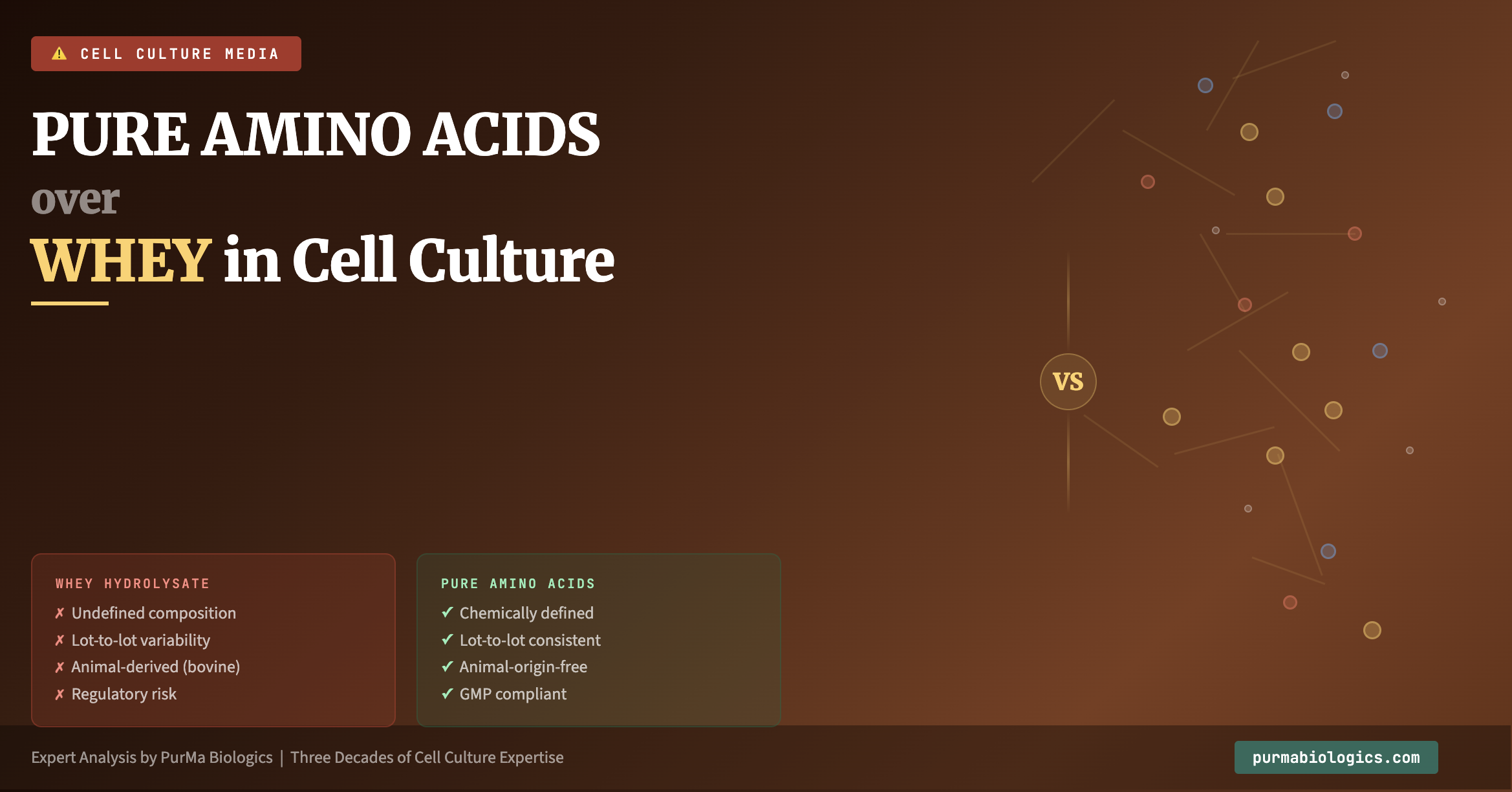
The Necessity of NOT Using Whey Instead of Pure Amino Acids in Cell Culture Media
Many biotech companies quietly substitute whey powder for pure amino acids in their cell culture media to cut costs. The result is undefined variability, compromised reproducibility, and regulatory risk that most labs never see coming.
⚠️ Key Takeaways
Hidden industry practice: Several well-known biotech companies outsource media production overseas, where manufacturers substitute whey powder for pure amino acids, vitamins, and other components — then sell at low prices.
Whey is undefined and variable: Whey hydrolysate is a complex animal-derived mixture whose exact composition changes with every lot — introducing confounding variables that compromise experimental reproducibility.
Pure amino acids are immediately bioavailable: Free amino acids are directly available for cellular uptake and protein synthesis, unlike whey peptides that require proteolysis before cells can use them.
Regulatory and safety risk: Whey is bovine/milk-origin, raising concerns about adventitious agents and prion risk. Regulatory authorities increasingly favor or require animal-origin-free, chemically defined components for GMP manufacturing.
Cleaner downstream processing: Pure amino acids minimize extraneous proteinaceous material, simplifying chromatography and reducing variability in critical quality attributes.
Higher cost, decisive payoff: Pure amino acids cost more than bulk whey, but the gains in reproducibility, process robustness, regulatory compliance, and downstream simplification are often decisive.
In this article we deeply discuss the necessity of NOT using whey instead of pure amino acids in cell culture media. Unfortunately, several well-known biotech companies outsource the production of conventional cell culture media to overseas companies. As a result, they receive these media as powders. Most of these manufacturers use whey powder instead of pure amino acids. That includes similarly substituting whey for vitamins and other components that normally cannot exist in a dry, stable form. The latter prevents absorbing humidity from the air and forming clumps. This is the main reason they can sell these media at very low prices. Unfortunately, many laboratories across the United States and around the world purchase such media because of their affordability.
This article outlines the scientific and practical advantages of using pure amino acids instead of whey-derived supplements. Moreover, it provides practical guidance for formulation and implementation.
Importance of Using Defined Nitrogen Sources
One of the main goals for scientists working with mammalian, insect, or microbial cell culture is reproducibility and product quality. Undoubtedly, it is fundamental for experimental and regulatory compliance to use an identical, well-defined source of nitrogen and peptides.
Historically, complex supplements such as whey protein hydrolysates (and other undefined hydrolysates or peptones) have been used to boost growth and productivity because they are rich in peptides, amino acids, vitamins, and minerals. However, there has been a sustained shift toward pure amino acids for the reasons described below.
Composition and Biochemical Consequences of Whey vs Pure Amino Acids
Whey (or whey hydrolysate) is a complex, animal-derived mixture containing intact proteins, peptides of varied sizes, lipids, lactose, minerals, and trace bioactive molecules. Its exact composition depends on the source material and processing conditions, leading to substantial lot-to-lot variability.
In contrast, pure amino acid supplements are chemically defined. Each amino acid (or stable derivative/dipeptide) is supplied at a known concentration and purity, and will be consistent from lot to lot.
This distinction has direct biochemical consequences. Free amino acids are immediately available for uptake and incorporation into protein synthesis or metabolic pathways, whereas peptides may require extracellular or endocytic proteolysis before cells can utilize the constituent amino acids. Moreover, non-amino-acid constituents of whey (lipids, hormones, growth factors, proteases, endotoxin spikes) can modulate signaling, metabolism, or product quality in unpredictable ways.
Key Advantages of Pure Amino Acids
1. Reproducibility and Experimental Control
Defined amino acid feeds permit precise, repeatable formulations. For scientists publishing mechanistic studies, removing the undefined variables introduced by whey improves the interpretability of results. Metabolic fluxes, gene expression responses, and product quality attributes are not confounded by unknown bioactive peptides or fluctuating micronutrient content.
2. Optimized Metabolic Control
Using pure amino acids enables rational tuning of metabolic inputs (e.g., branched-chain and aromatic amino acids) to steer anabolic and catabolic pathways, reduce by-product formation (lactate, ammonia), and control post-translational modifications (glycosylation, phosphorylation). It also supports informed use of metabolic engineering and flux analysis to maximize yields while minimizing undesirable catabolism.
3. Product Quality and Downstream Processing
Undefined protein/peptide contaminants from whey can increase host-cell protein background, bind to the product, or introduce proteolytic activity that degrades the molecule of interest. Pure amino acids in the medium minimize extraneous proteinaceous material entering downstream purification, simplifying chromatography and reducing variability in critical quality attributes.
4. Regulatory and Safety Advantages
Whey is an animal-derived material (bovine/milk origin) and therefore raises concerns about adventitious agents, prion risk (even if remote), and regulatory complexity in therapeutic production. Many regulatory authorities favor, or require, animal-origin-free and chemically defined components for biological manufacturing. Pure amino acids facilitate GMP implementation, supply-chain traceability, and more straightforward compliance.
5. Compatibility with High-Throughput and Omics Workflows
For proteomics, metabolomics, and systems biology experiments, defined amino acid media reduce background signals and allow clearer attribution of observed changes to experimental variables rather than to complex media artifacts.
Practical Considerations and Caveats
While the advantages are substantial, moving to pure amino acids requires attention to several practical issues:
Imbalance and Excessive Amino Acid Levels
Using free amino acids requires expertise and careful optimization of concentrations. Incorrectly balanced or excessively high amino acid levels can impair cell growth and product quality.
Ammonia Generation
Increased availability of free amino acids can elevate deamination reactions and ammonia accumulation, which can impair growth and product quality. Control strategies include fed-batch feeding schedules, selection of amino acids less prone to rapid catabolism, and metabolic engineering of cell lines.
Stability and Solubility
Some amino acids are chemically or physically problematic.
- L-glutamine degrades spontaneously to ammonia at neutral pH and room temperature; many groups therefore substitute stabilized dipeptides (e.g., alanyl-glutamine) or add glutamine in feeds immediately before use.
- Cysteine oxidizes readily — cystine or protected derivatives are commonly used.
- Tyrosine has limited aqueous solubility and may require pH adjustment or separate solubilization steps.
- Tryptophan is light-sensitive.
Formulators must design stock solutions and storage conditions accordingly (cold, dark, pH-controlled).
Osmolality and Ionic Balance
High concentrations of free amino acids increase medium osmolality. Formulations must balance osmolarity and ionic strength to remain within the physiological tolerance of the cell line.
Cost and Supply
Pure, pharmaceutical-grade amino acids are typically more expensive than bulk whey hydrolysates. However, this premium must be weighed against gains in reproducibility, product yield/quality, and downstream savings in purification and reduced regulatory risk.
Biological Responses to Peptides
In some cases, short peptides present in hydrolysates can promote growth or beneficially modulate signaling pathways (e.g., for hard-to-adapt cell lines). Transitioning away from whey may require an adaptation period or the replacement of specific growth-promoting factors with defined substitutes.
Conclusion
Pure amino acids offer clear scientific and practical benefits relative to whey-derived supplements for modern cell culture. They enable chemically defined media, reduce variability and contaminants, facilitate regulatory compliance, and permit precise control of cellular metabolism and product quality.
Transitioning to pure amino acids requires attention to stability, solubility, osmolarity, and feeding strategies, and may entail higher raw-material costs. However, the payoff — in reproducibility, process robustness, and downstream simplification — is often decisive for academic studies, bioprocess development, and GMP manufacturing.
For projects where experimental clarity, product quality, or regulatory predictability matter, formulating with defined amino acids (and stabilized derivatives) is the recommended path forward.
Frequently Asked Questions
Several well-known biotech companies outsource media production to overseas manufacturers who substitute whey powder for pure amino acids. Whey powder is cheaper, easier to handle in dry form, and prevents humidity absorption and clumping. This allows them to sell media at very low prices. However, the trade-off is significant lot-to-lot variability, undefined composition, and potential regulatory concerns that most purchasing labs are unaware of.
Whey (or whey hydrolysate) is a complex, animal-derived mixture containing intact proteins, peptides of varied sizes, lipids, lactose, minerals, and trace bioactive molecules — with composition that varies between lots. Pure amino acid supplements are chemically defined, with each amino acid supplied at a known concentration and purity, consistent from lot to lot. Free amino acids are immediately available for cellular uptake, while whey peptides require proteolysis before cells can utilize the constituent amino acids.
Whey introduces undefined variables — unknown bioactive peptides, fluctuating micronutrient content, lipids, hormones, and growth factors — that can confound metabolic fluxes, gene expression responses, and product quality attributes. These variables make it difficult to attribute observed effects to specific experimental conditions, compromising the interpretability and reproducibility of results across experiments, laboratories, and time.
Yes. Whey is an animal-derived material (bovine/milk origin) that raises concerns about adventitious agents, prion risk (even if remote), and regulatory complexity in therapeutic production. Many regulatory authorities favor or require animal-origin-free and chemically defined components for biological manufacturing. Pure amino acids facilitate GMP implementation, supply-chain traceability, and more straightforward regulatory compliance.
Several practical issues require attention: (1) amino acid concentrations must be carefully balanced — excessive levels impair cell growth; (2) free amino acids can increase ammonia generation through deamination; (3) some amino acids have stability or solubility issues — L-glutamine degrades to ammonia, cysteine oxidizes readily, tyrosine has limited solubility, and tryptophan is light-sensitive; (4) high concentrations increase medium osmolality; and (5) pure pharmaceutical-grade amino acids cost more than bulk whey hydrolysates.
Yes, whey-based media is typically less expensive because whey powder is a bulk commodity that is cheap to source and easy to handle in dry powdered form. However, this cost advantage must be weighed against the downstream consequences: reduced reproducibility, potential product quality issues, increased purification complexity, and regulatory risk. For projects where experimental clarity, product quality, or regulatory predictability matter, the higher cost of pure amino acids is justified by the payoff in process robustness and simplification.
Absolutely. Defined amino acid media are particularly advantageous for proteomics, metabolomics, and systems biology experiments because they reduce background signals from undefined media components. This allows clearer attribution of observed changes to experimental variables rather than to complex media artifacts, improving the quality and interpretability of omics data.
References
- Forte T, Grinnell C, Zhang A, Polilli B, Leshinski J, Khattak S. Methods for identifying precipitates and improving stability of chemically defined highly concentrated cell culture media. Biotechnol Prog. 2023 Jul-Aug;39(4):e3345. doi: 10.1002/btpr.3345. PMID: 37062873.
- Jayme DW, Smith SR. Media formulation options and manufacturing process controls to safeguard against introduction of animal origin contaminants in animal cell culture. Cytotechnology. 2000 Jul;33(1-3):27-36. doi: 10.1023/A:1008133717035. PMID: 19002808.