
Dulbecco’s Phosphate Buffered Saline (DPBS) shows up constantly in stem cell and tissue engineering protocols, but its usefulness in both fields comes down to one specific design choice: what it deliberately leaves out.
DPBS’s lack of calcium and magnesium is the whole point: it prevents these ions from interfering with cell dissociation, adhesion, and signaling during stem cell and tissue engineering work.
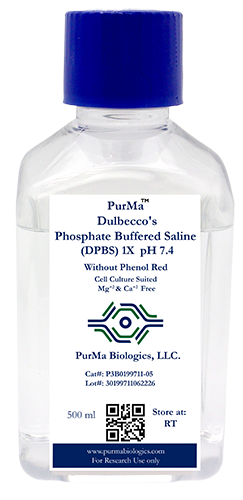
What Makes DPBS Different From Standard PBS
DPBS is formulated without calcium or magnesium, unlike some standard PBS formulations that include them. That absence isn’t an oversight, it’s the entire point. Calcium and magnesium are cofactors for cell adhesion molecules and a range of enzymatic activity, including the endogenous proteases involved in cell-cell and cell-matrix attachment. A buffer that still contains these ions can interfere with the very processes researchers are trying to control during dissociation, washing, and passaging steps.
DPBS in Stem Cell Handling
Stem cells are unusually sensitive to their immediate physical and chemical environment during routine handling. Using a calcium- and magnesium-free wash buffer like DPBS before trypsinization or other dissociation steps helps ensure that cell-cell adhesion is disrupted cleanly and predictably, rather than partially, since residual calcium can keep some adhesion complexes engaged and produce inconsistent, clumpy dissociation. That consistency matters directly for passaging efficiency, single-cell cloning, and any downstream assay that depends on a uniform single-cell suspension.
DPBS in Tissue Engineering
Tissue engineering constructs, whether that’s a scaffold seeded with cells or an assembled multi-cell tissue model, need a rinse and handling buffer that won’t introduce unintended signaling during manipulation. Because DPBS doesn’t carry the divalent cations that can trigger premature adhesion or differentiation-related signaling in sensitive cell populations, it’s a common choice for washing steps between seeding, media changes, and construct handling, anywhere researchers want an isotonic, pH-stable rinse that stays chemically neutral with respect to calcium-dependent signaling pathways.
The Practical Takeaway
The pattern across both applications is the same: DPBS is the right choice whenever calcium or magnesium ions themselves would interfere with the biology you’re trying to control, dissociation, adhesion, or signaling. For general washing steps where divalent cations aren’t a concern, a standard PBS formulation with calcium and magnesium is equally appropriate and sometimes preferred, since some downstream applications actually benefit from their presence.
PurMa Biologics manufactures Dulbecco’s Phosphate Buffered Saline (DPBS). See our product page for full specifications, or our Cell Culture Buffers guide for how DPBS compares to our other buffer formulations.