
Cell culture buffers keep cells healthy outside the incubator and during routine handling. They maintain a stable pH, hold the right osmotic balance, and supply the inorganic ions cells need — during washing, dissociation, transport, and short-term storage. But “buffer” covers several different solutions, each built for a different job. This guide breaks down the main types of cell culture buffer and how to choose the right one for your work.
PBS is the everyday default buffer for most washing and dilution steps. Reach for HBSS or EBSS specifically when your protocol needs bicarbonate buffering matched to a CO2 incubator, or Ca/Mg-free conditions for dissociation.
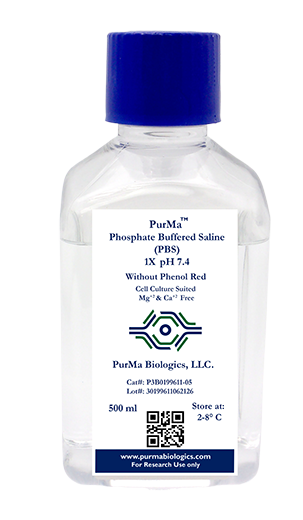
From PurMa Biologics
The full buffer range
PurMa manufactures HEPES 1M pH 8.0, TRIS 1M pH 8.0, EDTA 0.5M pH 8.0 and MES 0.5M pH 6.0, alongside Hanks’ and Earle’s balanced salt solutions at 1X pH 7.4.
All buffers and salt solutionsHEPES Buffer 1M
Made in the USA and manufactured in house. Certificate of Analysis with every lot. Bulk pricing, purchase orders and custom formulations welcome.
What Do Buffers Do in Cell Culture?
Cells are sensitive to their environment, and a good buffer protects them by:
- Maintaining pH — resisting the pH swings that stress or kill cells
- Holding osmotic balance — staying isotonic so cells don’t swell or shrink
- Supplying essential ions — sodium, potassium, calcium, magnesium, and phosphate
- Providing energy — some balanced salt solutions include glucose
Because these jobs differ, no single buffer is right for everything.
Balanced Salt Solutions (BSS)
These contain inorganic salts (and often glucose) to maintain pH and osmotic balance while supplying ions.
HBSS (Hanks’ Balanced Salt Solution) has low bicarbonate, so it holds a stable pH in normal room air — making it ideal for bench work: washing cells, prepping for dissociation, and short-term transport. Explore HBSS.
EBSS (Earle’s Balanced Salt Solution) has high bicarbonate and is built for a 5% CO2 incubator, and it’s often used as a base for CO2-buffered media. Explore EBSS.
PBS (Phosphate Buffered Saline) is a simple, phosphate-buffered isotonic solution for washing cells and preparing dilutions — typically calcium- and magnesium-free. Explore PBS.
DPBS (Dulbecco’s Phosphate Buffered Saline) is a PBS variant available with or without calcium and magnesium, used for cell washing and gentle handling. Explore DPBS.
pH Buffers
When you need tighter pH control — especially outside a CO2 incubator — zwitterionic buffers help.
HEPES maintains a stable physiological pH (7.2–7.4) and is widely added to media for CO2-independent work and open-air procedures. Explore HEPES.
MES buffers in a lower pH range (about 5.5–6.7), for applications that need a stable, slightly acidic pH. Explore MES.
How to Choose the Right Cell Culture Buffer
| Your task | Best buffer |
|---|---|
| Washing cells / bench work | HBSS or PBS |
| Prepping for dissociation (Ca/Mg-free) | PBS or DPBS |
| Working inside a 5% CO2 incubator | EBSS |
| Keeping pH stable outside the incubator | HEPES |
| A stable, slightly acidic pH | MES |
| A media base with balanced salts | EBSS or HBSS |
Beyond type, also consider with vs. without calcium & magnesium (Ca/Mg-free for dissociation), phenol red vs. phenol-red-free, endotoxin level, and grade.
Frequently Asked Questions
What is the difference between HBSS and PBS?
Both are used for washing and short-term cell handling, but HBSS is a balanced salt solution with a fuller set of inorganic salts plus glucose, while PBS is a simpler phosphate-buffered saline. Use HBSS when you want salts and an energy source; use PBS for a straightforward wash or dilution buffer.
What does HEPES do in cell culture?
HEPES is a zwitterionic buffer that holds a stable physiological pH, especially useful when cells are outside a CO2 incubator or during procedures done in open air.
Why choose a calcium- and magnesium-free buffer?
Calcium and magnesium promote cell adhesion. Removing them helps cells detach more easily, which is why Ca/Mg-free buffers are used to wash cells before trypsinization or dissociation.
Choosing With Confidence
The right cell culture buffer comes down to your task and environment — HBSS or PBS for washing, EBSS for the CO2 incubator, HEPES for pH stability outside it. PurMa Biologics supplies research-grade cell culture buffers — HBSS, PBS, DPBS, EBSS, HEPES, and MES — in multiple grades and formats for reliable, consistent results. Browse PurMa’s full range of cell culture buffers to find the right grade and format for your protocol.