
DMEM vs DMEM F12 is a common fork in the road once a cell line needs more than a basic Eagle-style medium can offer. Both share the same DMEM backbone, but DMEM/F-12 adds a second formulation into the mix, and that addition changes which cell types and applications each one fits best.
Standard DMEM is the simpler default for robust immortalized cell lines. DMEM/F-12 is the better choice for primary cells, epithelial lines, or work moving toward serum-free conditions.
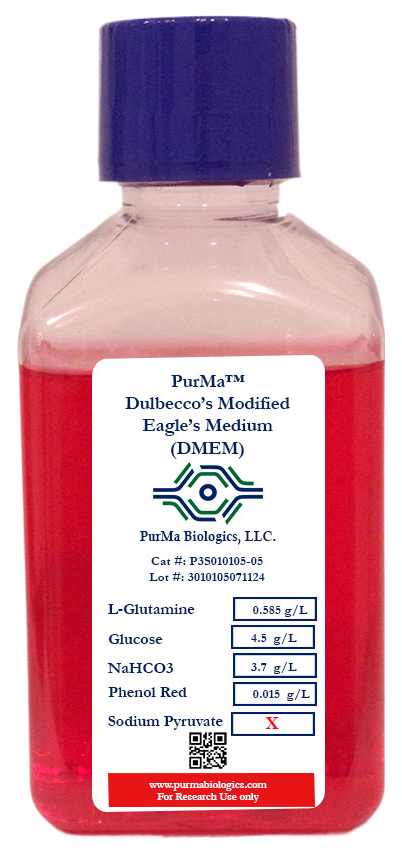
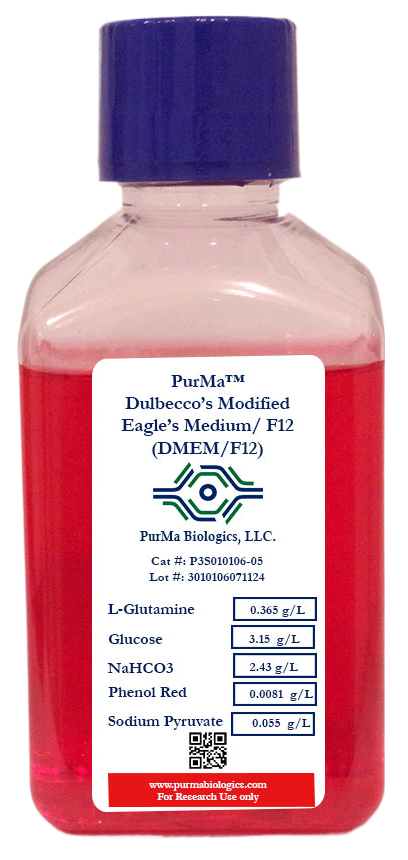
From PurMa Biologics
Both, in a wide range of formulations
PurMa manufactures DMEM and DMEM/F-12 in house, with options for glucose level, sodium bicarbonate, L-glutamine, phenol red, HEPES and sodium pyruvate.
Cell culture mediaChemically Defined DMEM
Made in the USA and manufactured in house. Certificate of Analysis with every lot. Bulk pricing, purchase orders and custom formulations welcome.
What Is DMEM (Dulbecco’s Modified Eagle Medium)?
DMEM is a concentrated, modified Eagle formulation built for robust growth in demanding or high density cultures.
- Roughly 4 times the amino acid and vitamin concentration of standard MEM
- Available in standard or high glucose formulations (1 g/L or 4.5 g/L)
- The default choice for many fibroblast, epithelial, and other commonly used immortalized cell lines
What Is DMEM/F-12?
DMEM/F-12 is a 1:1 blend of DMEM and Ham’s F-12 medium. F-12 contributes a set of components DMEM doesn’t include on its own: biotin, vitamin B12, hypoxanthine, thymidine, linoleic acid, putrescine, and additional trace elements like zinc and selenium. Pairing a basal medium with Ham’s F-12 to reduce dependence on serum traces back to foundational serum-free culture work by Barnes and Sato (Cell, 1980).
- Broader nutrient and trace element profile than DMEM alone
- Generally lower glucose and osmolality than high glucose DMEM
- Supports a wider range of cell types, including many primary cells and epithelial lines
- A common base for serum-free and low-serum culture systems, since F-12’s added components reduce reliance on serum-supplied factors
DMEM vs DMEM F12: Key Differences
| Factor | DMEM | DMEM/F-12 |
|---|---|---|
| Nutrient and trace element profile | DMEM formulation only | DMEM plus F-12 components (biotin, B12, trace elements) |
| Glucose | Standard or high glucose (1 g/L or 4.5 g/L) | Generally lower, diluted by the F-12 half of the mix |
| Best for | Robust, fast growing, high density immortalized lines | Primary cells, epithelial lines, serum-free and low-serum systems |
Which One Should You Use?
- Following an established protocol? Match what the protocol already calls for. Switching between the two can shift growth rate, morphology, and how well the culture tolerates reduced serum.
- Working with a robust, well characterized immortalized line? Standard DMEM is usually sufficient and is the simpler, more common default.
- Working with primary cells, epithelial cultures, or moving toward serum-free conditions? DMEM/F-12’s broader nutrient and trace element profile generally performs better.
Frequently Asked Questions
Can I substitute DMEM/F-12 for DMEM in an existing protocol?
It’s possible, but the different glucose level and added F-12 components can shift growth rate and morphology. Validate on a small batch before switching over an established protocol.
Does DMEM/F-12 replace the need for serum?
Not on its own. DMEM/F-12’s added trace elements and components make it a common serum-free base, but a full serum-free system still requires supplementing with the growth factors serum would otherwise provide. See our Chemically Defined Media guide for how that’s done in a fully defined format.
Is DMEM/F-12 always the better choice?
Not necessarily. For robust immortalized lines already validated in standard DMEM, there’s often no benefit to switching. DMEM/F-12 earns its place with primary cells, epithelial lines, and serum-free or low-serum work.
PurMa Biologics manufactures both DMEM and DMEM/F-12 in multiple formulations, including chemically defined, serum-free versions of each. See our product pages for full specifications.
Want the basics first? See our guide on what DMEM is and how to use it.
New to this medium? See what DMEM/F-12 is.