
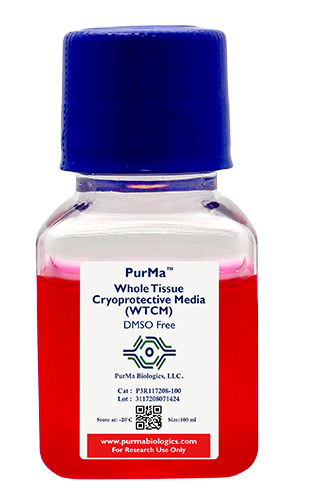
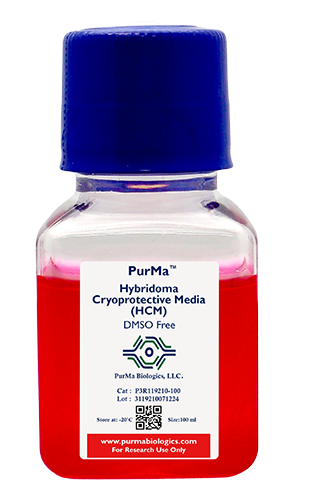
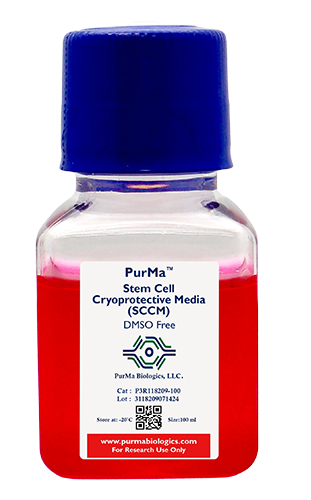
- ✓Proudly made in the USA, manufactured in house
- ✓Certificate of Analysis available for every lot
- ✓Backed by decades of cell culture and protein biochemistry expertise
- ✓Bulk pricing, purchase orders, and custom formulations welcome
Stem Cell Cryoprotective Media (SCCM); DMSO Free
PurMa™ Stem Cell Cryoprotective Media (SCCM); DMSO Free lacks DMSO or other penetrating agents. PurMa™ SCCM is a powerful highly evaluated cryoprotective media. Moreover, PurMa™ SCCM has been designed to have an excellent performance in the absence of any penetrating agent such as DMSO.
Description
Background
PurMa™ Stem Cell Cryoprotective Media (SCCM); DMSO Free lacks DMSO or other penetrating agent. PurMa™ SCCM is a powerful highly evaluated cryoprotective media. Moreover, PurMa™ SCCM has been designed to have an excellent performance in absence of any penetrating agent such as DMSO.
To emphasize, DMSO-free cryoprotective media needs to be applied only to certain cell lines which are damaged or poorly performing in the presence of DMSO or other penetrating agents.
limitations and disadvantages of DMSO
- Basically, it has a broad toxicity.
- Additionally, it modifies the expression of cells such an NK and T cells
- It alters the mRNA level of the de novo DNA methyltransferase DNMT3A. This, therefore, is accompanied by hyper- or hypo-methylation of many genetic loci.
- Moreover, it causes difficulties in scaling up DMSO-based cryoprotectants.
- It damages the mitochondria in certain cell culture models such as astrocytes.
- It negatively impacts cellular membrane/cytoskeleton structure integrity by interacting with proteins and dehydrating lipids.
- Besides, it induces unwanted stem cell differentiation.
- Affects cellular epigenetic profile resulting in undesirable phenotypic disturbances. That is basically because of repeated usage of DMSO even at sub-toxic levels.
- Afterwards, it is necessary to remove DMSO by intensive washing. That in turn results in cell sensitivity to osmotic/mechanical stresses occurring. This is a costly and time-consuming process during freezing and thawing, and moreover leads to a significant loss of cell number.
PurMa™ DMSO Free Stem Cell Cryoprotective Media provides high post-thaw cell viability and preserves original morphology, proliferation, and differentiation potentials of tested stem cells such as MSCs.
Special Features
- Ready-to-Use.
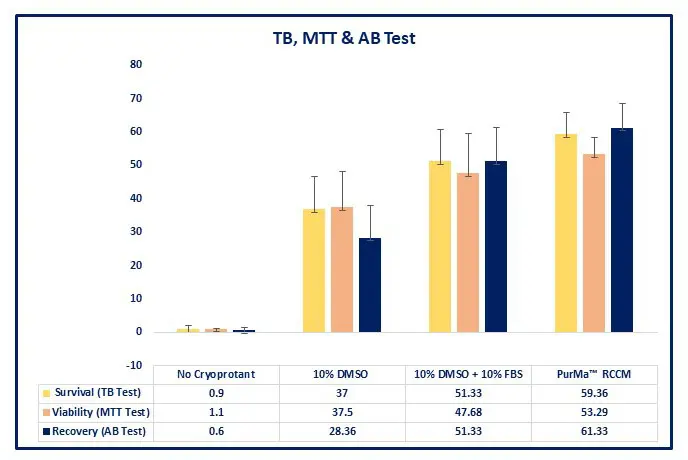
- PurMaTM DMSO Free SCCM provides much higher cell viability after short/long-term cryoprotection, (61% recovery rate)
- PurMaTM DMSO Free SCCM Prevents the formation of crystals in extracellular space, consequently, preventing cellular dehydration and resulting in less exposure to toxins from the non-recovering cells.
- Preserves morphological appearance as a standard factor of cell recovery.
- Tested for pH, osmolality, sterility, and endotoxin.
- Each Lot of PurMaTM SCCM besides the pathogens and sterility evaluations goes through a survival test (by Trypan Blue method), viability & performance evaluation (by MTT Test), and the rate of recovery by Alamar Blue test.
- PurMaTM DMSO Free SCCM has been tested successfully for several commonly used stem cells including hematopoietic, mesenchymal stromal/stem, and induced pluripotent stem cells.
- Suitable for clinical applications.
Guideline
for PurMa Biologics guideline for cryoprotection, click here as well as in corresponding tab: PurMa™ Guideline for Cryoprotecting various cell lines
References
- Evaluation of polyvinylpyrrolidone as a cryoprotectant for adipose tissue-derived adult stem cells. Thirumala et al. Tissue Eng Part C Methods. 2010 Aug;16(4):783-92. doi:10.1089/ten .TEC.2009.0552.
- Long-term preservation of permanent human hematopoietic cell lines. Mizrahi et al. J Med. 1971; 2(6) :380-6.
| Parameter | Specification |
|---|---|
| Appearance | Red, clear liquid |
| pH | 7.2 ± 0.1 |
| Osmolality | 275-360 mOsm/L |
| Endotoxin | NMT< 2EU/mL |
| Mycoplasma | Negative |
| Suitability | Suitable for mammalian cell culture |
| Additive | Sodium pyruvate |
| Indicator | Phenol red |
| Mycoplasma Detection | Negative |
| Sterility Tested | Sterile filtered using 0.22 µm filter |
| Form | Liquid |
| Shipping Condition | Room temperature |
Learn more: What Is Cryoprotective Media?
Additional information
| Size | 1 x 10 ml, 1 x 100 ml |
|---|
Documents
Certificate of Analysis (COA): Available upon request for your specific order — email info@purmabiologics.com and we will send the current lot documentation.
Safety Data Sheet (SDS): Available upon request — email info@purmabiologics.com.
What our customers say about PurMa Biologics
Feedback from labs we supply, across our full catalogue.
PurMa products are of excellent quality and highly reliable.
I've ordered cell culture media multiple times. Great prices and excellent customer service. The ordering process was smooth, and everything arrived as expected. I'll definitely be purchasing from them again.
We buy all of our cell culture media, fetal bovine sera, and lipid-depleted sera from PurMa. The quality of their reagents is absolutely top-notch, giving us reliable, repeatable results in our experiments. We highly recommend PurMa!
We have been working with PurMa biologics for the past several years, we buy cell culture related media like DMEM F12 and EMEM and Fetal Bovine Serum. We appreciate the high quality and reasonable price, and great customer service.
We purchase everything we need related to cell and tissue culture from PurMa, reagents like: DMEM, LL15, EMEM, FBS, trypsin, antibiotics mix100X and... Always great quality, fast processing and shipping. We are totally satisfied.
Very fast, efficient, and economic service. Great for new PIs like me.
Frequently asked questions
Should I choose the DMSO or DMSO free formulation?
DMSO is the standard cryoprotectant and gives the best recovery for most lines. Choose DMSO free where DMSO would interfere with the application, for example in differentiation work or certain clinical and hybridoma protocols where residual DMSO is a problem.
What freezing rate should I use?
Approximately minus 1 degree C per minute to around minus 80, using a controlled rate cooler or an insulated freezing container, before transfer to liquid nitrogen. Faster cooling causes intracellular ice and slower cooling causes osmotic damage.
How should vials be stored long term?
In the vapour phase of liquid nitrogen, below minus 150 degrees C. Storage in a minus 80 freezer is acceptable only for weeks, not years, because viability declines steadily above minus 130.
How should I thaw cells frozen in Stem Cell Cryoprotective Media (SCCM); DMSO Free?
Thaw rapidly in a 37 degree C bath until only a small ice crystal remains, then dilute promptly into pre warmed medium. DMSO is toxic to cells at room temperature, so the interval between thaw and dilution should be as short as possible.
How should the cryoprotective media itself be stored?
Store as stated on the Certificate of Analysis, protected from light. Do not refreeze after thawing the media, and use within the period stated for the lot.
Related products
-
- Sale!
- Cryoprotective Media, Cryoprotective media DMSO-Free
Hybridoma Cryoprotective Media (HCM); DMSO Free
- Price range: $199.89 through $858.36
- Select options This product has multiple variants. The options may be chosen on the product page
-
- Cryoprotective Media, Cryoprotective media With DMSO
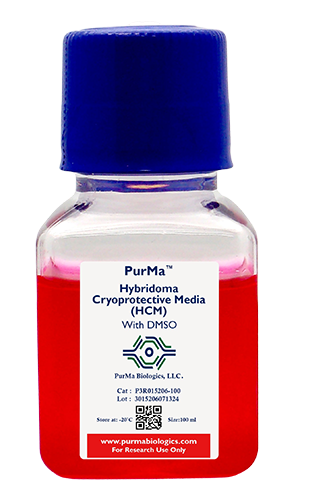
Hybridoma Cryoprotective Media with DMSO (HCM-D)
- Price range: $89.99 through $326.32
- Select options This product has multiple variants. The options may be chosen on the product page
-
- Sale!
- Cryoprotective Media, Cryoprotective media With DMSO
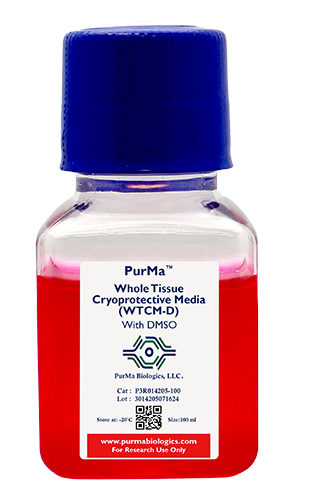
Whole Tissue Cryoprotective Media (WTCM-D) with DMSO
- Price range: $133.39 through $799.59
- Select options This product has multiple variants. The options may be chosen on the product page

Reviews