
Description
Background
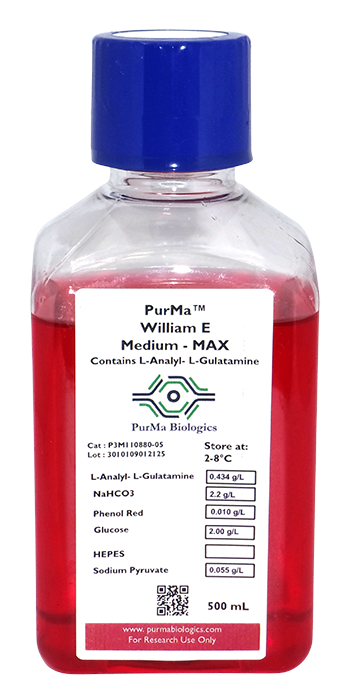
Williams’ E Medium – Max is a commonly used media for Mammalian cell culture.
Advantages
The advantages of Williams’ E Medium – Max over Williams’ E Medium are:
- Higher PH Capacity
- Moreover, it contains 4 mM L-Alanyl-L-Glutamine (0.869 g/L) instead of L-Glutamine and therefore:
- Possess longer shelf life.
- More importantly, minimizes toxic ammonia build-up.
- Significantly improves cell viability and growth.
- Remains stable across a wide range of temperatures.
- Improves the culture of primary cells.
Mechanism
Although L-glutamine is a vital amino acid, it degrades, resulting in the generation of toxic ammonia and pyrrolidine carboxylic acid. One way to minimize L-glutamine degradation in media is to gradually add these amino acids to your cell culture. However, keeping track of time to keep the amount of L-glutamine at the same level is tedious, if not impossible.
Alternatively, L-alanyl-L-glutamine can be used because it is much more stable in aqueous solutions. More importantly, it does not easily degrade and is gradually cleaved by aminopeptidases. As a result, L-glutamine and L-alanine are then used by the cells for protein production in the TCA cycle.
In addition to our Max formulation products, we manufacture PurMaTM GluaSup (Cat# P3S210 559), a combination of L-alanyl-L-glutamine which prevents degradation of L-glutamine.
Contents
Williams’ E Medium – Max contains:
- 5 mM sodium pyruvate
- High glucose (4.5g/L)
- Non-Essential Amino Acids
- 3.7 g/L Sodium Bicarbonate; PurMa Biologics Manufactures several types of William’s E Medium based on the amount of Sodium Bicarbonate and HEPES (PH capacity)
- Phenol Red
Williams’ E Medium – Max contains no proteins, lipids, or growth factors. Therefore, it requires supplementation, commonly with 10% Fetal bovine Serum (FBS).
Formulation
For complete formulation click here: Williams’ E Medium-MAX Formulation
References
- Isolation and long-term cell culture of epithelial-like cells from rat liver. Williams GM, Weisburger EK, Weisburger JH. Exp Cell Res. 1971 Nov;69(1):106-12. doi: 10.1016/0014-4827(71)90316-8. PMID:
- Growth and continuous passage of COMMA-D mouse mammary epithelial cells in hormonally defined serum-free medium. Riss TL, Sirbasku DA. Cancer Res. 1987 Jul 15;47(14):3776-82. PMID: 3297308.
- Primary in vitro antibody responses by purified murine B lymphocytes in serum-free defined medium. Mosier DE. J Immunol. 1981 Oct;127(4):1490-3. PMID: 6792277
| Parameter | Specification |
|---|---|
| Appearance | Red, clear liquid |
| pH | 7.2 ± 0.1 |
| Osmolality | 275-360 mOsm/L |
| Endotoxin | NMT< 2EU/mL |
| Mycoplasma | Negative |
| Suitability | Suitable for mammalian cell culture |
| Additive | Sodium pyruvate |
| Indicator | Phenol red |
| Mycoplasma Detection | Negative |
| Sterility Tested | Sterile filtered using 0.22 µm filter |
| Form | Liquid |
| Shipping Condition | Room temperature |
Learn more: What Is William’s E Medium?

Verified Customer, University of Oklahoma –
Verified Customer, University of Oklahoma –