
Leibovitz’s L-15 Medium solves a problem most basal media don’t even try to address: how do you keep cells alive and growing when there’s no CO2 incubator available? L-15 is built for exactly that situation, and understanding why it’s formulated the way it is also explains the most common mistakes labs make when they switch to it.
L-15 is built to hold a stable pH in room air without a CO2 incubator. The most common mistake is placing it in a CO2 incubator anyway, which drives the pH too acidic.
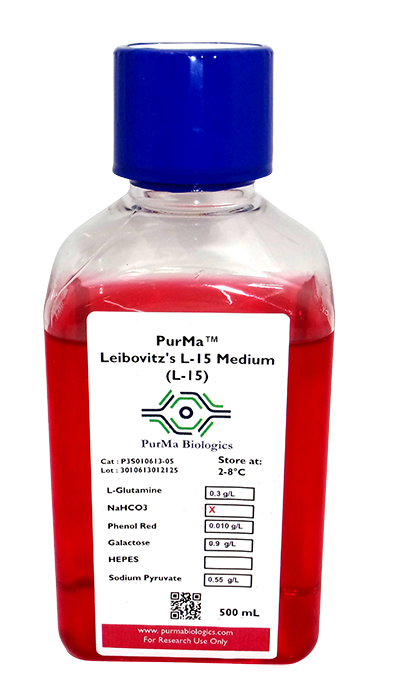
From PurMa Biologics
L-15 Medium from PurMa
PurMa manufactures Leibovitz’s L-15 in standard and MAX formulations, plus a chemically defined version for work that needs no animal derived components.
Leibovitz’s L-15 MediumChemically Defined L-15
Made in the USA and manufactured in house. Certificate of Analysis with every lot. Bulk pricing, purchase orders and custom formulations welcome.
What Makes L-15 Different: No CO2 Required
Most basal media rely on a sodium bicarbonate buffer system, which only holds a stable pH when balanced against a controlled CO2 atmosphere, typically 5% in a standard incubator. L-15 was formulated around a different buffering strategy, relying primarily on free base amino acids and a phosphate buffer system rather than bicarbonate, so it maintains a stable physiological pH in ordinary atmospheric air. That single design choice is what makes L-15 the standard choice for cell culture work performed outside a CO2 incubator: transport between facilities, extended bench work, shipping live cultures, or any application where a sealed, gas-tight vessel and a CO2 atmosphere simply aren’t available.
To support this atmosphere-independent design, L-15 also substitutes galactose for glucose as its primary carbohydrate source. Cells metabolize galactose more slowly than glucose, which reduces the rate of acidic byproduct (lactate) accumulation, an important detail for a medium that isn’t relying on CO2-buffered bicarbonate to correct pH drift.
The Most Common L-15 Mistake: Using It in a CO2 Incubator
The single most common error labs make with L-15 is treating it like any other basal medium and placing it in a standard 5% CO2 incubator. Because L-15 isn’t bicarbonate-buffered, the added CO2 reacts with the medium and drives the pH down into an acidic range the medium was never designed to tolerate, stressing or killing the culture rather than protecting it. L-15 is meant for room air, either in a standard incubator with the CO2 function switched off, or on the open bench in a sealed vessel.
The second most common mistake is the mirror image of the first: leaving vessels unsealed. Because L-15’s whole design point is working in ambient room air rather than a controlled gas environment, culture vessels need to be tightly sealed, using screw-cap flasks rather than vented caps, to prevent evaporative loss and contamination during extended open-air use.
Where L-15 Is the Right Choice
- Cell culture work performed outside a CO2 incubator, including shipping and transport of live cultures
- Extended time-lapse microscopy or bench manipulations where a sealed vessel in room air is more practical than a CO2 chamber
- Insect and cold-blooded vertebrate cell lines, many of which were originally adapted to L-15 for its atmosphere-independence
- Applications where the slower galactose metabolism and correspondingly slower lactate buildup better matches the cell line’s requirements
PurMa Biologics manufactures Leibovitz’s L-15 Medium, a higher-performance L-15 Medium MAX formulation, and a Chemically Defined L-15 version for labs that need a fully defined, serum-free format. See our product pages for full specifications.