
- ✓Proudly made in the USA, manufactured in house
- ✓Certificate of Analysis available for every lot
- ✓Backed by decades of cell culture and protein biochemistry expertise
- ✓Bulk pricing, purchase orders, and custom formulations welcome
MEM-Alpha-Modification with Nucleosides in Hanks’ Buffer
MEM α-Modification with Nucleosides in Hanks’ buffer provides a great nutritional culture environment for mammalian cells. this media as well plays a key role in the process of selection for transfected DHFR-negative cells.
For research use only. Not for human, veterinary or diagnostic use.
Description
Background
MEM α-Modification with Nucleosides in Hanks’ buffer provides a great nutritional culture environment for mammalian cells. This media also plays a key role in the process of selection of transfected DHFR-negative cells. Moreover, MEM-α-N-HBSS is widely used for a variety of suspension and adherent cells. Calcium, however, plays a crucial role in media as eliminating this ion facilitates the growth of cells in suspension cultures.
Ingredients
MEM-α with nucleosides is basically the modified version of MEM-α and contains:
- Ribonucleosides
- Deoxyribonucleosides
- Non-essential amino acids.
- Sodium pyruvate.
- Lipoic acid.
- Vitamin B12.
- Biotin and,
- Ascorbic acid.
PurMa™ MEM-α-N-HBSS contains HBSS buffer
The composition of HBSS buffer:
- Potassium Chloride
- Potassium Phosphate, monobasic
- Sodium Bicarbonate
- Sodium Chloride
- Sodium Phosphate, dibasic
Additionally, MEM α-Modification with Nucleosides in Hanks’ Buffer also Contains:
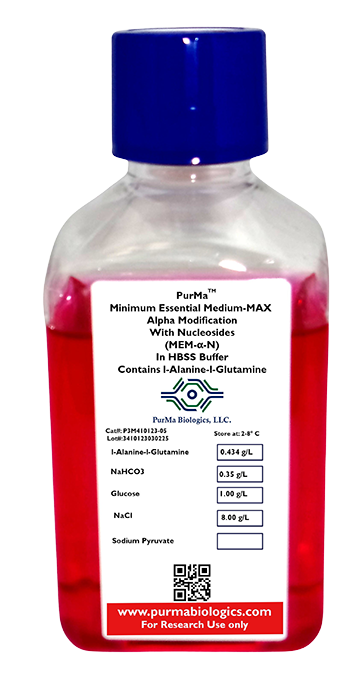
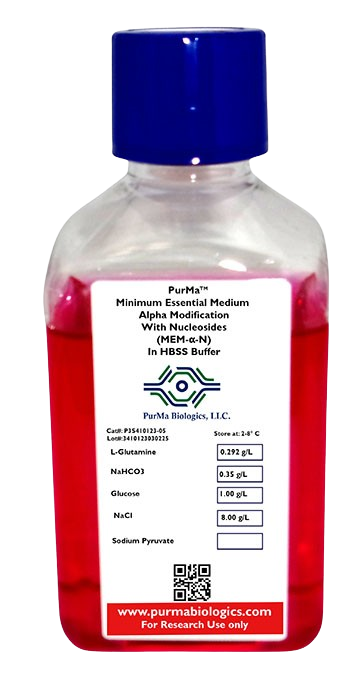
- Low level of glucose (1.00 g/ liter)
- Sodium bicarbonate (0.35 g/L)
- 2 mM L-glutamine (292 mg/L)
PurMa Biologics manufactures 119 types of MEM-α-N-HBSS
Why PurMa Biologics? Why we stand behind our cell culture media
Our products are the outcome of 30 years of experience in cutting-edge science. We routinely manufacture over 1500 media. We have the most comprehensive collection of cell and tissue culture media. Moreover, We utilize 99% pure amino acids. This will significantly increase the consistency among your experiments. Considering the highest quality, our prices certainly are extremely reasonable.
Application
Furthermore, MEM-α-N-HBSS is used for various cell types such as keratinocytes, primary rat astrocytes, as well as human melanoma cells. Also, MEM-α-N-HBSS has been used for the isolation of mesenchymal stem cells, adipose-derived stem cells, and osteoblasts. Moreover, MEM α-Modification is widely used for primary osteoblast cultures.
Formulation
For complete formulation click here as well as ” formulation Tab : MEM alpha with nucleoside in HBSS Buffer Formulation
References
- A previously functional tetracycline-regulated transactivator fails to target gene expression to the bone. Schmidt et al. BMC Res Notes. 2011 Aug 11;4:282. doi: 10.1186/1756-0500-4-282. PMID: 21835026.
- The growth of L-cells and Vero cells on an autoclavable MEM-peptone medium. Keay L, Biotechnology and bioengineering, 19(3), 399-411 (1977-03-01
| Parameter | Specification |
|---|---|
| Appearance | Red, clear liquid |
| pH | 7.2 ± 0.1 |
| Osmolality | 275-360 mOsm/L |
| Endotoxin | NMT< 2EU/mL |
| Mycoplasma | Negative |
| Suitability | Suitable for mammalian cell culture |
| Additive | Sodium pyruvate |
| Indicator | Phenol red |
| Mycoplasma Detection | Negative |
| Sterility Tested | Sterile filtered using 0.22 µm filter |
| Form | Liquid |
| Shipping Condition | Room temperature |
Additional information
| Condition | MEM-α-N (HBSS) Standard Formulation, MEM-α-N (HBSS) w/o Glutamine, MEM-α-N (HBSS) w/o Phenol Red, MEM-α-N (HBSS) w/o Sodium Bicarbonate, MEM-α-N (HBSS) w/o Glucose, MEM-α-N (HBSS) w/o Lipoic Acid, MEM-α-N (HBSS) w/o Glutamine, w/o Phenol Red, MEM-α-N (HBSS) w/o Glutamine, w/o Phenol Red, w/o Sodium Bicarbonate, MEM-α-N (HBSS) 15 mM HEPES (3.6 g/L), MEM-α-N (HBSS) 25 mM HEPES (5.9 g/L), MEM-α-N (HBSS) w/o Sodium Pyruvate, MEM-α-N (HBSS) High Sodium Bicarbonate (0.85 g/L), MEM-α-N (HBSS) High Glucose (4.5 g/L), MEM-α-N (HBSS) 15 mM HEPES (3.6 g/L), High Glucose (4.5 g/L), MEM-α-N (HBSS) 25 mM HEPES (5.9 g/L), High Glucose (4.5 g/L) |
|---|---|
| Format | Liquid, Powder |
| Size | 10 X 1000ml, 10 X 500ml, 1 x 500 ml, 6 x 500 ml, 1 x 1000 ml, 6 x 1000 ml, 1 x 10 L, 1 x 50 L |
Documents
Certificate of Analysis (COA): Available upon request for your specific order — email info@purmabiologics.com and we will send the current lot documentation.
Safety Data Sheet (SDS): Available upon request — email info@purmabiologics.com.
What our customers say about PurMa Biologics
Feedback from labs we supply, across our full catalogue.
Very fast, efficient, and economic service. Great for new PIs like me.
it is reliable vendor!
We always buy our agarose from PurMa and have never been disappointed.
I recently had the pleasure of interacting with Dr. Seif Azadi from Purma Biologics, and I cannot thank him enough for his expertise and prompt assistance. His deep knowledge and dedication were instrumental in meeting our laboratory’s needs with remarkable efficiency. We ordered FBS, DMEM, and Trypsin from Purma Biologics, and I’m thrilled to report that all the products have performed exceptionally well. They consistently deliver reproducible results, significantly enhancing the reliability of our experiments. Thank you, Team Purma Biologics, for your good products and support!
It’s been a pleasure working with PURMA Biologics. Their service is efficient, delivery is fast, and the quality of their products has met our expectations consistently. Very smooth collaboration overall.
PurMa products are of excellent quality and highly reliable.
Frequently asked questions
How should I store MEM-Alpha-Modification with Nucleosides in Hanks’ Buffer?
Store at 2 to 8 degrees C, protected from light, and do not freeze unless the label states otherwise. Freezing can precipitate salts and degrade light sensitive components such as riboflavin and folic acid. Always follow the storage line on the Certificate of Analysis for the specific lot.
What is the shelf life once opened?
Unopened and correctly stored, the typical shelf life is 12 months from manufacture. Once opened, use within about four weeks and always handle in a laminar flow hood, since the practical limit after opening is contamination risk rather than chemical stability.
Is it sterility and endotoxin tested?
Yes. Every lot is sterile filtered and tested for sterility and endotoxin, and a Certificate of Analysis is issued for each lot. The COA is available on request for any catalogue number.
Do I need to add L-glutamine?
It depends on the formulation you order. Standard formulations may contain free L-glutamine, which degrades in solution over time, while MAX formulations use a stable L-alanyl-L-glutamine dipeptide that does not require fresh supplementation. Check the option you have selected before adding more.
Can I order this in bulk or as a custom formulation?
Yes. Bulk volumes and custom formulations are made to order, including adjusted glucose, bicarbonate, buffering and cation content. Use the request bulk pricing button on this page and include the specification you need.
Related products
-
- Sale!
- Cell Culture Media, DMEM F-12
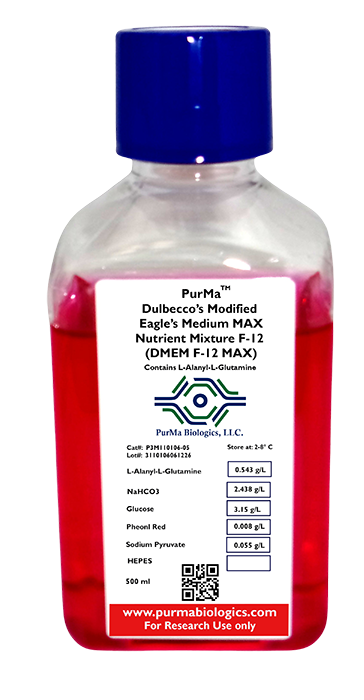
PurMa™ Dulbecco’s Modified Eagle’s Medium/F-12 MAX (DMEM F12-MAX)
- Price range: $31.10 through $590.46
- Select options This product has multiple variants. The options may be chosen on the product page
-
- Cell Culture Media, William's E Medium
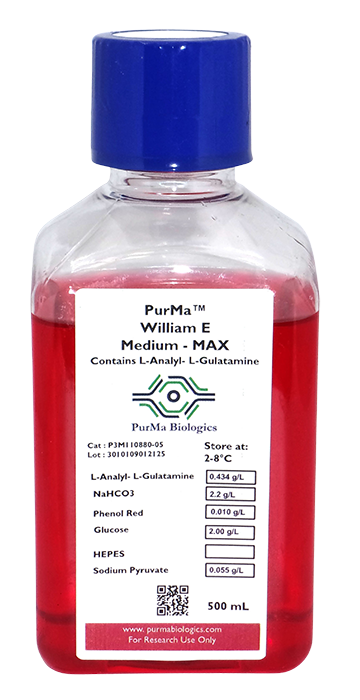
Williams’ E Medium – Max
- Price range: $40.29 through $1025.23
- Select options This product has multiple variants. The options may be chosen on the product page
-
- Sale!
- Cell Culture Media, Kaighn's Modification of Ham's F-12K Medium
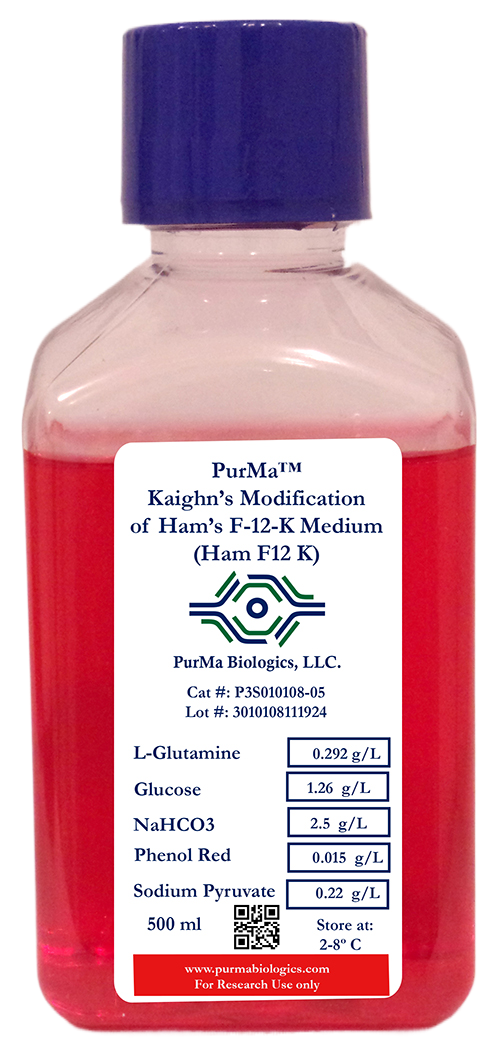
PurMa™ Kaighn’s Modification of Ham’s F-12-K Medium
- Price range: $21.05 through $518.27
- Select options This product has multiple variants. The options may be chosen on the product page

Reviews