

- ✓Proudly made in the USA, manufactured in house
- ✓Certificate of Analysis available for every lot
- ✓Backed by decades of cell culture and protein biochemistry expertise
- ✓Bulk pricing, purchase orders, and custom formulations welcome
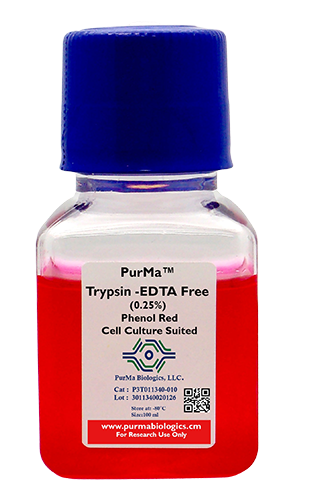
Trypsin EDTA Free 0.25%
Ultra-pure EDTA-free Trypsin at 0.25% for routine dissociation of adherent cells.
- Ultra-pure trypsin, a serine protease, for detaching adherent cells
- Supplied in HBSS, available with or without phenol red
Description
Background
PurMa™ Trypsin EDTA Free 0.25% is a trypsin without EDTA, an ultra-pure solution for standard dissociation and passaging of adherent cells in mammalian cell culture. Trypsin is a serine protease that cleaves peptide bonds at lysine and arginine residues (except when followed by proline), releasing cells from the culture surface and from one another for passaging, counting, and downstream work.
Why Trypsin Without EDTA?
Many trypsin solutions include EDTA, a chelating agent that binds calcium and magnesium ions to speed up cell detachment. PurMa™ Trypsin EDTA Free 0.25% contains no EDTA, giving you a gentler, more controlled dissociation. It is preferred when working with cells sensitive to EDTA or to calcium/magnesium depletion, or when you want to preserve divalent-cation-dependent surface proteins and functions.
Features and Benefits
- Contains no EDTA, calcium, magnesium, or heavy metals.
- Contains no serine protease inhibitors (DFP, TLCK, APMSF, AEBSF).
- Contains no phytates or phytic acid salts (e.g., myo-inositol) that can inhibit trypsin activity.
- Ultra-pure trypsin, HPLC-purified to 99%.
- Rigorously evaluated for yeast, mold, mycoplasma, and endotoxin contamination.
Available Concentrations
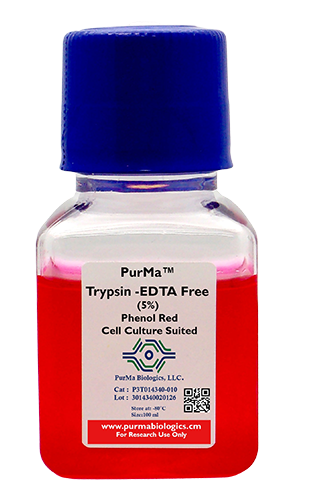
PurMa Biologics produces trypsin in 0.05%, 0.25%, 0.5%, 2.5%, and 5%, both with EDTA and EDTA-free, in phenol red or phenol-red-free formats, so you can match the strength and indicator to your protocol.
Specifications
| Parameter | Specification |
|---|---|
| Appearance | Red, clear liquid |
| pH | 7.8 ± 0.1 |
| Osmolality | 275–360 mOsm/L |
| Endotoxin | NMT < 2 EU/mL |
| Mycoplasma | Negative |
| Sterility | Sterile filtered (0.22 µm) |
| Indicator | Phenol red |
| Form | Liquid |
| Suitability | Mammalian cell culture |
| Shipping | Room temperature |
References
- Goldberg DM, Roy AD. Fate of trypsin and chymotrypsin in the human small intestine. Gut. 1969;10(6):477-83. PMID: 5786145.
- Razin S, et al. Adhesion of mycoplasmas to eukaryotic cells. Ciba Found Symp. 1981;80:98-118. PMID: 6790254.
- Vogel KG. Effects of hyaluronidase, trypsin, and EDTA on surface composition and topography during detachment of cells in culture. Exp Cell Res. 1978;113(2):345-57. PMID: 122554.
Learn more: What Is Trypsin?
Additional information
| Condition | Trypsin 0.25%, Standard Formulation, Trypsin 0.25%, Without Sodium Bicarbonate, Trypsin 0.25%, Without Calcium Chloride, Trypsin 0.25%, Without Glucose |
|---|---|
| Size | 1 x 100 ml, 6 x 100 ml, 1 x 500 ml, 6 x 500 ml |
| Phenol Red | With Phenol Red, Without Phenol Red |
Documents
Certificate of Analysis (COA): Available upon request for your specific order — email info@purmabiologics.com and we will send the current lot documentation.
Safety Data Sheet (SDS): Available upon request — email info@purmabiologics.com.
What our customers say about PurMa Biologics
Feedback from labs we supply, across our full catalogue.
We always buy our agarose from PurMa and have never been disappointed.
I recently had the pleasure of interacting with Dr. Seif Azadi from Purma Biologics, and I cannot thank him enough for his expertise and prompt assistance. His deep knowledge and dedication were instrumental in meeting our laboratory’s needs with remarkable efficiency. We ordered FBS, DMEM, and Trypsin from Purma Biologics, and I’m thrilled to report that all the products have performed exceptionally well. They consistently deliver reproducible results, significantly enhancing the reliability of our experiments. Thank you, Team Purma Biologics, for your good products and support!
It’s been a pleasure working with PURMA Biologics. Their service is efficient, delivery is fast, and the quality of their products has met our expectations consistently. Very smooth collaboration overall.
PurMa products are of excellent quality and highly reliable.
I've ordered cell culture media multiple times. Great prices and excellent customer service. The ordering process was smooth, and everything arrived as expected. I'll definitely be purchasing from them again.
We buy all of our cell culture media, fetal bovine sera, and lipid-depleted sera from PurMa. The quality of their reagents is absolutely top-notch, giving us reliable, repeatable results in our experiments. We highly recommend PurMa!
Frequently asked questions
Should I use trypsin with or without EDTA?
EDTA chelates calcium and magnesium, which weakens cadherin mediated adhesion and makes detachment faster and gentler. Choose EDTA free when downstream work is sensitive to chelation, or when you need to preserve calcium dependent surface proteins.
Why are my cells not detaching?
The three usual causes are serum carryover inhibiting the trypsin, the reagent being used cold rather than at 37 degrees C, and an over confluent monolayer. Wash the monolayer with a cation free buffer such as PBS first, since even a trace of serum will block the enzyme.
Can I over trypsinise my cells?
Yes, and it is a common hidden problem. Extended exposure strips surface proteins, lowers viability and skews downstream staining. Watch the monolayer and stop the reaction with serum containing medium or a defined inhibitor as soon as cells round up and release.
How should I store Trypsin EDTA Free 0.25%?
Store frozen at minus 20 degrees C and aliquot on first thaw. Repeated freeze and thaw cycles reduce enzymatic activity, which shows up as gradually slower detachment over time.
What concentration should I use?
0.25 percent is standard for routine passaging of robust adherent lines, and 0.05 percent is gentler for primary cells and sensitive lines. Higher is not better, since the aim is the lowest concentration and shortest time that releases the monolayer cleanly.
Related products
-
- Sale!
- Trypsin EDTA and EDTA-Free, Trypsin With EDTA
Trypsin-EDTA 0.25%
- Price range: $13.99 through $412.88
- Select options This product has multiple variants. The options may be chosen on the product page
-
- Sale!
- Trypsin EDTA and EDTA-Free, Trypsin EDTA Free
Trypsin EDTA Free 2.5%
- Price range: $38.15 through $818.07
- Select options This product has multiple variants. The options may be chosen on the product page
-
- Sale!
- Trypsin EDTA and EDTA-Free, Trypsin EDTA Free
Trypsin EDTA Free 5%
- Price range: $62.90 through $1615.03
- Select options This product has multiple variants. The options may be chosen on the product page

Reviews