
Cell culture serum is one of the most important supplements in mammalian cell culture. Added to basal media, it supplies the growth factors, hormones, attachment factors, and transport proteins that cells need to survive, grow, and divide. But “serum” isn’t one single product — there are several types and specialized treatments, and choosing the right one has a real effect on how your cells behave. This guide breaks down the main types of cell culture serum and how to pick the one that fits your work.
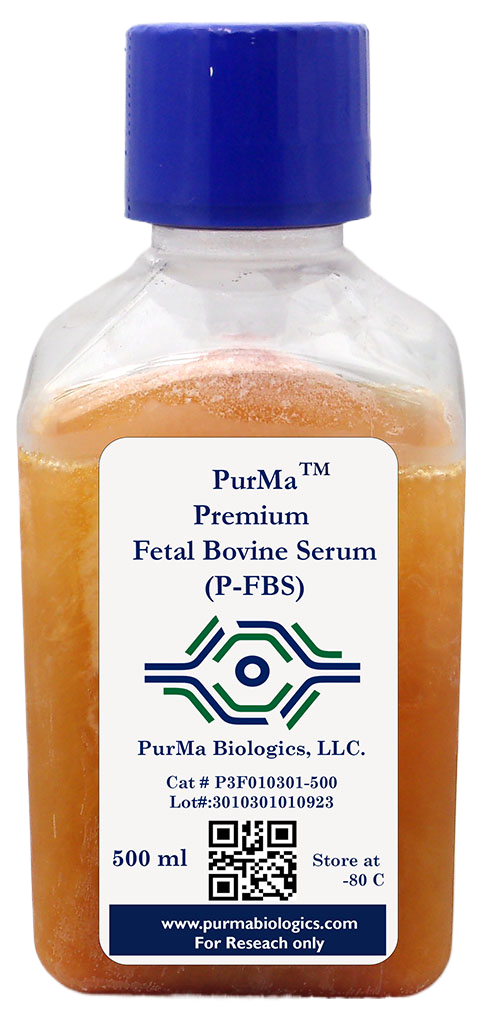
Standard FBS is the default supplement for most cell culture work. Reach for a treated variant, dialyzed, charcoal-stripped, or lipid-depleted, only when a specific serum component would interfere with your assay.
What Does Serum Do in Cell Culture?
Serum is the liquid fraction of blood left after clotting. In culture, it provides a rich mix of components that basal media alone can’t:
- Growth factors and hormones that drive cell proliferation
- Attachment and spreading factors that help adherent cells anchor to surfaces
- Transport proteins (like albumin and transferrin) that carry hormones, lipids, and iron
- Protease inhibitors, lipids, and trace minerals that support cell health
Because serum is biological, its exact composition varies from batch to batch — which is why the type and quality you choose matters.
The Main Types of Cell Culture Serum
Fetal Bovine Serum (FBS) is the gold standard. Collected from bovine fetuses, it’s the richest in growth factors and lowest in antibodies, making it excellent for promoting rapid growth across the widest range of cell lines. It’s the default choice for most labs. Explore Fetal Bovine Serum (FBS).
Bovine Calf Serum (BCS) comes from young cattle and is more economical than FBS. It contains fewer growth factors, so it suits established, less demanding cell lines where the full richness of FBS isn’t required — a cost-effective option for routine, large-scale culture. Explore Bovine Calf Serum (BCS).
Horse Serum is collected from adult or donor horses. It offers more batch-to-batch consistency than FBS and is the preferred serum for specific applications like muscle cell differentiation, certain neuronal cultures, and some immunology work. For a full comparison, see our guide on Horse Serum vs FBS. Explore Horse Serum.
Specialty (Treated) Serums
When a study demands a more defined environment, serum can be treated to remove specific components:
Charcoal-Stripped Serum is treated with activated charcoal to remove hormones, steroids, and other lipophilic substances — the go-to for hormone- and steroid-response research such as estrogen receptor studies. Explore Charcoal-Stripped FBS.
Dialyzed Serum is passed through a dialysis membrane to remove small molecules — amino acids, glucose, hormones, and salts — while keeping the large proteins and growth factors. It’s used when you need a defined low-molecular-weight background, such as metabolic or amino acid studies. Explore Dialyzed Horse Serum.
Lipid-Depleted Serum has its lipids and lipoproteins removed, making it ideal for lipid metabolism and cholesterol studies where background lipids would interfere. Explore Lipid-Depleted FBS.
How to Choose the Right Cell Culture Serum
| Your situation | Best serum |
|---|---|
| General growth, most cell lines | Fetal Bovine Serum (FBS) |
| Cost-sensitive, established lines | Bovine Calf Serum |
| Muscle differentiation, specific cell types | Horse Serum |
| Studying hormones or steroids | Charcoal-Stripped Serum |
| Need a defined, low-molecular-weight background | Dialyzed Serum |
| Studying lipids or cholesterol | Lipid-Depleted Serum |
Beyond type, also consider origin and traceability (e.g., USA-sourced), heat inactivation (to destroy complement), gamma irradiation (for viral safety), and endotoxin levels — all of which affect performance and reproducibility.
Frequently Asked Questions
What is serum used for in cell culture?
Serum supplements basal media with the growth factors, hormones, attachment factors, and transport proteins that cells need to grow and stay healthy.
What is the most common cell culture serum?
Fetal Bovine Serum (FBS) is the most widely used, because it’s rich in growth factors and supports the broadest range of cell lines.
What’s the difference between dialyzed and charcoal-stripped serum?
Dialyzed serum has small molecules (like amino acids and salts) removed; charcoal-stripped serum has hormones and steroids removed. You choose based on what your experiment needs to control.
Choosing With Confidence
The right cell culture serum depends on your cell type and your experiment. For most work, FBS is the safe default; for specialized studies, a treated serum gives you the defined conditions you need. PurMa Biologics supplies research-grade serums across every category — FBS, bovine calf, horse, and treated serums — for reliable, reproducible results.
Looking at a lower-cost option? See our guide on what bovine calf serum is and when to use it.
Running hormone-sensitive models? See our guide on using charcoal stripped FBS in organ-on-a-chip development.