
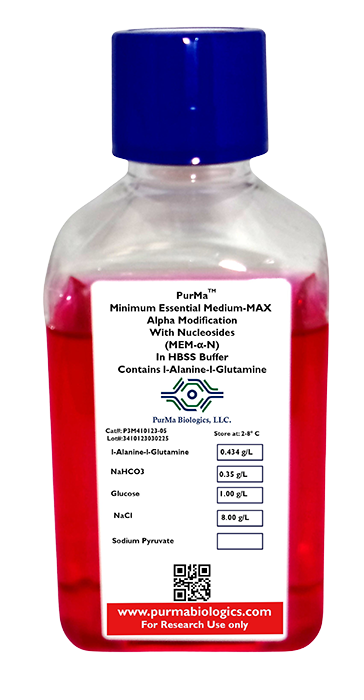
Description
Background
MEM Alpha-Modification with Nucleosides MAX (MEM-Alpha-N-MAX) in Hanks’ Buffer is a commonly used media for Mammalian cell culture.
Advantages
The advantages of MEM Alpha-Modification with Nucleosides MAX (MEM-Alpha-N-MAX) in Hanks’ Buffer over MEM-α-N (HBSS) are:
- Higher PH Capacity
- Moreover, it contains 4 mM L-Alanyl-L-Glutamine (0.869 g/L) instead of L-Glutamine and therefore:
- Possess longer shelf life.
- More importantly, minimizes toxic ammonia build-up.
- Significantly improves cell viability and growth.
- Remains stable across a wide range of temperatures.
- Consequently, it improves the culture of primary cells.
Mechanism
Although L-glutamine is a vital amino acid, it degrades, resulting in the generation of toxic ammonia and pyrrolidine carboxylic acid. One way to minimize L-glutamine degradation in media is to gradually add these amino acids to your cell culture. However, keeping track of time to keep the amount of L-glutamine at the same level is tedious, if not impossible.
Alternatively, L-alanyl-L-glutamine can be used because it is much more stable in aqueous solutions. More importantly, it does not easily degrade and gradually releases aminopeptidases. As a result, L-glutamine and L-alanine are then used by the cells for protein production in the TCA cycle.
In addition to our Max formulation products, we manufacture PurMaTM GluaSup (Cat# P3S210 559), a combination of L-alanyl-L-glutamine which prevents degradation of L-glutamine.
Contents
MEM Alpha-Modification with Nucleosides MAX (MEM-Alpha-N-MAX) in Hanks’ Buffer contains:
- 5 mM sodium pyruvate
- High glucose (4.5g/L)
- Non-Essential Amino Acids
- 3.7 g/L Sodium Bicarbonate; PurMa Biologics Manufactures several types of MEM-α-N-MAX (HBSS) based on the amount of Sodium Bicarbonate and HEPES (PH capacity)
- Phenol Red
PurMa™ MEM Alpha-Modification with Nucleosides MAX (MEM-Alpha-N-MAX) in Hanks’ Buffer is modified from MEM-α-MAX with the following ingredients:
- Ribonucleosides
- Deoxyribonucleosides
MEM Alpha-Modification with Nucleosides MAX (MEM-Alpha-N-MAX) in Hanks’ Buffer contains no proteins, lipids, or growth factors. Therefore, it requires supplementation, commonly with 10% Fetal bovine Serum (FBS).
Formulation
The complete formulation can be found here: MEM alpha-MAX with nucleoside in HBSS Buffer Formulation
References
- Culture of granulosa cells in collagen gels: the influence of cell shape on steroidogenesis. Carnegie JA, et al. Biol Reprod. 1988 May;38(4):881-90. doi: 10.1095/biolreprod38.4.881. PMID: 3401543
- Myelin formation in rat dorsal root ganglion cultured in a serum-free medium. Ninomiya T, Takahashi K. J Anat. 1987 Jun;152:209-13. PMID: 3654371
- Long-term organ culture of hamster cheek pouch mucosa. Mock D, Main JH. J Oral Pathol. 1976 Jul;5(4):237-40. doi: 10.1111/j.1600-0714.1976.tb01770.x. PMID: 820846
| Parameter | Specification |
|---|---|
| Appearance | Red, clear liquid |
| pH | 7.2 ± 0.1 |
| Osmolality | 275-360 mOsm/L |
| Endotoxin | NMT< 2EU/mL |
| Mycoplasma | Negative |
| Suitability | Suitable for mammalian cell culture |
| Additive | Sodium pyruvate |
| Indicator | Phenol red |
| Mycoplasma Detection | Negative |
| Sterility Tested | Sterile filtered using 0.22 µm filter |
| Form | Liquid |
| Shipping Condition | Room temperature |

Verified Customer, University of Oklahoma –
Verified Customer, University of Oklahoma –