
- ✓Proudly made in the USA, manufactured in house
- ✓Certificate of Analysis available for every lot
- ✓Backed by decades of cell culture and protein biochemistry expertise
- ✓Bulk pricing, purchase orders, and custom formulations welcome
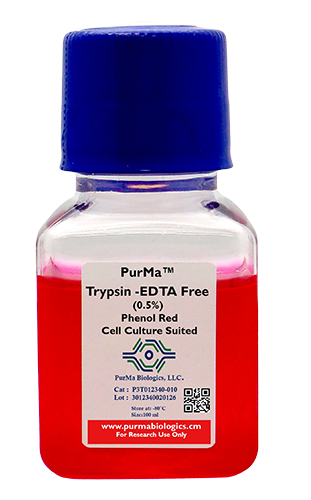
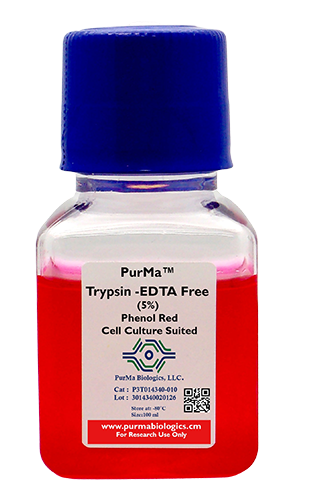
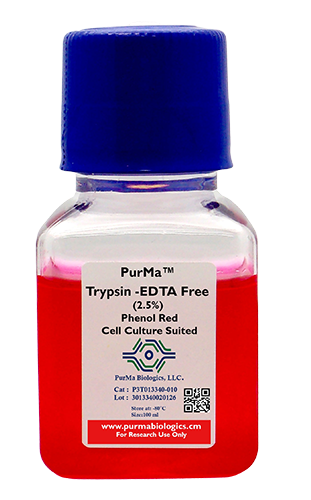
Trypsin EDTA Free 2.5%
Ultra-pure EDTA-free Trypsin at 2.5% for routine dissociation of adherent cells.
- Ultra-pure trypsin, a serine protease, for detaching adherent cells
- Supplied in HBSS, available with or without phenol red
For research use only. Not for human, veterinary or diagnostic use.
Description
Background
PurMa™ Trypsin EDTA Free 2.5% contains ultra-pure trypsin. This enzyme is a member of the serine protease family. Trypsin, initially produced in the pancreas, is subsequently secreted and activated in the intestines. Cell culture laboratories use trypsin to dissociate adherent cells for routine cell culture.
Trypsin Activity
Trypsin cleaves its substrates: IGDKLIPA unless these amino acids are followed by proline. PurMa™ trypsin is HPLC purified at 99% purity for bovine pancreas. Moreover, optical rotatory dispersion of trypsin in the presence of calcium shows a major conformational transition between 40 and 45° which results in deactivation of trypsin. Therefore, all the buffers needed to be Ca+2 & Mg+2 free for the proper function of this enzyme.
Preparation
The activity of this enzyme is further modulated by the sulfation of Tyr154. To overcome the mentioned issue, we use our most sophisticated water quality to ensure the absence of Mg+2 and Ca+2 as well as other heavy metals, please see: PurMa™ Ultra-Pure Cell Culture Suited Water (Cat# P3W110102)
Additionally, we include 2mM EDTA as it chelates metals such as calcium, magnesium, lead, mercury, copper, iron…
PurMa™ Trypsin Deactivates Mycoplasma in your Cell Culture
Trypsin treatment abolishes the ability of mycoplasmas to attach to the cells. Incidentally, mycoplasma is a common, slowly deteriorating contamination in cell culture, especially due to the invisibility of the contamination. PurMa Biologics manufactures all the reagents you need to fight mycoplasma in your cell culture. The presence of a trace of SDS and other detergents leads to a decrease in the trypsin activity.
Features and Benefits
PurMa Biologics manufactures trypsin without EDTA 0.05 % as a complete Ready-To-Use solution that contains 1X Hanks’ buffer and DOES NOT need any additional ingredients.
- PurMa™ Trypsin EDTA Free 2.5% does not contain calcium or magnesium ions or any other heavy metals.
- PurMa™ Trypsin EDTA Free 2.5% does not contain serine protease inhibitors, including DFP, TLCK, APMSF, and AEBSEF.
- PurMa™ Trypsin EDTA Free does not contain Phytates or salts of phytic acid, such as myo-inositol which is commonly present in cell culture media and inhibits trypsin activity.
- PurMa™ Trypsin is rigorously evaluated for yeast, mold, mycoplasma, and endotoxin contamination.
Concentrations
PurMa Biologics produces 0.05%, 0.25%, 0.5%, 2.5%, and 5% Trypsin with EDTA as well as without EDTA in phenol red or without phenol red. Moreover, we manufacture PurMa™ Trypsin in Hanks’ Buffer with 2mM EDTA (pH 7.8).
Formulation
Here is the complete formulation: 2.5% Trypsin without EDTA
References
Adhesion of mycoplasmas to eukaryotic cells. Razin et al. Ciba Found Symp. 1981;80:98-118. doi: 10.1002/9780470720639.ch8. PMID: 6790254.
Fate of trypsin and chymotrypsin in the human small intestine. Goldberg DM, Roy AD. 1969 Jun;10(6):477-83. doi: 10.1136/gut.10.6.477. PMID: 5786145.
Specific immunoassay for quantitative determination of human trypsin in intestinal content. Shapira E, Arnon R, Russell A. J Lab Clin Med. 1971 May;77(5):877-84. PMID: 4997546.
| Parameter | Specification |
|---|---|
| Appearance | Red, clear liquid |
| pH | 7.8 ± 0.1 |
| Osmolality | 275-360 mOsm/L |
| Endotoxin | NMT< 2EU/mL |
| Mycoplasma | Negative |
| Suitability | Suitable for mammalian cell culture |
| Additive | EDTA |
| Indicator | Phenol red |
| Mycoplasma Detection | Negative |
| Sterility Tested | Sterile filtered using 0.22 µm filter |
| Form | Liquid |
| Shipping Condition | Room temperature |
Learn more: What Is Trypsin?
Additional information
| Condition | Trypsin 2.5%, Standard Formulation, Trypsin 2.5%, Without Sodium Bicarbonate, Trypsin 2.5%, Without Calcium Chloride, Trypsin 2.5%, Without Glucose |
|---|---|
| Size | 1 x 100 ml, 6 x 100 ml, 1 x 500 ml, 6 x 500 ml |
| Phenol Red | With Phenol Red, Without Phenol Red |
Documents
Certificate of Analysis (COA): Available upon request for your specific order — email info@purmabiologics.com and we will send the current lot documentation.
Safety Data Sheet (SDS): Available upon request — email info@purmabiologics.com.
What our customers say about PurMa Biologics
Feedback from labs we supply, across our full catalogue.
We buy all of our cell culture media, fetal bovine sera, and lipid-depleted sera from PurMa. The quality of their reagents is absolutely top-notch, giving us reliable, repeatable results in our experiments. We highly recommend PurMa!
We have been working with PurMa biologics for the past several years, we buy cell culture related media like DMEM F12 and EMEM and Fetal Bovine Serum. We appreciate the high quality and reasonable price, and great customer service.
We purchase everything we need related to cell and tissue culture from PurMa, reagents like: DMEM, LL15, EMEM, FBS, trypsin, antibiotics mix100X and... Always great quality, fast processing and shipping. We are totally satisfied.
Very fast, efficient, and economic service. Great for new PIs like me.
it is reliable vendor!
We always buy our agarose from PurMa and have never been disappointed.
2 reviews for Trypsin EDTA Free 2.5%
Frequently asked questions
Should I use trypsin with or without EDTA?
EDTA chelates calcium and magnesium, which weakens cadherin mediated adhesion and makes detachment faster and gentler. Choose EDTA free when downstream work is sensitive to chelation, or when you need to preserve calcium dependent surface proteins.
Why are my cells not detaching?
The three usual causes are serum carryover inhibiting the trypsin, the reagent being used cold rather than at 37 degrees C, and an over confluent monolayer. Wash the monolayer with a cation free buffer such as PBS first, since even a trace of serum will block the enzyme.
Can I over trypsinise my cells?
Yes, and it is a common hidden problem. Extended exposure strips surface proteins, lowers viability and skews downstream staining. Watch the monolayer and stop the reaction with serum containing medium or a defined inhibitor as soon as cells round up and release.
How should I store Trypsin EDTA Free 2.5%?
Store frozen at minus 20 degrees C and aliquot on first thaw. Repeated freeze and thaw cycles reduce enzymatic activity, which shows up as gradually slower detachment over time.
What concentration should I use?
0.25 percent is standard for routine passaging of robust adherent lines, and 0.05 percent is gentler for primary cells and sensitive lines. Higher is not better, since the aim is the lowest concentration and shortest time that releases the monolayer cleanly.
Related products
-
- Sale!
- Trypsin EDTA and EDTA-Free, Trypsin With EDTA
Trypsin-EDTA 0.05%
- Price range: $13.69 through $444.23
- Select options This product has multiple variants. The options may be chosen on the product page
-
- Sale!
- Cell Culture Media, Roswell-Park Memorial Institute 1640
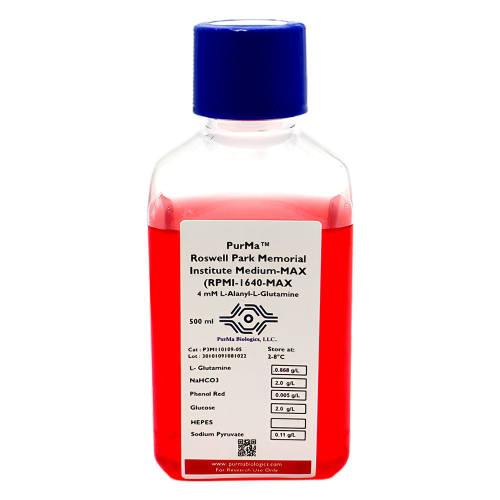
PurMa™ Roswell Park Memorial Institute 1640-MAX (RPMI-1640-MAX)
- Price range: $31.61 through $586.18
- Select options This product has multiple variants. The options may be chosen on the product page
-
- Sale!
- Cell Culture Media, McCoy’s 5A Modified Media (M5AMM)
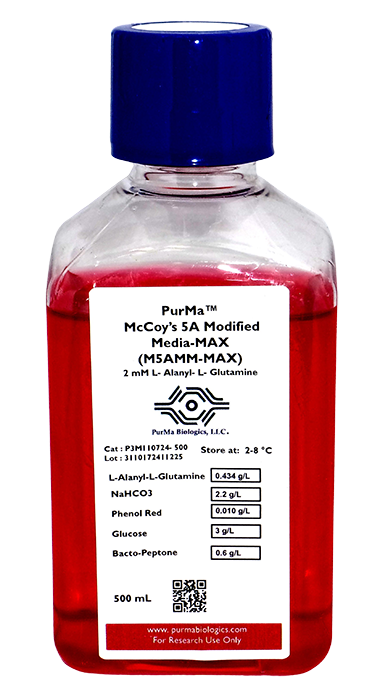
McCoy’s 5A Modified Media MAX (M5AMM-MAX)
- Price range: $31.51 through $573.22
- Select options This product has multiple variants. The options may be chosen on the product page


azadi@purmabiologics.com –
great
sdilmac@ou.edu –