
- ✓Proudly made in the USA, manufactured in house
- ✓Certificate of Analysis available for every lot
- ✓Backed by decades of cell culture and protein biochemistry expertise
- ✓Bulk pricing, purchase orders, and custom formulations welcome
Chemically Defined Basal Medium Eagle (CD-BME) in Earle’s Buffer
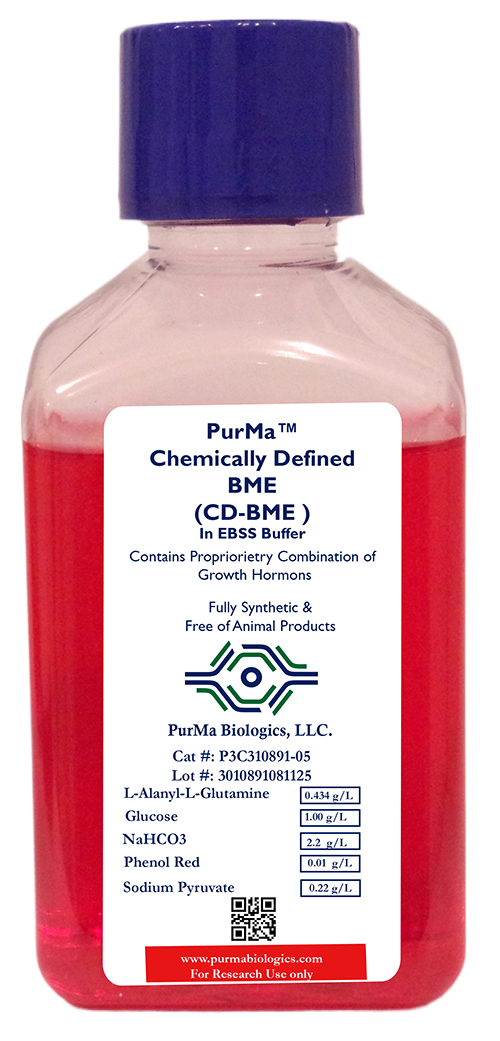
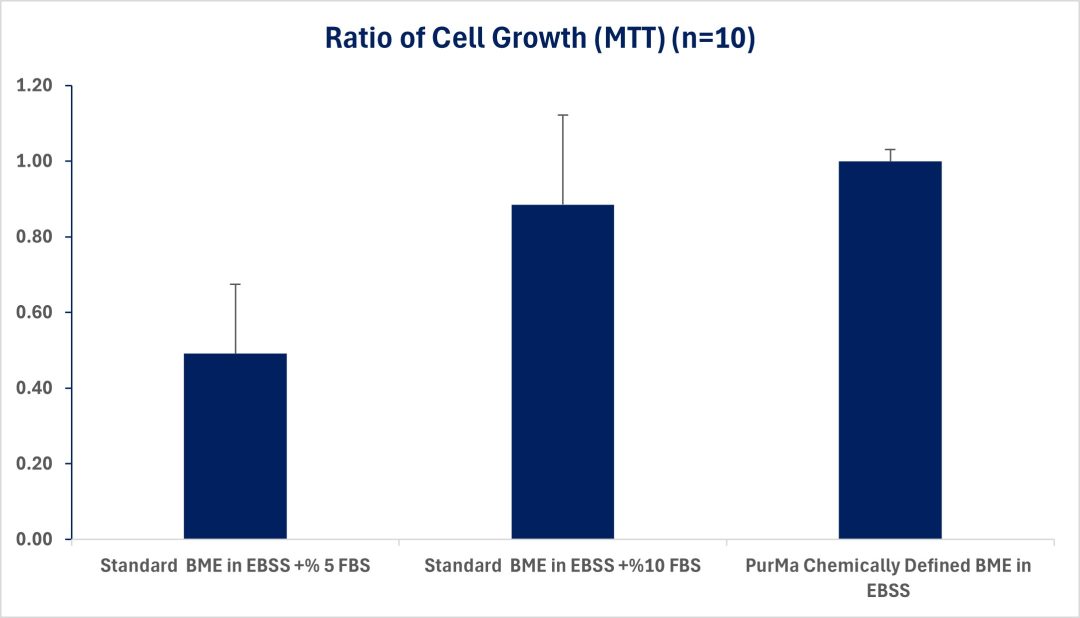
PurMa™ Chemically Defined BME in Earls’ Buffer (CD-MEM- EBSS) medium does not need any serum, fully synthetic and is free of any trace of animal products. Additionally, the cell growth with CD-MEM- EBSS Medium is equivalent to Medium+ 10% FBS.
This product is priced per order. Choose the options you need, then request a quote and we will reply by email.
Description
Background
PurMa™ Chemically Defined BME in Earls’ buffer (CD-MEM- EBSS) is a proprietary formula used to grow cells in vitro without any undefined or animal-derived components. Moreover, CD-MEM- EBSS Medium contains known quantities of pure chemicals, including amino acids, vitamins, salts, sugars, and more importantly a proprietary combination of synthetic growth factors.
It is absolutely crucial to mention that the PurMa™ Growth Supplement for each conventional media such as DMEM, IMDM, RPMI-1640… (base media) are slightly different in combination, amount of several growth factors, ions, chemicals, pH with particular adjustments needs to be done, based on the environments the base media provides.
This provides a consistent and controlled environment for cell growth and research. Noticeably, CD-MEM- EBSS Medium is essential for applications that require reproducibility and regulatory compliance as well as for studying specific cellular processes, without extraneous variables. Furthermore, CD-MEM- EBSS Medium is designed for custom formulations tailored for various cell types
Important Notes
It is crucially vital for a gradual transition from media containing FBS to chemically defined cell culture media, follow these steps:
- Starting Point: 10% FBS+ (control) (you need two controls, one to be left in only 10% FBS and continue monitoring for comparing with 0% FBS + PurMa™ Chemically Defined Medium. The second one is chemically defined medium + 10% FBS, which is going through the reduction of the FBS process.)
- 48 hours later: 8% FBS in + PurMa™ Chemically Defined Medium
- 48 hours later: 6% FBS in + PurMa™ Chemically Defined Medium
- 48 hours later: 4% FBS+ PurMa™ Chemically Defined Medium
- 48 hours later: 2% FBS+ PurMa™ Chemically Defined Medium
- 48 hours later: 1% FBS + PurMa™ Chemically Defined Medium
- 24 hours later: 0% FBS and only PurMa™ Chemically Defined Medium
Importantly, for each change, spin down and fully discard the media and replace it with a lower percentage of FBS.
Noticeably, you don’t have to start with a huge number of cells (~500,000 cells/ml). Additionally, we strongly recommend you start with more than one plate as some of the plates might get contaminated
So, once the cells are kept in chemically defined medium, you should always keep them in the same chemically defined medium from the same vendor and the same formulation, even for freezing (see below).
Usually, after you get your cells adapted to PurMa™ Chemically Defined Medium you need to make several plates and freeze down several vials. The mentioned cells are adapted to chemically defined medium and when you thaw them in the first week, in addition to PurMa™ Chemically Defined Medium, you need to add 10% PurMa™ CD Booster (Cat# P3C10144).
Formulation
The CD-MEM- EBSS Medium includes a base formulation including L-Alanine -L Glutamine: Base formulation for CD BME in EBSS P3C310891
Additionally, CD-MEM- EBSS Medium contains a proprietary synthetic cocktail of specific growth factors, hormones, and other nutrients which make it independent of any serum and any trace of animal products.
References
- Improved chemically defined basal medium (CMRL-1969) for primary monkey kidney and human diploid cells. Healy GM, et al. Appl Microbiol. 1971 Jan;21(1):1-5. doi: 10.1128/am.21.1.1-5.1971.
- Nutritional requirements for the production of herpes simplex virus. I. Influence of glucose and glutamine of herpes simplex virus production by HeLa cells. LEWIS VJ Jr, SCOTT LV. J Bacteriol. 1962 Mar;83(3):475-82. doi: 10.1128/jb.83.3.475-482.1962. PMID: 14464909
| Parameter | Specification |
|---|---|
| Appearance | Red, clear liquid |
| pH | 7.2 ± 0.1 |
| Osmolality | 275-360 mOsm/L |
| Endotoxin | NMT< 2EU/mL |
| Mycoplasma | Negative |
| Suitability | Suitable for mammalian cell culture |
| Additive | Sodium pyruvate |
| Indicator | Phenol red |
| Mycoplasma Detection | Negative |
| Sterility Tested | Sterile filtered using 0.1 µm filter, 3 Times |
| Form | Liquid |
| Shipping Condition | Room temperature, Overnight |
Additional information
| Condition | CD-BME Standard Formulation, CD-BME w/o L-Alanyl-L-Glutamine, CD-BME w/o Phenol Red, CD-BME w/o Sodium Bicarbonate, CD-BME w/o Glucose, CD-BME w/o L-Alanyl-L-Glutamine, w/o Phenol Red, w/o Sodium Bicarbonate, CD-BME 15 mM HEPES (3.6 g/L), CD-BME 25 mM HEPES (5.9 g/L), CD-BME With Sodium Pyruvate (0.11 g/L), CD-BME Low Sodium Bicarbonate (1.2 g/L), CD-BME High Glucose (4.5 g/L), CD-BME 15 mM HEPES (3.6 g/L), Low Sodium Bicarbonate (1.2 g/L), CD-BME 25 mM HEPES (5.9 g/L), Low Sodium Bicarbonate (1.2g/L) |
|---|---|
| Size | 1X 100 ml, 1X 1000 ml, 1X 500 ml |
Documents
Certificate of Analysis (COA): Available upon request for your specific order — email info@purmabiologics.com and we will send the current lot documentation.
Safety Data Sheet (SDS): Available upon request — email info@purmabiologics.com.
What our customers say about PurMa Biologics
Feedback from labs we supply, across our full catalogue.
It’s been a pleasure working with PURMA Biologics. Their service is efficient, delivery is fast, and the quality of their products has met our expectations consistently. Very smooth collaboration overall.
PurMa products are of excellent quality and highly reliable.
I've ordered cell culture media multiple times. Great prices and excellent customer service. The ordering process was smooth, and everything arrived as expected. I'll definitely be purchasing from them again.
We buy all of our cell culture media, fetal bovine sera, and lipid-depleted sera from PurMa. The quality of their reagents is absolutely top-notch, giving us reliable, repeatable results in our experiments. We highly recommend PurMa!
We have been working with PurMa biologics for the past several years, we buy cell culture related media like DMEM F12 and EMEM and Fetal Bovine Serum. We appreciate the high quality and reasonable price, and great customer service.
We purchase everything we need related to cell and tissue culture from PurMa, reagents like: DMEM, LL15, EMEM, FBS, trypsin, antibiotics mix100X and... Always great quality, fast processing and shipping. We are totally satisfied.
Frequently asked questions
How should I store Chemically Defined Basal Medium Eagle (CD-BME) in Earle’s Buffer?
Store at 2 to 8 degrees C, protected from light, and do not freeze unless the label states otherwise. Freezing can precipitate salts and degrade light sensitive components such as riboflavin and folic acid. Always follow the storage line on the Certificate of Analysis for the specific lot.
What is the shelf life once opened?
Unopened and correctly stored, the typical shelf life is 12 months from manufacture. Once opened, use within about four weeks and always handle in a laminar flow hood, since the practical limit after opening is contamination risk rather than chemical stability.
Is it sterility and endotoxin tested?
Yes. Every lot is sterile filtered and tested for sterility and endotoxin, and a Certificate of Analysis is issued for each lot. The COA is available on request for any catalogue number.
Do I need to add L-glutamine?
It depends on the formulation you order. Standard formulations may contain free L-glutamine, which degrades in solution over time, while MAX formulations use a stable L-alanyl-L-glutamine dipeptide that does not require fresh supplementation. Check the option you have selected before adding more.
Can I order this in bulk or as a custom formulation?
Yes. Bulk volumes and custom formulations are made to order, including adjusted glucose, bicarbonate, buffering and cation content. Use the request bulk pricing button on this page and include the specification you need.
Related products
-
- Sale!
- Trypsin EDTA and EDTA-Free, Trypsin EDTA Free
Trypsin EDTA Free 0.05%
- Price range: $14.39 through $389.36
- Select options This product has multiple variants. The options may be chosen on the product page
-
- Sale!
- Trypsin EDTA and EDTA-Free, Trypsin EDTA Free
Trypsin EDTA Free 2.5%
- Price range: $38.15 through $818.07
- Select options This product has multiple variants. The options may be chosen on the product page


Reviews