
- ✓Proudly made in the USA, manufactured in house
- ✓Certificate of Analysis available for every lot
- ✓Backed by decades of cell culture and protein biochemistry expertise
- ✓Bulk pricing, purchase orders, and custom formulations welcome
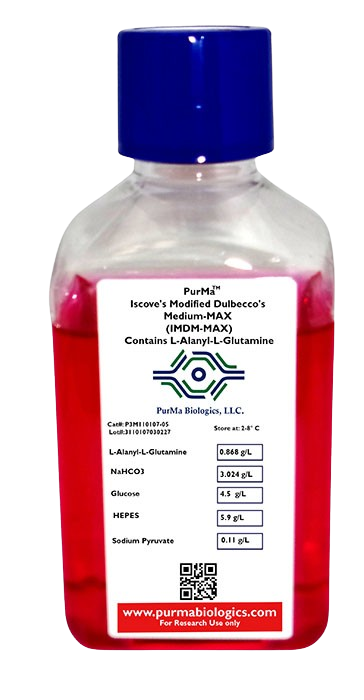
PurMa™Iscove’s Modified Dulbecco’s Medium MAX (IMDM-MAX)
PurMa™ Iscove’s Modified Dulbecco’s Medium MAX (IMDM‑MAX) is a premium IMDM with L alanyl Lglutamine cell culture medium optimized for demanding mammalian cells. Unlike standard IMDM, IMDM‑MAX uses stable L‑alanyl‑L‑glutamine instead of L‑glutamine. This provides a longer shelf life, stronger buffering capacity, and reduced risk of contamination, helping you achieve more consistent, reliable cell culture performance.
For research use only. Not for human, veterinary or diagnostic use.
Description
PurMa™ Iscove’s Modified Dulbecco’s Medium MAX (IMDM‑MAX)
Product Description
PurMa™ IMDM MAX cell culture medium is an advanced form of IMDM cell culture medium designed for high‑performance mammalian cell culture. It is ideal for labs that need robust, reproducible growth conditions for hybridomas, lymphocytes, and other fastidious cell lines.
The defining feature of IMDM‑MAX is its use of L‑alanyl‑L‑glutamine instead of conventional L‑glutamine. This unique MAX formulation is proprietary to PurMa Biologics and is engineered to support modern cell culture workflows with improved stability and reliability.
Why choose IMDM‑MAX over Regular IMDM?
While iscoves modified dulbeccos medium IMDM is widely used, it has key limitations for long or sensitive cultures. IMDM‑MAX offers several practical advantages:
-
L‑alanyl‑L‑glutamine instead of L‑glutamine
L‑glutamine is chemically unstable in aqueous solution and degrades over time, producing ammonia that can stress cells. IMDM‑MAX replaces it with dipeptide L‑alanyl‑L‑glutamine, which is far more stable during storage and incubation. -
Longer shelf life
Because L‑alanyl‑L‑glutamine is more stable, IMDM‑MAX maintains glutamine availability for a longer period. This helps preserve the functional quality of the medium over its entire shelf life, reducing waste and re‑preparation. -
Higher buffering capacity IMDM‑MAX is formulated to better maintain pH under typical CO₂ incubator conditions. Stronger buffering helps keep your cultures in a more consistent environment, even with frequent door openings or higher metabolic activity.
-
Lower risk of contamination events
More stable nutrients and better pH control mean fewer stressful medium changes and less handling. Reduced handling often translates into fewer contamination opportunities and more consistent results across experiments.
Together, these differences make IMDM MAX cell culture medium a strong upgrade path for users of traditional IMDM iscoves modified dulbecco medium who need longer, cleaner, and more controlled cultures.
Key Features and Benefits
-
MAX formulation unique to PurMa Biologics
Only PurMa Biologics uses the MAX designation, which specifically indicates the use of L‑alanyl‑L‑glutamine in this IMDM MAX cell culture medium. -
Optimized for mammalian cell culture
Supports a wide range of mammalian cells, including suspension and adherent lines that demand a rich, balanced nutrient profile. -
Improved stability during storage and use
L‑alanyl‑L‑glutamine reduces glutamine breakdown and ammonia buildup, helping maintain a healthier culture environment over time. -
Stronger pH control
Enhanced buffering capacity supports stable pH across longer culture intervals, improving experimental consistency. -
Lower contamination risk through fewer interventions
More stable medium can reduce the frequency of complete medium changes, decreasing the number of manipulations and potential contamination points. -
Consistent, reproducible performance
Designed for labs that depend on stable cell performance across multiple passages, assays, and production runs.
Typical Applications
- Expansion and maintenance of mammalian cell lines
- Hybridoma and antibody‑producing cell culture
- Immunology, oncology, and vaccine research
- Pre‑production and process development runs
- Long‑term or higher‑density cultures where stability is critical
How IMDM‑MAX Compares in Daily Lab Use
Researchers moving from standard IMDM often notice:
- More consistent growth curves over extended culture periods
- Reduced variability between flasks and batches
- Fewer culture failures linked to pH drift or glutamine degradation
- Lower need for frequent medium replacement
These practical gains can save time, reduce cost per usable culture, and improve confidence in downstream data and product quality.
PurMa Biologics manufactures 142 types of IMDM including IMDM with L-alanyl-L-glutamine without phenol red which is used a lot by laboratories.
Storage and Handling
- Store at the recommended temperature (typically 2–8 °C; check product label)
- Protect from light where applicable
- Use aseptic technique for all transfers and medium changes
- Do not use if the medium shows turbidity, unexpected color change, or precipitates
FAQ
Q1. What is IMDM‑MAX and how is it different from standard IMDM?
IMDM‑MAX is PurMa™ Iscove’s Modified Dulbecco’s Medium formulated with L‑alanyl‑L‑glutamine instead of L‑glutamine. This MAX formulation is unique to PurMa Biologics and provides improved stability, longer shelf life, and better pH control compared to conventional IMDM preparations.
Q2. How does IMDM‑MAX differ from regular IMDM?
The major difference is the use of L‑alanyl‑L‑glutamine in IMDM MAX cell culture medium rather than L‑glutamine in regular IMDM. This makes the IMDM MAX cell culture medium more stable, with higher buffering capacity and a lower probability of contamination due to fewer required medium changes and interventions.
Q3. Why is L‑alanyl‑L‑glutamine beneficial in cell culture media?
L‑alanyl‑L‑glutamine is a stable dipeptide that slowly releases glutamine over time. It resists degradation and ammonia formation better than free L‑glutamine, helping to maintain a healthier environment for mammalian cells during storage and incubation.
Q4. Which cell types are suitable for IMDM‑MAX?
IMDM‑MAX is suitable for a broad range of mammalian cells, including suspension and adherent cell lines. It is especially useful for hybridomas, lymphocytes, and other demanding cells that benefit from a stable, nutrient‑rich IMDM MAX cell culture medium.
Q5. Does IMDM‑MAX reduce contamination in my cultures?
IMDM MAX cell culture medium cannot eliminate contamination, but its improved stability and buffering reduce the need for frequent medium changes and handling. Less handling typically means fewer opportunities for contaminants to enter your cultures.
Q6. Can I switch from regular IMDM to IMDM‑MAX directly?
Many labs can transition from Regular IMDM to IMDM‑MAX with a brief adaptation phase. It is good practice to test the IMDM MAX cell culture medium in parallel with your current medium and monitor growth, viability, and product expression before fully switching.
Q7. How should I store IMDM‑MAX?
Store IMDM‑MAX at the temperature specified on the product label, typically 2–8 °C, and protect it from light if indicated. Always use sterile technique, and discard the bottle if you notice turbidity, unexpected color changes, or precipitates.
Q8. Is IMDM‑MAX supplied with serum or supplements?
Check the specific catalog number for details. IMDM‑MAX is available as a basal IMDM MAX cell culture medium that can be combined with your preferred serum and supplements, allowing you to match your existing protocols.
Formulation
Complete formulation click here: IMDM-MAX Formulation
References
- Plaque production by the polyoma virus. DULBECCO R, FREEMAN G. 1959 Jul;8(3):396-7. doi: 10.1016/0042-6822(59)90043-1. PMID: 13669362.
- Complete replacement of serum by albumin, transferrin, and soybean lipid in cultures of lipopolysaccharide-reactive B lymphocytes. J Exp Med. 1978 Mar 1; 147(3): 923–933. doi: 10.1084/jem.147.3.923 PMCID: PMC2184195
- Development of an infusible-grade solution for non-cryopreserved hematopoietic cell storage. Burger SR, Hubel A, McCullough J. 1999;1(2):123-33. doi:10.1080/0032472031000141250. PMID: 19746589
| Parameter | Specification |
|---|---|
| Appearance | Red, clear liquid |
| pH | 7.2 ± 0.1 |
| Osmolality | 275-360 mOsm/L |
| Endotoxin | NMT< 2EU/mL |
| Mycoplasma | Negative |
| Suitability | Suitable for mammalian cell culture |
| Additive | Sodium pyruvate |
| Indicator | Phenol red |
| Mycoplasma Detection | Negative |
| Sterility Tested | Sterile filtered using 0.22 µm filter |
| Form | Liquid |
| Shipping Condition | Room temperature |
Learn more: What Is IMDM?
Additional information
| Condition | IMDM-MAX Standard Formulation, IMDM-MAX Standard Formulation, ATCC Formulation, IMDM-MAX w/o Phenol Red, IMDM-MAX w/o Sodium Bicarbonate, IMDM-MAX w/o Sodium Pyruvate, IMDM-MAX w/o Glucose, IMDM-MAX w/o HEPES, IMDM-MAX w/o Phenol Red, w/o Sodium Bicarbonate, IMDM-MAX w/o Sodium Bicarbonate, w/o Sodium Pyruvate, IMDM-MAX Low Glucose (1.5 g/L), IMDM-MAX 15 mM HEPES (3.6 g/L), IMDM-MAX 15 mM HEPES (3.6 g/L), Low Sodium Bicarbonate (1.5 g/L), IMDM-MAX w/o Sodium Pyruvate, w/o Phenol Red, IMDM-MAX w/o Sodium Pyruvate, w/o HEPES, IMDM-MAX w/o Phenol Red, with 15 mM HEPES (3.6 g/L), IMDM-MAX w/o Sodium Pyruvate, with 15 mM HEPES (3.6 g/L), IMDM-MAX w/o Phenol Red, Low Sodium Bicarbonate (1.5 g/L), IMDM-MAX w/o Sodium Pyruvate, Low Sodium Bicarbonate (1.5 g/L) |
|---|---|
| Format | Liquid, Powder |
| Size | 10 X 1000ml, 10 X 500ml, 1 x 500 ml, 6 x 500 ml, 1 x 1000 ml, 6 x 1000 ml, 1 x 10 L, 1 x 50 L |
Documents
Certificate of Analysis (COA): Available upon request for your specific order — email info@purmabiologics.com and we will send the current lot documentation.
Safety Data Sheet (SDS): Available upon request — email info@purmabiologics.com.
What our customers say about PurMa Biologics
Feedback from labs we supply, across our full catalogue.
Very fast, efficient, and economic service. Great for new PIs like me.
it is reliable vendor!
We always buy our agarose from PurMa and have never been disappointed.
I recently had the pleasure of interacting with Dr. Seif Azadi from Purma Biologics, and I cannot thank him enough for his expertise and prompt assistance. His deep knowledge and dedication were instrumental in meeting our laboratory’s needs with remarkable efficiency. We ordered FBS, DMEM, and Trypsin from Purma Biologics, and I’m thrilled to report that all the products have performed exceptionally well. They consistently deliver reproducible results, significantly enhancing the reliability of our experiments. Thank you, Team Purma Biologics, for your good products and support!
It’s been a pleasure working with PURMA Biologics. Their service is efficient, delivery is fast, and the quality of their products has met our expectations consistently. Very smooth collaboration overall.
PurMa products are of excellent quality and highly reliable.
Frequently asked questions
How should I store PurMa™Iscove’s Modified Dulbecco’s Medium MAX (IMDM-MAX)?
Store at 2 to 8 degrees C, protected from light, and do not freeze unless the label states otherwise. Freezing can precipitate salts and degrade light sensitive components such as riboflavin and folic acid. Always follow the storage line on the Certificate of Analysis for the specific lot.
What is the shelf life once opened?
Unopened and correctly stored, the typical shelf life is 12 months from manufacture. Once opened, use within about four weeks and always handle in a laminar flow hood, since the practical limit after opening is contamination risk rather than chemical stability.
Is it sterility and endotoxin tested?
Yes. Every lot is sterile filtered and tested for sterility and endotoxin, and a Certificate of Analysis is issued for each lot. The COA is available on request for any catalogue number.
Do I need to add L-glutamine?
It depends on the formulation you order. Standard formulations may contain free L-glutamine, which degrades in solution over time, while MAX formulations use a stable L-alanyl-L-glutamine dipeptide that does not require fresh supplementation. Check the option you have selected before adding more.
Can I order this in bulk or as a custom formulation?
Yes. Bulk volumes and custom formulations are made to order, including adjusted glucose, bicarbonate, buffering and cation content. Use the request bulk pricing button on this page and include the specification you need.
Related products
-
- Sale!
- Other Cell and Tissue Culture Reagents
Cell Culture Suited Vitamin Solution (100X)
- Price range: $13.33 through $23.33
- Select options This product has multiple variants. The options may be chosen on the product page
-
- Sale!
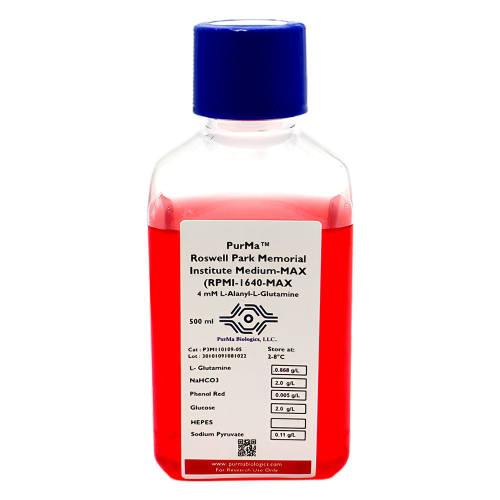
- Cell Culture Media, Roswell-Park Memorial Institute 1640
PurMa™ Roswell Park Memorial Institute 1640-MAX (RPMI-1640-MAX)
- Price range: $31.61 through $586.18
- Select options This product has multiple variants. The options may be chosen on the product page
-
- Sale!
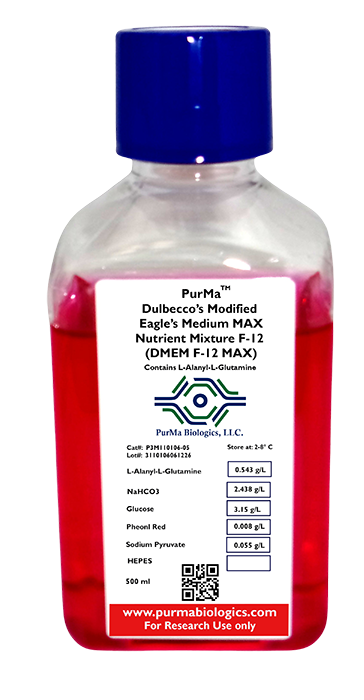
- Cell Culture Media, DMEM F-12
PurMa™ Dulbecco’s Modified Eagle’s Medium/F-12 MAX (DMEM F12-MAX)
- Price range: $31.10 through $590.46
- Select options This product has multiple variants. The options may be chosen on the product page

Reviews