
- ✓Proudly made in the USA, manufactured in house
- ✓Certificate of Analysis available for every lot
- ✓Backed by decades of cell culture and protein biochemistry expertise
- ✓Bulk pricing, purchase orders, and custom formulations welcome
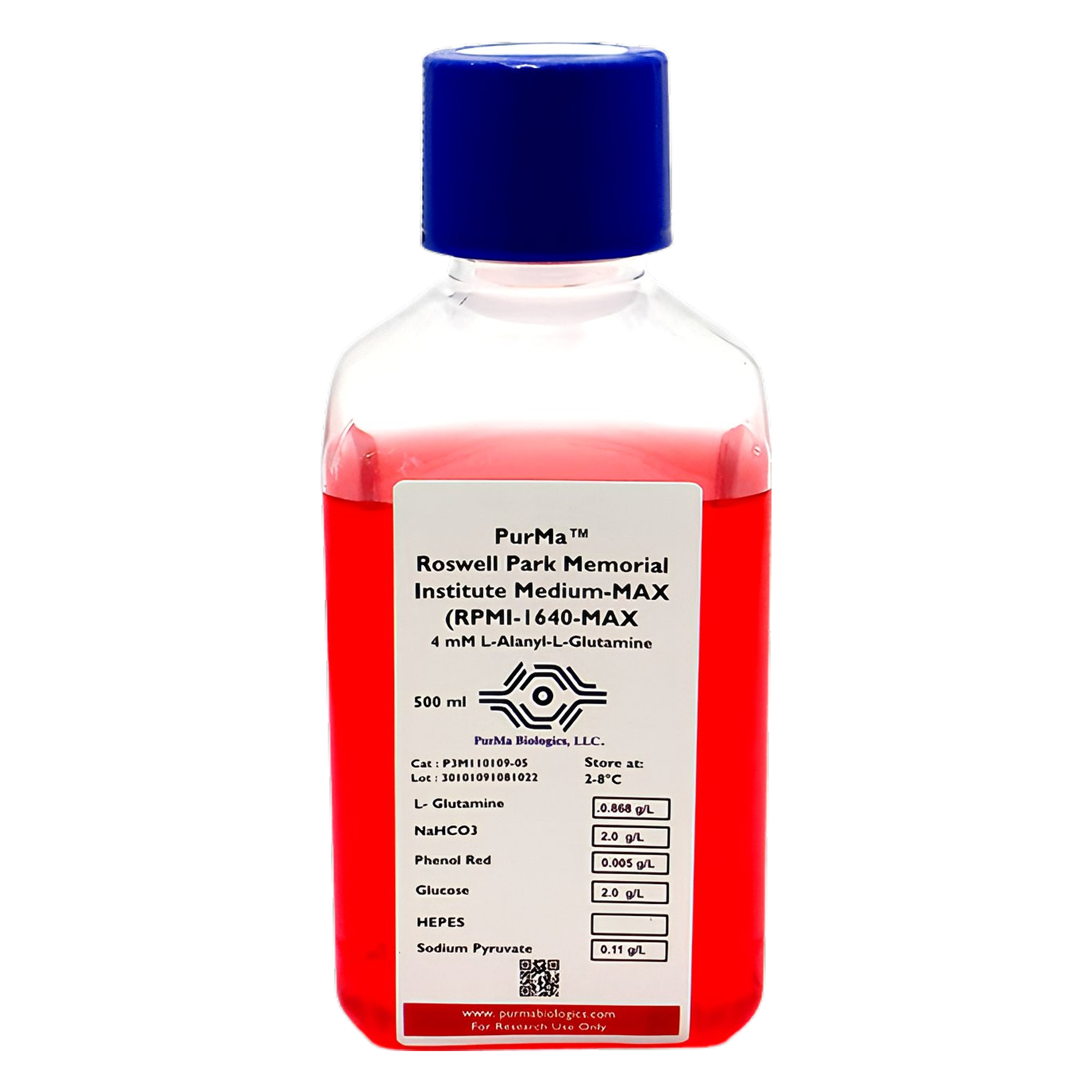
PurMa™ Roswell Park Memorial Institute 1640-MAX (RPMI-1640-MAX)
PurMa™ RPMI-1640-MAX cell culture medium contains L‑alanyl‑L‑glutamine.PurMa™ Roswell Park Memorial Institute 1640-MAX (RPMI-1640-MAX) is a next‑generation mammalian cell culture medium. Unlike standard RPMI‑1640, this RPMI-1640-MAX cell culture medium contains 4 mM L‑alanyl‑L‑glutamine instead of L‑glutamine. This stabilized dipeptide provides higher pH buffering capacity, significantly longer shelf life, and reduced toxic ammonia build‑up. The result is more consistent cultures, improved viability and growth, and better support for sensitive primary cells.
For research use only. Not for human, veterinary or diagnostic use.
Description
PurMa™ RPMI-1640-MAX Cell Culture Medium
Product Description
PurMa™ RPMI-1640-MAX cell culture medium contains L‑alanyl‑L‑glutamine. PurMa™ Roswell Park Memorial Institute 1640-MAX (RPMI-1640-MAX) is a specialized mammalian cell culture medium. This RPMI-1640-MAX cell culture medium is engineered for demanding research and bioprocess workflows that need stable glutamine and strong pH control. The key innovation in RPMI-1640-MAX is the use of L‑alanyl‑L‑glutamine instead of free L‑glutamine. This single change dramatically improves medium stability, shelf life, and performance in culture.
What makes RPMI-1640-MAX different?
The major difference between RPMI-1640-MAX and regular RPMI‑1640 is the glutamine source. Standard RPMI‑1640 contains free L‑glutamine, which is chemically unstable in aqueous solution. Over time, L‑glutamine degrades and generates toxic ammonia and pyrrolidone carboxylic acid. PurMa™ RPMI-1640-MAX replaces L‑glutamine with 4 mM L‑alanyl‑L‑glutamine (0.869 g/L). This dipeptide is far more stable and degrades much more slowly in liquid media. As a result, the medium maintains its composition, pH, and performance for a longer period.
Advantages of RPMI-1640-MAX over standard RPMI‑1640
Because RPMI-1640-MAX cell culture medium contains L‑alanyl‑L‑glutamine, it offers several critical performance advantages:
- Higher pH buffering capacity
Optimized sodium bicarbonate and, where applicable, HEPES levels provide superior pH stability during culture. - Longer shelf life
RPMI1640 with l alanyl lglutamine is highly stable in aqueous solution, extending the functional shelf life of the medium. - Reduced toxic ammonia build‑up
Minimal glutamine degradation means less ammonia accumulation, helping protect sensitive cell lines. - Improved cell viability and growth
More stable glutamine delivery supports robust proliferation and higher overall culture performance. - Temperature stability
The formulation remains stable across a wide range of temperatures during storage and handling. - Better performance with primary cells
Primary and hard‑to‑grow cells often respond better to the lower ammonia and stable nutrient environment.
These advantages make RPMI-1640-MAX ideally suited for long‑term cultures, high‑density cultures, and experiments that require reproducible conditions.
Mechanism: Why L‑alanyl‑L‑glutamine?
L‑glutamine is an essential amino acid for mammalian cell growth and protein synthesis.
However, in aqueous media it degrades over time, producing ammonia and pyrrolidone carboxylic acid.
This degradation changes the medium composition, raises toxicity, and can compromise experimental results.
One strategy is to repeatedly add fresh L‑glutamine to the culture.
In practice, this is labor‑intensive and difficult to control precisely over time.
Advantages of a cell culture medium that contains L-alanyl-L-glutamine.
This dipeptide is much more stable in solution and does not rapidly generate ammonia.
Instead, cellular aminopeptidases gradually cleave L‑alanyl‑L‑glutamine into L‑glutamine and L‑alanine.
The released amino acids are then used by the cells for protein synthesis and energy production in the TCA cycle.
By providing a controlled, sustained release of glutamine, RPMI-1640-MAX helps maintain consistent culture conditions from start to finish.
Composition of RPMI-1640-MAX
PurMa™ RPMI-1640-MAX cell culture medium is based on a modified RPMI‑1640 formulation and contains:
- 4 mM L‑alanyl‑L‑glutamine (0.869 g/L) instead of L‑glutamine
- 5 mM sodium pyruvate
- High glucose (4.5 g/L)
- Non‑essential amino acids (NEAA)
- 3.7 g/L sodium bicarbonate
- Phenol red as a pH indicator
PurMa Biologics manufactures several RPMI-1640-MAX variants with different sodium bicarbonate and HEPES concentrations. For instance RPMI1640-MAX alanyl lglutamine hepes without phenol is available in PurMa Biologics. The combination of L-alanyl-L-glutamine and HEPES offers an extra buffering capacity which prevents contamination against mold as well as mycoplasma. PurMa Biologics manufactures RPMI with lglutamine hepes without phenol red as well: Here is the Link
These options allow you to select the pH buffering capacity that best matches your incubator conditions and experimental needs.
Note: RPMI-1640-MAX cell culture medium contains L‑alanyl‑L‑glutamine but does not contain any proteins, lipids, or growth factors.
For complete medium, supplementation with 10% Fetal Bovine Serum (FBS) or an appropriate serum replacement is required.
Formulation
For complete formulation click here: RPMI-1640 MAX Formulation
Applications
This RPMI-1640-MAX cell culture medium is designed for:
- Routine culture of mammalian cell lines historically grown in RPMI‑1640
- Long‑term and high‑density cultures requiring stable glutamine levels
- Primary cells and sensitive cell types that are susceptible to ammonia toxicity
- Experiments needing highly reproducible metabolic and pH conditions
- Assays where changes in ammonia or pH could confound functional readouts
By minimizing medium variability, RPMI-1640-MAX supports high‑quality, publication‑ready data and smoother scale‑up.
Related stabilized glutamine product
In addition to our MAX formulation media, PurMa Biologics manufactures PurMa™ GluaSup (Cat# P3S210 559).
PurMa™ GluaSup is a concentrated L‑alanyl‑L‑glutamine supplement designed to prevent L‑glutamine degradation in other basal media.
It is ideal when you want to upgrade existing media formulations with the same stabilized glutamine technology used in RPMI-1640-MAX.
FAQs
Q1. What is the main difference between RPMI-1640-MAX and standard RPMI‑1640?
The main difference is the glutamine source.
RPMI-1640-MAX replaces unstable L‑glutamine with 4 mM L‑alanyl‑L‑glutamine.
This change improves pH stability, shelf life, and reduces toxic ammonia build‑up, which enhances cell viability and growth.
Q2. Why does L‑alanyl‑L‑glutamine extend the shelf life of the medium?
L‑alanyl‑L‑glutamine is much more stable in aqueous solution than free L‑glutamine.
It degrades slowly and does not rapidly generate ammonia or breakdown products.
RPMI-1640-MAX cell culture medium contains L‑alanyl‑L‑glutamine, which keeps the medium closer to its original composition for a longer time.
Q3. Does RPMI-1640-MAX reduce the risk of contamination?
RPMI-1640-MAX does not directly sterilize cultures, but its higher buffering capacity and stability help maintain physiological pH.
Stable pH and consistent medium composition reduce stress on cells and minimize conditions that can favor opportunistic contaminants.
Standard aseptic technique and proper filtration are still required.
Q4. Do I need to add FBS or other supplements to RPMI-1640-MAX?
Yes. RPMI-1640-MAX does not contain proteins, lipids, or growth factors.
For most applications, we recommend supplementing with 10% Fetal Bovine Serum (FBS) or an appropriate serum alternative.
Additional supplements can be added according to your cell line’s specific requirements. But because RPMI-1640-MAX cell culture medium contains L‑alanyl‑L‑glutamine, FBS performs better due to the condition mentioned above.
Q5. Is RPMI-1640-MAX suitable for primary cells?
Yes. RPMI-1640-MAX is particularly well suited for primary and sensitive cells.
The stabilized L‑alanyl‑L‑glutamine minimizes ammonia accumulation and maintains more consistent pH.
These features create a gentler environment that can support better attachment, viability, and long‑term growth of primary cells.
Q6. How should I store and handle RPMI-1640-MAX?
Store RPMI-1640-MAX cell culture medium, which contains L‑alanyl‑L‑glutamine, as recommended on the product label, typically at 2–8 °C and protected from light.
Avoid repeated freeze–thaw cycles and prolonged exposure to room temperature. Because RPMI-1640-MAX cell culture medium contains L‑alanyl‑L‑glutamine, it will keep the potency much longer.
Use aseptic technique when opening and aliquoting to maintain sterility and maximize shelf life.
References
- Culture of normal human leukocytes. Moore GE, et al. 1967 Feb 20;199(8):519-24. PMID: 4960081
- Leukocytes as carriers in the transmission of bovine leukemia: certain morphologic and functional characteristics of cultured leukocytes from normal and leukemic cattle. Dunne HW, et al. Am J Vet Res. 1970 Apr;31(4):597-617. PMID: 5437104.
- Long-term culture of human leukaemic leukocytes. Pössnerová V, et al. 1970;17(5):513-23. PMID: 5274436
| Parameter | Specification |
| Appearance | clear liquid, Red liquid |
| pH | 7.4 ± 0.1 |
| Osmolality | 275-360 mOsm/L |
| Endotoxin | NMT< 2EU/mL |
| Mycoplasma | Negative |
| Suitability | Suitable for mammalian cell culture |
| Additive | NA |
| Indicator | NA |
| Sterility Tested | Sterile filtered using 0.22 µm filter |
| Form | Liquid |
| Shipping Condition | Dry Ice |
Learn more: What Is RPMI 1640?
Additional information
| Condition | RPMI 1640 MAX, Standard Formulation, RPMI 1640 MAX, Standard Formulation (ATCC formulation), RPMI 1640 MAX, w/o Phenol Red, RPMI 1640 MAX, w/o Sodium Bicarbonate, RPMI 1640 MAX, w/o Glucose, RPMI 1640 MAX, w/o Phenol Red, w/o Sodium Bicarbonate, RPMI 1640 MAX, With Low Glucose (1 g/L), RPMI 1640 MAX, With High Sodium Bicarbonate (3.7 g/L), RPMI 1640 MAX, With 15 mM HEPES (3.6 g/L), RPMI 1640 MAX, With 25 mM HEPES (5.9 g/L), RPMI 1640 MAX, With 15 mM HEPES (3.6 g/L), High Sodium Bicarbonate (3.7 g/L), RPMI 1640 MAX, With 25 mM HEPES (5.9 g/L), High Sodium Bicarbonate (3.7 g/L, RPMI 1640 MAX, w/o Phenol Red, with 15 mM HEPES (3.6 g/L), RPMI 1640 MAX, w/o Phenol Red, with 25 mM HEPES (5.9 g/L), RPMI 1640 MAX, w/o Phenol Red, High Sodium Bicarbonate (3.7 g/L) |
|---|---|
| Format | Liquid, Powder |
| Size | 10 X 1000ml, 10 X 500ml, 1 x 500 ml, 6 x 500 ml, 1 x 1000 ml, 6 x 1000 ml, 1 x 10 L, 1 x 50 L |
Documents
Certificate of Analysis (COA): Available upon request for your specific order — email info@purmabiologics.com and we will send the current lot documentation.
Safety Data Sheet (SDS): Available upon request — email info@purmabiologics.com.
What our customers say about PurMa Biologics
Feedback from labs we supply, across our full catalogue.
We have been working with PurMa biologics for the past several years, we buy cell culture related media like DMEM F12 and EMEM and Fetal Bovine Serum. We appreciate the high quality and reasonable price, and great customer service.
We purchase everything we need related to cell and tissue culture from PurMa, reagents like: DMEM, LL15, EMEM, FBS, trypsin, antibiotics mix100X and... Always great quality, fast processing and shipping. We are totally satisfied.
Very fast, efficient, and economic service. Great for new PIs like me.
it is reliable vendor!
We always buy our agarose from PurMa and have never been disappointed.
I recently had the pleasure of interacting with Dr. Seif Azadi from Purma Biologics, and I cannot thank him enough for his expertise and prompt assistance. His deep knowledge and dedication were instrumental in meeting our laboratory’s needs with remarkable efficiency. We ordered FBS, DMEM, and Trypsin from Purma Biologics, and I’m thrilled to report that all the products have performed exceptionally well. They consistently deliver reproducible results, significantly enhancing the reliability of our experiments. Thank you, Team Purma Biologics, for your good products and support!
Frequently asked questions
How should I store PurMa™ Roswell Park Memorial Institute 1640-MAX (RPMI-1640-MAX)?
Store at 2 to 8 degrees C, protected from light, and do not freeze unless the label states otherwise. Freezing can precipitate salts and degrade light sensitive components such as riboflavin and folic acid. Always follow the storage line on the Certificate of Analysis for the specific lot.
What is the shelf life once opened?
Unopened and correctly stored, the typical shelf life is 12 months from manufacture. Once opened, use within about four weeks and always handle in a laminar flow hood, since the practical limit after opening is contamination risk rather than chemical stability.
Is it sterility and endotoxin tested?
Yes. Every lot is sterile filtered and tested for sterility and endotoxin, and a Certificate of Analysis is issued for each lot. The COA is available on request for any catalogue number.
Do I need to add L-glutamine?
It depends on the formulation you order. Standard formulations may contain free L-glutamine, which degrades in solution over time, while MAX formulations use a stable L-alanyl-L-glutamine dipeptide that does not require fresh supplementation. Check the option you have selected before adding more.
Can I order this in bulk or as a custom formulation?
Yes. Bulk volumes and custom formulations are made to order, including adjusted glucose, bicarbonate, buffering and cation content. Use the request bulk pricing button on this page and include the specification you need.
Related products
-
- Sale!
- Cell Culture Media, Iscove's Modified Dulbecco's Medium (IMDM)
PurMa™Iscove’s Modified Dulbecco’s Medium MAX (IMDM-MAX)
- Price range: $29.60 through $611.97
- Select options This product has multiple variants. The options may be chosen on the product page
-
- Sale!
- Cell Culture Media, Dulbecco’s Modified Eagle’s Medium (DMEM)
PurMa™ Dulbecco’s Modified Eagle’s Medium MAX (DMEM MAX)
- Price range: $29.99 through $647.87
- Select options This product has multiple variants. The options may be chosen on the product page
-
- Sale!
- Cell Culture Suited Buffers
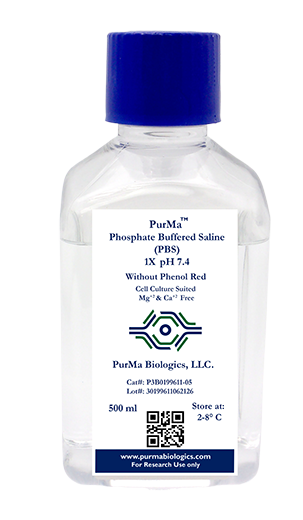
Phosphate Buffered Saline (PBS)
- Price range: $16.43 through $404.22
- Select options This product has multiple variants. The options may be chosen on the product page

Reviews